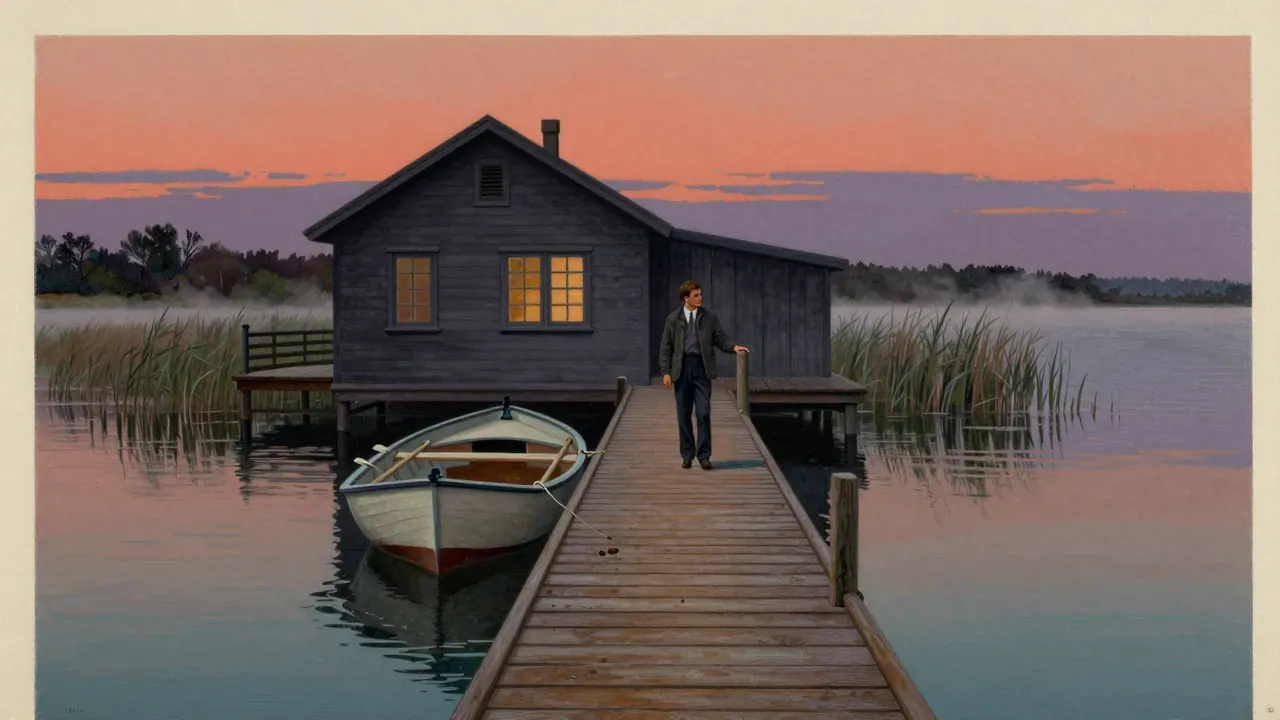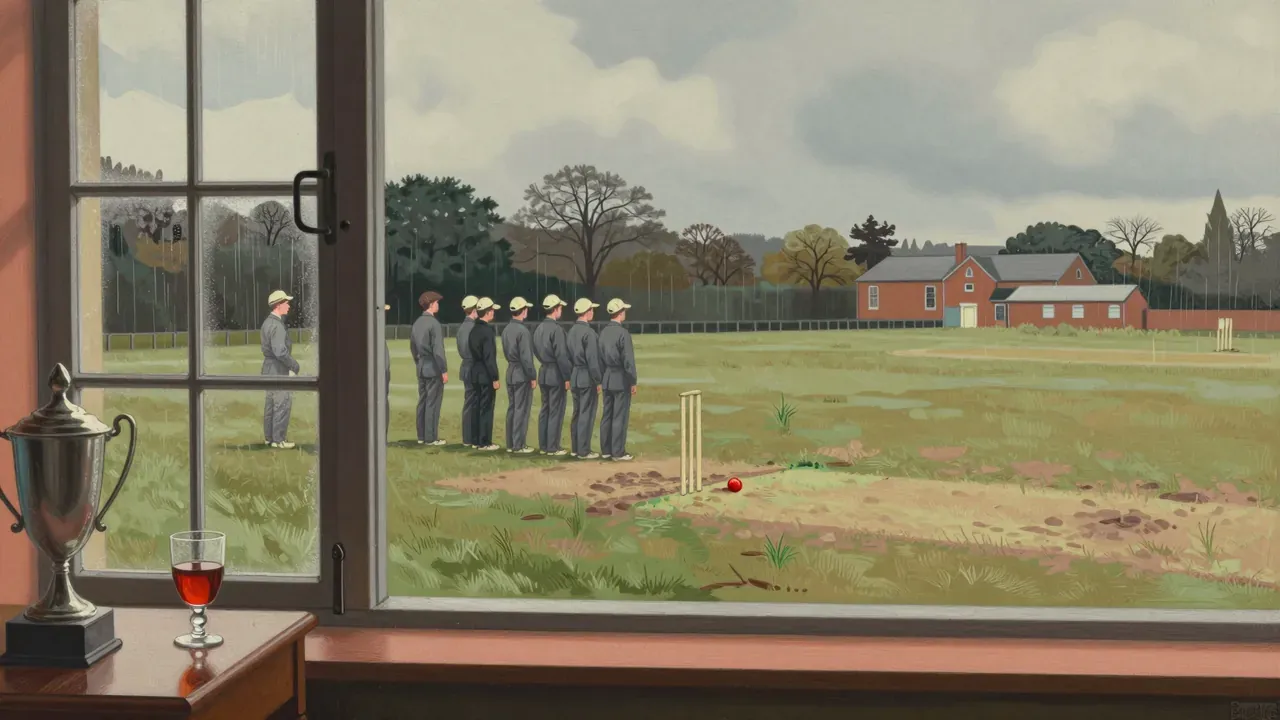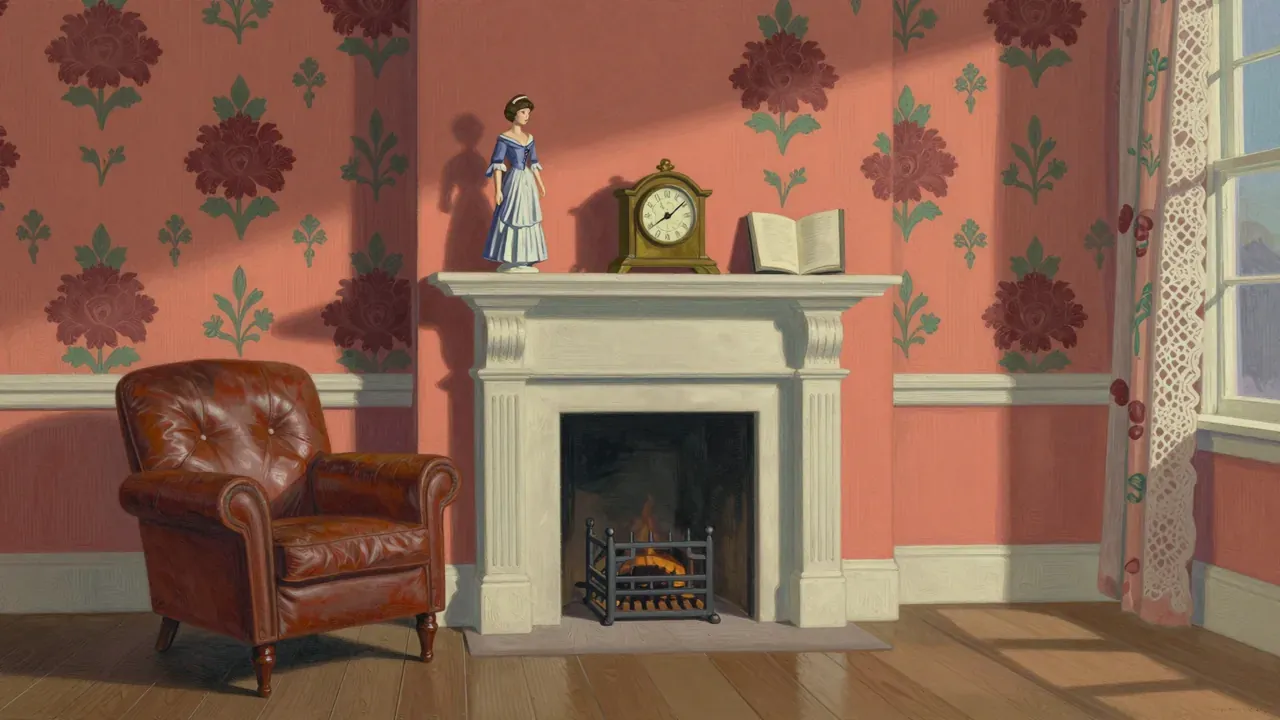
The shape of it
All That Heaven Allows is a studio melodrama made for Universal Pictures in 1955, built around a socially charged romance between a widow and her younger gardener. It does not disguise itself as realism or documentary; it works within the conventions of the ‘woman’s picture’ — a genre defined by its focus on domestic consequence, emotional restraint, and the weight of unspoken disapproval. Douglas Sirk treats those conventions as architecture, not limitation: he uses the genre’s expected beats — proposal, resistance, retreat, reconciliation — to stage a precise critique of postwar American conformity. The film’s ambition is not to surprise with plot but to expose how class, age, and gender norms constrict choice under the guise of propriety. Its method is compositional: every frame is calibrated to make social pressure visible — in the spacing between characters, the coldness of wallpaper, the way light falls across a face during silence. It assumes its audience knows the rules of the world it depicts, then shows how those rules punish deviation even when no one raises their voice.
The look of it
The story follows Cary Scott’s quiet rebellion against expectation, told through tightly controlled scenes where dialogue often serves as cover for what cannot be said. Jane Wyman holds the film with stillness: her performance registers hesitation in a blink, resignation in the angle of a shoulder. Rock Hudson avoids caricature by grounding Ron Kirby in physical ease — his hands are calloused, his posture relaxed, his speech unhurried. Russell Metty’s Technicolor cinematography is deliberate, not decorative: saturated greens and reds isolate characters within rooms, while shallow focus blurs background chatter into murmur. Frank Skinner’s score weaves Liszt and Brahms not as mood music but as counterpoint — their grandeur underscoring the disparity between inner feeling and outward composure. Editing by Frank Gross sustains rhythm without hurry, letting pauses settle. The Colonial Street backlot is used with irony: its manicured facades become evidence of curated respectability, not authenticity. Every craft decision serves the same end — making social constraint legible as texture, colour, silence.
The weight of it
What lands is the cumulative weight of small refusals: Cary’s children declining to meet Ron, her friend’s polite withdrawal, the way a neighbour’s glance tightens just before she speaks. These moments do not shout injustice; they register it as routine. The film’s visual language reinforces this — mirrors reflect Cary’s isolation even in crowded rooms, windows frame her as trapped behind glass, doorways repeatedly cut her off from movement. The use of Thoreau’s Walden is neither literary flourish nor exposition; it appears as a book Ron reads aloud, its ideas absorbed into daily life rather than debated. That integration gives the film’s philosophy credibility — it is lived, not lectured. The ending does not resolve tension so much as relocate it: Cary chooses Ron not as escape but as commitment to a different kind of responsibility. That shift lands because the film has spent eighty minutes showing how exhausting compliance is — not dramatic, but slow, daily, bone-deep.
The flaw in it
What does not land is the final cliff fall. It arrives without foreshadowing, its mechanics unclear — the precipice is introduced only seconds before the collapse, and Ron’s injury feels narratively expedient rather than earned. The accident functions less as consequence and more as plot device to clear the path for Cary’s return, undermining the film’s otherwise careful avoidance of melodramatic contrivance. Similarly, the children’s objections, though socially plausible, lack psychological specificity: their resistance reads as generic generational reflex rather than individual conviction. Agnes Moorehead’s character, Sara Warren, remains underwritten — her role as foil to Cary’s transformation is clear, but her own motivations stay opaque. The film also presumes familiarity with mid-century New England social codes; viewers unfamiliar with the weight of country-club affiliation or the stigma of selling a family home may miss the quiet severity of Cary’s choices. These are not flaws in execution but limits of its frame — the film assumes its world’s logic without pausing to explain it.
The idea in it
The themes that matter are not love versus society, but the materiality of constraint: how class expresses itself in floorboards and furniture, how ageism operates through scheduling and space, how gendered expectations shape who gets to initiate, who gets to leave, and who must wait. The film treats the home not as sanctuary but as archive — each room holds evidence of past decisions, each object a reminder of inherited roles. Cary’s headaches are not metaphor but symptom: the body registering what the mind suppresses. The contrast between Ron’s tree nursery and the Scott house is not about wealth but temporality — one grows, the other endures; one adapts, the other preserves. Even the recurring music carries theme: Liszt’s Consolation No. 3 is not comfort but ironic counterpoint — its lyrical flow at odds with the rigidity of the world around it. These are not abstract ideas but conditions embedded in gesture, setting, and sound — the film argues that ideology lives in the grain of everyday life, not in speeches.
The audience for it
This film is for viewers who attend to composition over exposition, who find tension in a held glance or a change in lighting, and who accept that social critique need not be loud to be sharp. It rewards patience with detail: the pattern on a curtain, the way a teacup is set down, the distance between two chairs. It is not for those who require narrative propulsion, psychological exposition, or moral clarity — Cary’s choices are never justified, only shown, and Ron’s character remains deliberately opaque beyond his function in her arc. Those expecting historical realism will find the Colonial Street backlot too polished; those seeking romantic fantasy will find the ending too quiet, too grounded in compromise. A viewer who values thematic density over plot surprise, and who trusts image over explanation, will find it rich. Someone who needs motivation spelled out, or conflict resolved through dialogue, will leave impatient — and rightly so, for the film makes no concession to that expectation.
The time for it
Yes, it is worth your evening — not as diversion but as calibration. Its ninety minutes recalibrate how you read surfaces: wallpaper, weather, silence, the tilt of a head. It asks you to notice what is withheld, not just what is said. That demands attention, but repays it with precision: few films map the cost of conformity so economically. It is not for viewers who require momentum or closure — the final scene offers no triumph, only reorientation. Those who value emotional realism over dramatic escalation will find it resonant; those who equate significance with scale or novelty may find it mannered. Its endurance lies not in universality but in specificity: it captures a precise social grammar of 1950s New England, and in doing so reveals how little the syntax of disapproval has changed. To watch it is to see how deeply ideology settles into domestic space — and that remains urgent, not dated.