The shape of it
Bitter Rice is a 1949 Italian drama that sets itself at the intersection of neorealism and melodrama, using the seasonal labour of rice-harvesting women in Piedmont as both setting and social argument. It attempts to document the physical hardship and collective organisation of the mondine while embedding that realism within a crime plot — two fugitives hiding among the workers — and a psychological arc centred on Silvana, a young woman drawn to glamour, transgression, and self-destruction. The film does not aim for neutrality: it frames American cultural imports — chewing gum, boogie-woogie, individualist ambition — as corrosive forces against communal resilience. Its method is hybrid: location shooting in Vercellese, non-professional extras among the cast, but also studio-calibrated performances, stylised lighting by Otello Martelli, and Goffredo Petrassi’s score, which underscores moral turning points rather than ambient reality. It tries to be both report and parable — a portrait of postwar Italy’s economic fragility and its ideological crosscurrents. (158 words)
The look of it
The story follows Francesca and Walter, thieves fleeing police, who infiltrate the rice fields; their presence catalyses tension between documented and undocumented workers, then fractures further when Silvana — newly arrived, untrained, and magnetically restless — becomes Walter’s target and Francesca’s foil. Vittorio Gassman plays Walter with coiled charm and sudden violence; Doris Dowling’s Francesca is watchful, pragmatic, morally anchored. Silvana Mangano, in her first credited role, carries the film’s visual and psychological weight: her movements are studied, her expressions volatile, her voice dubbed but her singing voice retained — a deliberate split between artifice and authenticity. Otello Martelli’s cinematography favours low angles amid flooded paddies and tight framing in cramped lodgings, heightening claustrophobia and class density. Carlo Egidi’s sets blend documentary fidelity with symbolic starkness — the dormitory bunk beds, the mud-choked paths, the harvest machinery looming like indifferent gods. Mario Monicelli’s uncredited script work tightened the second act’s pacing, though the final confrontation remains operatic rather than inevitable. (159 words)
What holds the ground
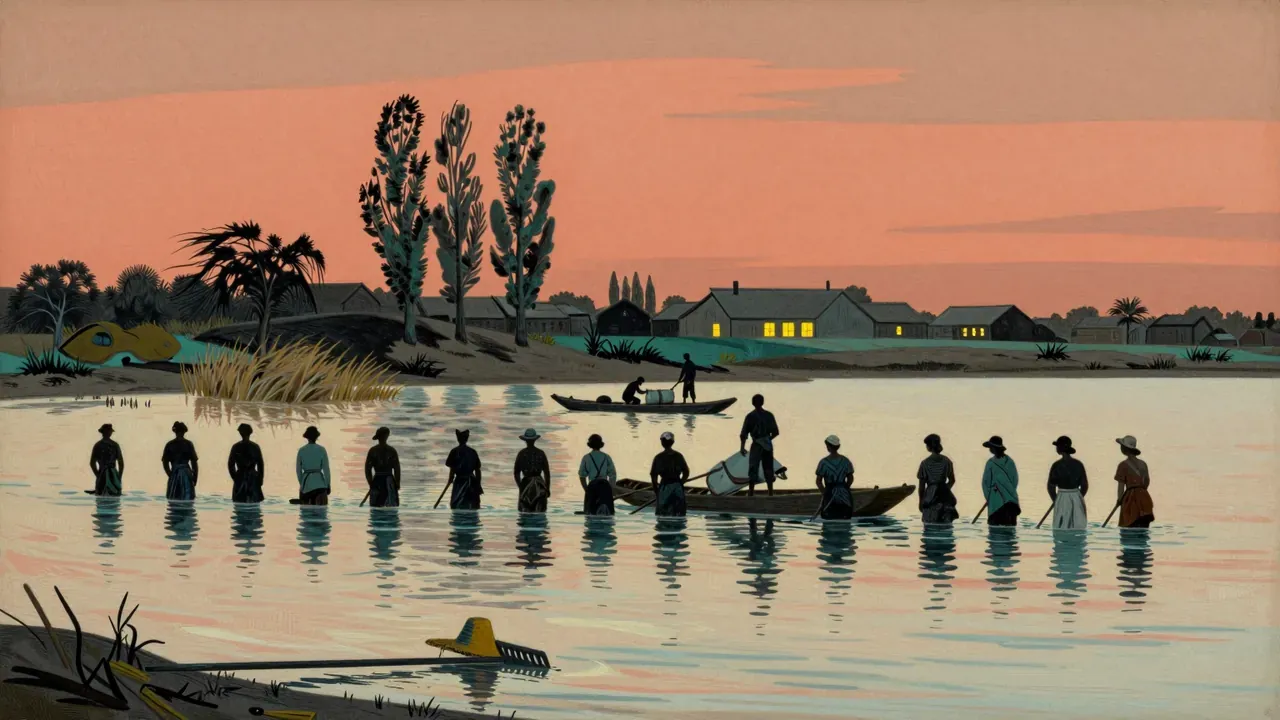
What lands most firmly is the texture of collective labour: the rhythm of bent backs in waterlogged fields, the shared exhaustion in dormitory corridors, the quiet solidarity of women dividing rice sacks or mending clothes. The scenes depicting the ‘illegals’ negotiating space — not just physical, but legal and dignified — carry documentary heft and narrative urgency. Silvana’s early fascination with American gestures — gum-chewing, hip-swaying, defiant eye contact — lands not as caricature but as plausible yearning, made more unsettling by how quickly it curdles into alienation. The flooding sequence works precisely because it merges spectacle with consequence: water rising over stubble is visually arresting, but its function — disabling theft, exposing betrayal — is clear and earned. Francesca’s final revelation about the necklace being fake lands with structural weight: it reframes Silvana’s entire arc as misdirection, not madness. The funeral coda — rice scattered over Silvana’s coffin — lands without sentimentality, a gesture rooted in the land’s material logic, not poetic licence. These moments hold because they are anchored in place, labour, and consequence. (157 words)
Where the ground gives way
What does not land is the film’s attempt to sustain dual registers without friction: the neorealist scaffolding buckles under the weight of noirish plotting and psychodrama. Walter’s criminal scheming feels abruptly introduced late in the second act, and his pivot from manipulator to outright villain lacks psychological groundwork. Silvana’s descent — from spirited outsider to suicidal accomplice — relies on mood shifts rather than cause-and-effect; her deterioration is signalled by costume changes and close-ups, not decisions. The romance between Marco and Silvana never acquires emotional traction: Raf Vallone’s performance is earnest but underwritten, and their scenes lack the lived-in specificity of the group sequences. The film’s condemnation of American influence remains rhetorical rather than dramatised — we see Silvana chew gum, but not how that gesture isolates her from peers until it does. The courtroom-style moral climax — guns drawn, truths revealed — belongs to a different genre altogether, and its theatricality undermines the earlier restraint. Even the nomination for Best Story at the 1950 Oscars highlights this dissonance: the plot mechanics are tidy, but the human logic is often subordinated to allegory. (159 words)
What the rice says
The themes that matter are those embedded in the rice itself: labour as both exploitation and collective identity, legality as exclusionary bureaucracy, and female agency as contested terrain — claimed by bosses, stolen by thieves, asserted through protest, and finally erased by suicide. The film treats the mondine not as victims but as a political body: their strike is not sentimentalised, nor is their violence against the thieves. Class is rendered materially — in calloused hands, threadbare uniforms, the difference between a ration card and a forged one. Sexuality is present but not central; Silvana’s sexualisation is a symptom of external projection, not internal desire — it functions as social shorthand for disposability, not liberation. The American cultural references serve less as critique of imperialism than as markers of asymmetry: what arrives via cinema and radio is polished, mobile, seductive — unlike the slow, wet, communal work of rice planting. The film’s enduring power lies in how it ties personal collapse to structural failure: Silvana doesn’t fall because she is weak, but because the options available to her — compliance, theft, rebellion — all lead to erasure. Her death is not tragic individualism, but the logical end of a system offering no third way. (156 words)
Who walks with it
This film is for viewers who approach cinema as historical evidence first and entertainment second — those interested in how postwar Italy staged its contradictions on screen, or how neorealism absorbed and repurposed Hollywood grammar. It rewards attention to craft: Martelli’s lighting choices, Petrassi’s leitmotifs, the choreography of crowd movement in the harvest sequences. It is not for viewers seeking psychological coherence or character-driven momentum; Silvana’s arc resists empathy, and Walter’s motives remain opaque beyond convenience. Those expecting pure neorealism — say, Bicycle Thieves or Rome, Open City — may find its crime plot and heightened ending jarring. Others will object to its moral framing: feminist scholars have long noted how Silvana’s punishment reinforces patriarchal norms, even as the film critiques them. A shift toward deeper interiority — giving Silvana voice, not just image — would alter the verdict significantly. But as it stands, its value lies in its friction, not its fluency. (158 words)
What remains after
Yes, it is worth your evening — but only if you watch it as a document of cinematic negotiation, not as a seamless story. Its 108 minutes unfold with unhurried gravity: the opening train station sequence alone establishes hierarchy, surveillance, and mobility in six minutes of near-silent observation. You will not leave emotionally spent, but intellectually activated — aware of how much labour, ideology, and compromise went into each frame. It rewards patience, not immersion. Those who dislike films where plot serves theme, or where endings feel less resolved than resigned, will find it unsatisfying. But for anyone curious about how Italian cinema grappled with capitalism, gender, and national identity in real time — not retrospectively, but urgently — Bitter Rice remains indispensable. Its inclusion in the Ministry of Cultural Heritage’s ‘100 Films to Be Saved’ is not ceremonial: it preserves a moment when realism was still being argued over, not canonised. That argument is still live. (159 words)