The look of it
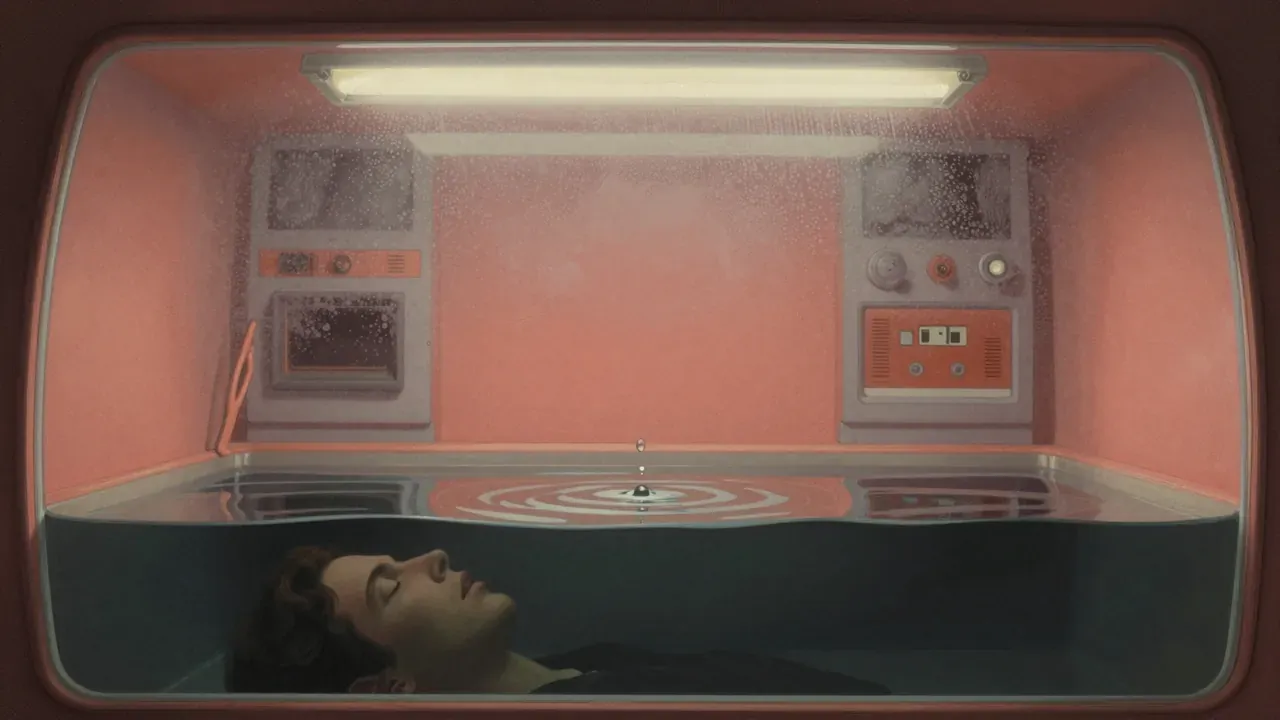
Videodrome is a Canadian body horror film that tests the permeability between media, flesh, and perception. It does not aim to frighten through jump scares or gore alone, but to make the viewer feel the physicality of signal intrusion — how a broadcast might burrow into neural tissue, reroute desire, and reconfigure the body as both receiver and transmitter. Its ambition is structural: to build a world where television is not a window but an organ, where watching becomes ingestion, and where the distinction between hallucination and interface collapses under sustained exposure. Cronenberg treats the cathode-ray tube as a prosthetic nervous system, and Max Renn’s descent is less a psychological breakdown than a biological upgrade gone wrong. The film refuses realism in favour of biomechanical logic: if video can alter behaviour, why shouldn’t it sprout cartilage? If desire is mediated, why shouldn’t it manifest as tumour-like growths? It is not allegory dressed as horror; it is horror operating as literal physiology. The project is coherent, self-contained, and rigorously committed to its own rules — even when those rules demand that a man’s abdomen opens like a VCR slot. (158 words)
How it moves
The story follows Max Renn, a Toronto UHF station operator who seeks edgier programming and stumbles on a pirate broadcast called Videodrome — a loop of sadistic, low-resolution torture footage. His investigation triggers escalating somatic distortions: a pulsing abdominal wound, hallucinated gun-hands, televised monologues from a dead media theorist. James Woods performs with tight-lipped intensity, anchoring the absurdity in recognisable ambition and fatigue. Sonja Smits and Debbie Harry play grounded counterpoints — one pragmatic, the other ambiguously symbiotic — while Leslie Carlson gives quiet weight to O’Blivion’s recorded sermons. Mark Irwin’s cinematography favours shallow focus and muted interiors, keeping faces half-submerged in shadow or glare, as though light itself is degrading. Howard Shore’s score uses analog synths to mimic tape hiss and feedback loops, and Ronald Sanders’ editing stitches reality and delusion with abrupt cuts that never explain the transition. The special effects — by Rick Baker — are tactile and unpolished: rubber, latex, and Betamax cassettes inserted into prosthetic slits, all designed to feel plausible within the film’s internal biology. (159 words)
What sticks
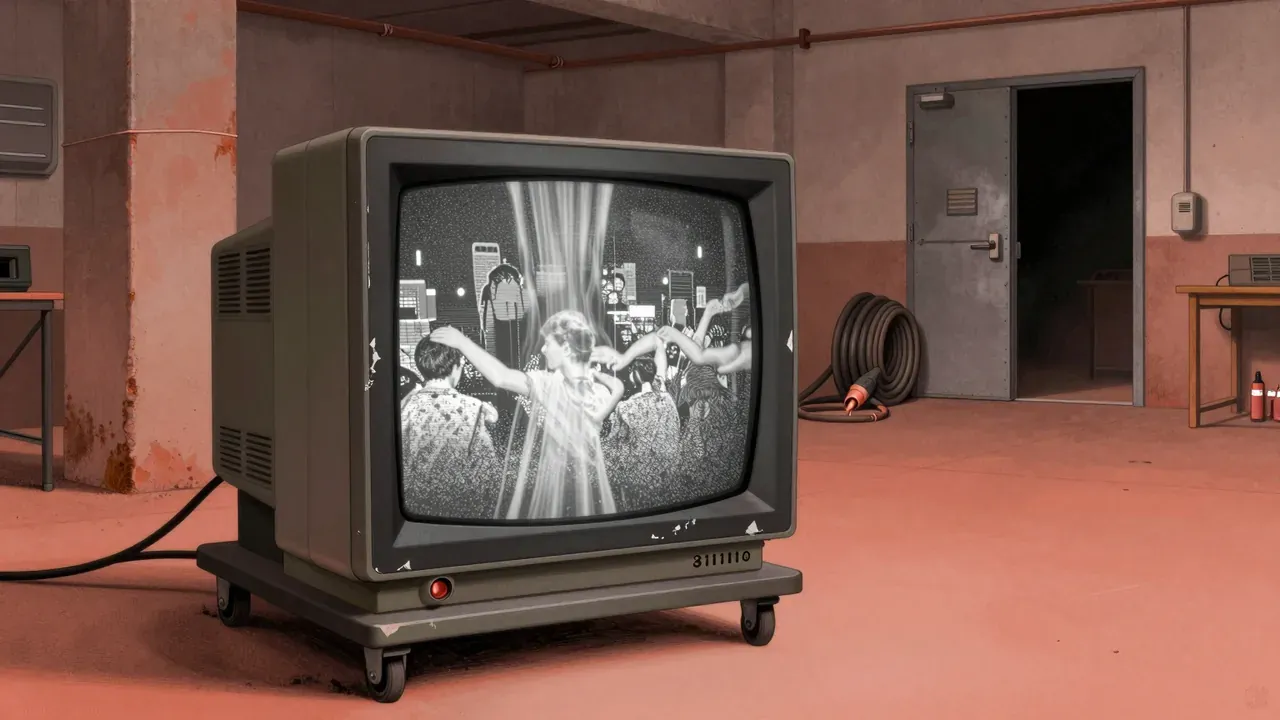
What lands is the film’s physical conviction. The stomach slit feels invasive not because it is shocking, but because it breathes, glistens, and accepts tapes with wet resistance — a detail that makes the premise stick in the gut long after viewing. The Videodrome signal itself works as a character: grainy, unstable, deliberately ugly, its content never fully legible yet undeniably contagious. Woods’ performance sustains credibility across increasingly surreal turns — his exhaustion reads as real, his curiosity as professionally habitual rather than plot-driven. The Toronto locations ground the techno-paranoia: CIVIC-TV’s cluttered offices, the derelict shipyard finale, the soft-core studio sets — all feel lived-in, not stylised. Howard Shore’s score avoids orchestral grandeur, instead using oscillating drones that vibrate at the edge of audibility, reinforcing the sense of neurological incursion. Even the low-budget constraints serve the theme: the flatness of the videotaped inserts, the slight lag in monitor responses, the way light bleeds across CRT screens — all become features of the world’s deteriorating coherence. The film earns its disorientation because every element conspires toward the same physiological grammar. (157 words)
Where it slips
What does not land is the narrative scaffolding around the conspiracy. The corporate and academic factions behind Videodrome — Spectacular Optical, the Cathode Ray Mission, O’Blivion’s posthumous influence — remain underdeveloped, their motives vague and their structures opaque. Their presence feels functional rather than felt: devices to escalate Max’s condition, not credible institutions. The political dimension — surveillance capitalism, media consolidation, Cold War subliminal testing — is implied but never dramatised with specificity. Characters like Barry Convex and Bianca O’Blivion exist primarily as vectors for Max’s transformation, not as agents with interior logic. Some hallucinations blur without purpose: the melting kiss, the chest slits in alternate endings — compelling as images, but disconnected from the film’s core tension between control and surrender. The final act’s acceleration sacrifices clarity for momentum, leaving key questions unresolved not as mystery but as omission. A viewer seeking causal coherence will find gaps; the film assumes the audience accepts that some systems operate beyond comprehension — but it does not always earn that assumption. (156 words)
What it means
The themes that matter are embodiment as interface, the erotics of submission, and the slow colonisation of subjectivity by broadcast logic. Videodrome treats the body not as a vessel for identity but as terrain to be mapped, modified, and overwritten — a premise rooted in Marshall McLuhan’s idea that media extend the senses, here taken to a grotesque, literal extreme. Sex and violence are not opposed but fused: Nicki’s death is eroticised, Max’s arousal is inseparable from his lesions, the climax merges orgasm and self-annihilation. This is not shock for its own sake, but a sustained inquiry into how desire is shaped by what we watch — and how watching reshapes us at the cellular level. The film also interrogates authorship: O’Blivion speaks only through recordings, Max loses agency to a signal he cannot trace, and the final suicide is framed as liberation, not defeat. There is no outside perspective — no narrator, no objective camera — only immersion in a perceptual loop where truth is indistinguishable from transmission fidelity. The horror lies not in mutation, but in consent: Max chooses the wound, embraces the signal, and dies believing he has achieved transcendence. (159 words)
Who it’s for
This film is for viewers who tolerate sustained discomfort, who value texture over exposition, and who approach horror as phenomenology rather than genre convention. It suits those familiar with Cronenberg’s earlier work, or with 1980s Canadian avant-garde cinema, and those willing to sit with ambiguity for long stretches. It is not for viewers who require narrative resolution, moral framing, or emotional distance from the protagonist’s disintegration. Those who find bodily transformation inherently alienating — or who react strongly to visceral, non-simulated prosthetics — will likely reject its central conceit. Some critics argue the film’s cold tone undermines empathy; others say its refusal to moralise is its strength. A viewer who values psychological realism over biomechanical metaphor would find it hollow. The verdict changes only if one accepts that horror can be diagnostic — not about fear of death, but about the quiet dread of becoming something you chose to watch. (158 words)
Is it worth your time
Yes, it is worth your evening — provided you watch it on a screen large enough to feel the flicker, with sound loud enough to register the bass hum beneath Shore’s score. Its 89 minutes pass with unnerving efficiency, each scene calibrated to deepen unease without resorting to cheap escalation. It repays attention not through hidden clues but through sensory accumulation: the way light pools in Max’s pupils before a hallucination, the precise timbre of a Betamax eject, the weight of silence after a monitor switches off. Those who dismiss it as dated miss how precisely it anticipates algorithmic feed design, deepfake intimacy, and the dopamine architecture of streaming platforms. Detractors — often those who expect horror to prioritise threat over transformation — would need the film to offer clearer villains or more stable reality to revise their view. But its power lies in refusing those comforts. It is not entertainment. It is exposure. (159 words)