The weight of ash
Vengeance Is Mine is a Japanese drama film from 1979, directed by Shohei Imamura and adapted from Ryūzō Saki’s non-fiction book about serial killer Akira Nishiguchi. It does not dramatise crime for suspense or moral instruction, nor does it seek psychological explanation as diagnosis. Instead, it traces the life and fugitive months of Iwao Enokizu — a man whose actions are neither framed as exceptional evil nor excused by trauma, but presented as continuous with the social, familial and economic textures around him. The film avoids courtroom resolution or redemptive arc; its structure is forensic and cyclical, beginning and ending with ash suspended in air. It treats the killer not as a case study but as a node in a network of failure: paternal authority undermined by war, Catholic doctrine hollowed out by hypocrisy, marriage corroded by silence and transaction. Its aim is not to understand Enokizu, but to hold still the conditions that let him move unimpeded through layers of Japanese society — police, clergy, sex work, law, family — without ever being truly seen. (158 words)
The look of him
The story unfolds through interlocking flashbacks anchored by Ken Ogata’s performance as Enokizu: physically restless, emotionally opaque, never pleading or confessing. Ogata avoids caricature; his Enokizu lies with ease, shifts allegiance without remorse, yet registers small hesitations — a pause before violence, a glance at a child he will not claim. Shinsaku Himeda’s cinematography keeps compositions grounded: interiors lit with flat, unromantic naturalism, exteriors shot in overcast daylight that flattens hierarchy between victim and perpetrator. Shinichiro Ikebe’s score is sparse, often absent — sound design leans on ambient noise: train announcements, bathwater sloshing, radio static. Editing avoids emphasis; cuts land without punctuation, letting scenes bleed into one another like memory under duress. Supporting performances — Mayumi Ogawa as Haru, Rentarō Mikuni as the father Shizuo — are restrained, their moral compromises rendered matter-of-fact. There is no stylisation to distance the viewer; the craft insists on proximity, not interpretation. (159 words)
The shape of memory
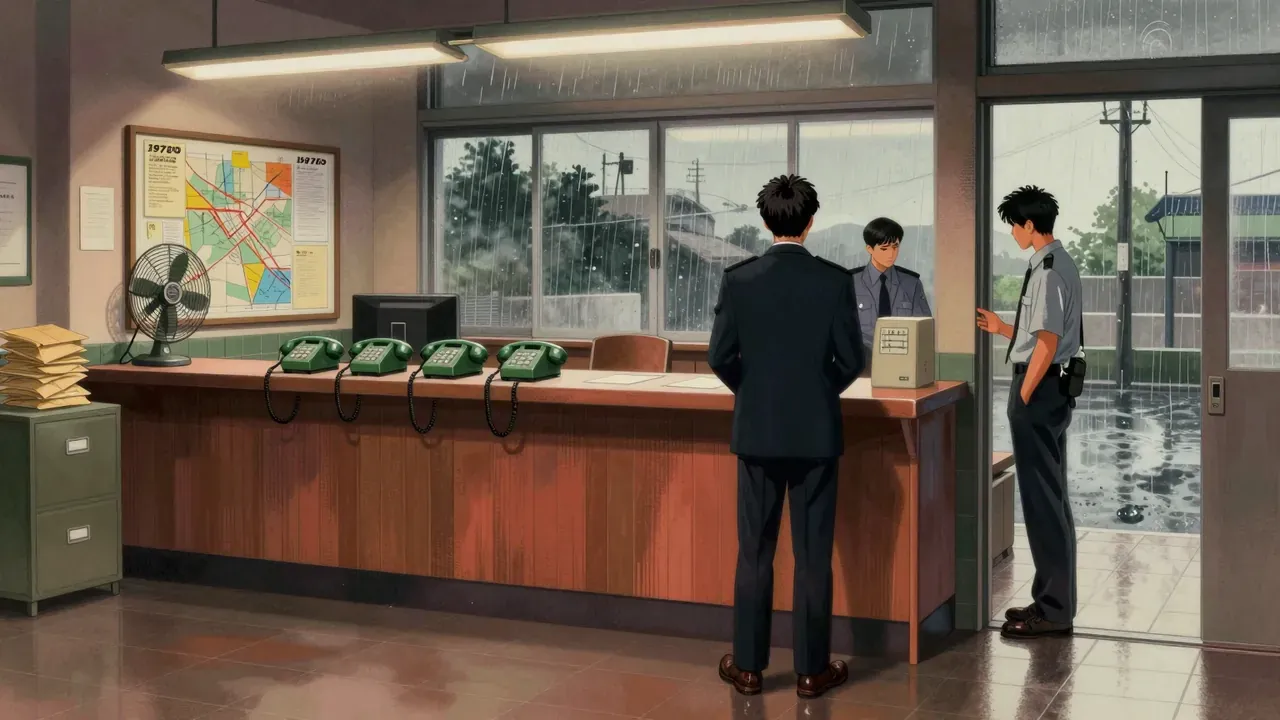
What lands is the cumulative weight of repetition: Enokizu repeats patterns — deception, flight, sexual transaction, betrayal — while those around him repeat failures of witness. Haru’s mother, released from prison, watches her daughter raped without intervening; Enokizu watches too, then kills them both. This symmetry is not symbolic but behavioural: the film shows how complicity hardens into habit. The mountain-top coda — ashes failing to fall — lands not as metaphor but as physical fact made resonant by everything preceding it: gravity, like justice or grief, has been suspended by the sheer inertia of unprocessed harm. The police station opening and closing frames do not resolve; they enclose. The film’s refusal to assign motive or meaning to Enokizu’s final act — the double murder — lands precisely because it refuses catharsis. What remains is not horror, but the quiet exhaustion of systems that absorb violence without breaking. That exhaustion feels documentary-accurate, not dramatised. (157 words)
The rhythm of harm
What does not land is any sustained engagement with the victims beyond function. Their names, histories, relationships outside Enokizu’s orbit remain uncharted; they exist primarily as surfaces he uses — money, shelter, alibi, body. This is deliberate, per Imamura’s method, but it risks flattening moral consequence into aesthetic pattern. A viewer expecting ethical reckoning may find the film’s neutrality alienating, not rigorous. Likewise, the childhood flashback — brief, elliptical — gestures at formative rupture but offers no causal chain; it suggests rather than substantiates how Shizuo’s rigid faith and wartime dispossession feed Enokizu’s nihilism. Some viewers will read this as discipline; others as evasion. The film’s resistance to interiority extends to its women: Haru, Kazuko, the prostitute — all defined by what men do to or through them, rarely by what they choose. This is consistent with the source material and period, but it leaves little room for counterpoint or contradiction within the frame. (156 words)
The hollow of ritual
The themes that matter are inheritance without transmission, belief without practice, and punishment without closure. The Catholicism in the film is structural, not spiritual: rituals persist — baptism, remarriage, confession — but stripped of meaning, reduced to administrative acts. Enokizu inherits his father’s name and shame, but not his faith; he inherits his mother’s silence, but not her endurance. The railway worker, the lawyer, the taxi driver — each represents a layer of civic infrastructure that fails to register anomaly until it is too late. Class operates not as barrier but as camouflage: Enokizu passes as professor, bail agent, lover, son — not because he is convincing, but because no one checks closely enough. The film treats violence not as rupture but as sediment: deposited, ignored, built over, then exposed again. Its central tension is between the state’s demand for narrative — confession, motive, sequence — and the lived reality of drift, where cause dissolves into habit and consequence into residue. (159 words)
The edges of sight
This film is for viewers who accept that some lives resist narrative coherence, and who value formal restraint over exposition. It suits those familiar with Japanese post-war cinema’s preoccupation with social dislocation, or with true-crime narratives that foreground systemic failure over individual pathology. It is not for viewers seeking moral clarity, psychological insight, or emotional release; those who require protagonists to evolve, villains to be contextualised, or endings to offer resolution will find it withholding. A viewer who values character-driven empathy over structural analysis may feel estranged by its clinical gaze. Someone drawn to Imamura’s earlier work — like The Pornographers or Pigs and Battleships — may expect more satire; this is colder, slower, less ironic. The film assumes patience with ambiguity and tolerance for prolonged discomfort without payoff. Without those, its length and tone become burdens, not conditions. (159 words)
The failure of gravity
Yes, it is worth your evening — but only if you are prepared to sit with unease without relief. Its 140 minutes unfold without hurry, trusting attention over stimulation. It rewards close watching not with revelation but with recalibration: after it ends, ordinary interactions — a stranger’s smile, a bureaucrat’s shrug, a parent’s silence — carry new weight. Those who dislike films that refuse to judge, explain or soothe will find it unrewarding. Someone who values historical specificity over universal themes may prefer Saki’s original book, which contains more factual scaffolding. But for those who believe cinema’s task includes holding space for irresolvable human failure — not as spectacle, but as weather — this remains essential. Its power lies in what it omits: no music swells at key moments, no camera lingers on tears, no voiceover interprets. That austerity is the point. (159 words)