The look of it
Trances is a docufiction portrait of Nass El Ghiwane, the Moroccan musical collective whose lyrics drew on Sufi poetry, street theatre, and anti-colonial resistance. It does not aim to narrate their biography or chart their discography, but to hold their presence in time: voice, gesture, rhythm, and silence as cultural acts. The film treats performance not as spectacle but as ritual — one rooted in communal space, oral transmission, and the physicality of breath and drum. Its ambition is ethnographic without distance, political without polemic, musical without mediation. It refuses the conventions of both concert film and biographical documentary, instead building its form from the band’s own compositional logic: repetition with variation, call-and-response between image and sound, interruption by memory. The colonial-era archival footage is not illustrative but counterpoint — a visual refrain that locates the band’s modernity within a longer arc of rupture and resilience. This is not a film about music; it is music made visible, and history made audible in the grain of a voice. (158 words)
How it moves
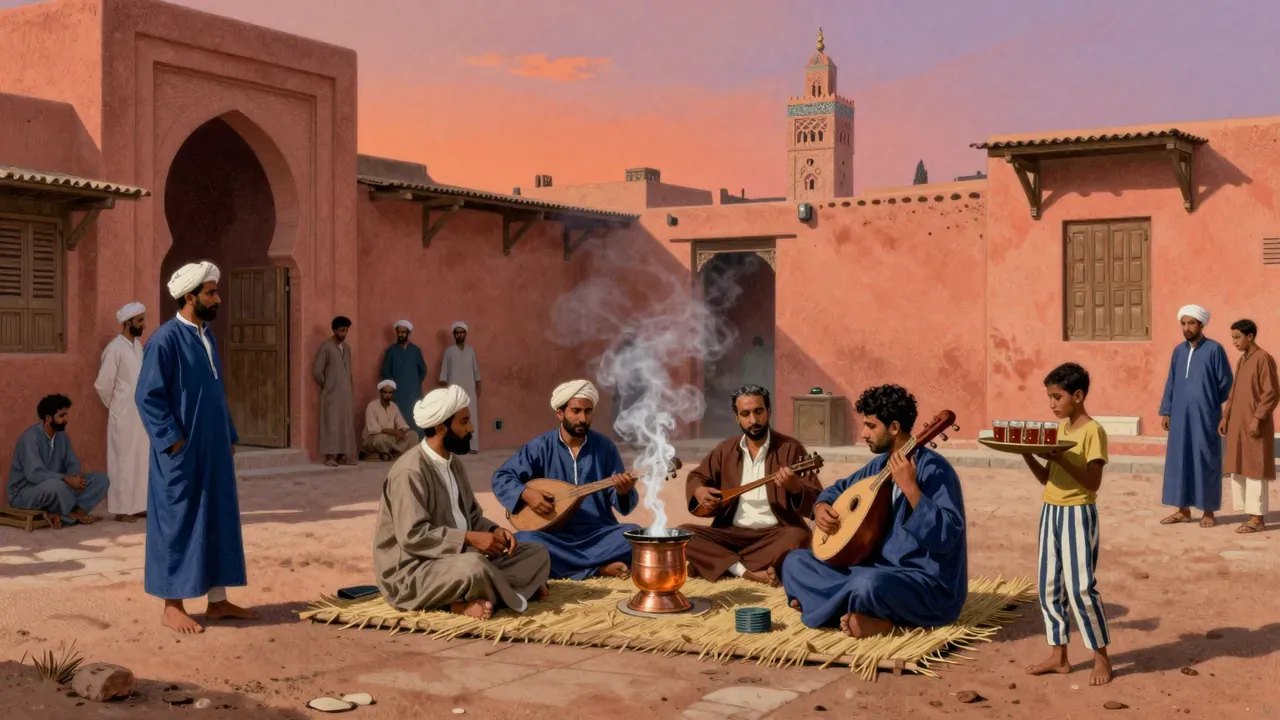
The film unfolds through three interwoven registers: live performance, direct address, and domestic observation. Ahmed El Maanouni’s cinematography favours medium shots and shallow focus, keeping faces and hands legible while letting ambient light — often from windows or stage lamps — shape the frame. He avoids cutting on beat, preferring sustained takes that let songs breathe and interviews settle. Nass El Ghiwane perform mostly in modest venues — courtyards, community halls, Djemaa el-Fna — and the camera stays at their level, never elevating them into icons. Interviews are unscripted but precise: band members speak of song meaning without explanation, assuming shared reference points in Amazigh and Arabic idioms. The archival cuts — grainy, silent, black-and-white — arrive without title cards or context, functioning as sensory punctuation rather than exposition. Music is recorded live on location, preserving the slight distortions of outdoor acoustics and audience murmur. There is no score beyond the band’s own compositions; no narration, no subtitles for the Arabic dialogue in the original release. The editing rhythm mirrors the qasida form: cyclical, accumulative, resistant to linear resolution. (159 words)
Where it holds
What lands most firmly is the weight of voice as instrument and archive. Larbi Batma’s singing carries a vocal timbre that feels both ancient and immediate — his phrasing, pauses, and breath control register as physical facts, not stylistic choices. The film captures how Nass El Ghiwane’s music functions socially: as gathering, as reminder, as refusal of erasure. When the camera holds on a listener’s face mid-song — eyes closed, head tilted, fingers tapping — it conveys transmission without translation. The domestic scenes, brief and unvarnished, ground the mythic status of the band in tangible detail: a man washing tea glasses, another tuning a lute in a sunlit room, children passing behind a doorway. These moments do not humanise the musicians so much as re-situate them within a continuum of labour, care, and continuity. The archival intercuts succeed not as historical illustration but as embodied contrast: the stiffness of colonial portraiture against the looseness of the band’s posture; the silence of old film against the polyrhythmic density of their percussion. The film’s restraint — its refusal to name, define, or summarise — becomes its strongest assertion of trust in the viewer’s capacity to listen. (157 words)
Where it slips
What does not land is the structural ambiguity between documentation and dramatisation. The docufiction label suggests deliberate blurring, but the film offers no cues — no staging, no re-enactment, no diegetic self-reference — to signal where observation ends and construction begins. This absence of framing leaves some sequences feeling unresolved: a rehearsal captured mid-flow lacks context for its significance; a walk through a market yields atmosphere but no narrative hinge. The lack of subtitles in the original Arabic-language version, while ethically coherent, creates a barrier for non-Arabic viewers that the film does not acknowledge or compensate for — no visual glossary, no repeated motifs to anchor meaning. The archival footage, though potent, appears without chronology or attribution, making its relationship to the band’s lyrics more intuitive than legible. Some interview passages drift into abstraction without sufficient grounding in lived experience, risking a kind of lyrical vagueness that substitutes resonance for clarity. A viewer expecting either rigorous ethnography or immersive concert energy may find the film’s middle path too elliptical — neither analytical enough to instruct nor visceral enough to overwhelm. (156 words)
What it remembers
The themes that matter are endurance, transmission, and the politics of vernacular form. Trances treats song not as entertainment but as vessel: for language that survived French and Spanish linguistic suppression, for rhythms that predate studio production, for communal memory held outside official archives. The film insists on the body as site of resistance — not through protest chants but through the physical act of singing in public space, of drumming with hands worn by work, of holding eye contact across generations. Colonialism appears not as backstory but as negative space: the silence beneath a lyric, the gap between an archival image and a living face. Decolonisation here is shown as daily practice — in the choice of dialect, the rejection of Western notation, the insistence on performing in open squares rather than theatres. Ritual matters more than message: the repetition of phrases, the call-and-response structure, the way a chorus gathers people into shared breath. There is no theme of individual genius; authorship is distributed across voices, instruments, listeners, and the city itself. The film’s quietest argument is that culture persists not by preservation but by constant, unremarkable re-creation. (159 words)
Who it speaks with
This film is for viewers who value listening over explanation, duration over exposition, and cultural specificity over universal appeal. It suits those familiar with North African musical forms, or with the aesthetics of 1970s–80s Third Cinema, or with the ethics of non-interventionist documentary. It is not for viewers who require narrative propulsion, contextual scaffolding, or linguistic accessibility without effort — those who expect subtitles as standard, or who read silence as emptiness rather than density. A music scholar might find its lack of technical analysis frustrating; a casual viewer seeking energetic concert footage may feel its pace too meditative. Those who believe documentaries must clarify rather than complicate will resist its withholding. But the verdict shifts if the film were re-released with optional Arabic-to-English subtitles that preserve poetic syntax rather than flattening it — not as concession, but as extension of its commitment to transmission. Without that, its audience remains necessarily narrow, but deeply served. (159 words)
What it leaves
Yes, it is worth your evening — provided you approach it as a score to be inhabited, not a text to be parsed. Its eighty-eight minutes unfold with the gravity of a ceremony: deliberate, unhurried, anchored in presence. It repays attention not through revelation but through accumulation — small gestures, recurring motifs, tonal shifts that only register on second viewing. The restoration sharpened contrast without sanitising grain, and the Criterion release includes contextual essays that help bridge its intentional gaps. Those who dislike films that refuse to name their stakes, or who need clear cause-and-effect structures, will find it elusive. But for anyone willing to sit with its silences, its repetitions, its refusal of summary, Trances offers something rare: a film that treats its subjects not as subjects of study but as co-authors of time. Its value lies not in what it says, but in how insistently it lets them be heard. (159 words)