A wartime proposition
The Man in Grey is a 1943 British period drama produced by Gainsborough Pictures to deliver wartime escapism through heightened emotional stakes, ornate Regency settings, and morally unambiguous character arcs. It adapts Eleanor Smith’s 1941 novel not as literary fidelity but as structural scaffolding for a dual-timeline melodrama: one thread anchored in contemporary London under blackout, the other in early-nineteenth-century England, where class, gender, and reputation dictate consequence with near-fatal rigidity. Its aim is neither psychological realism nor historical critique, but visceral moral contrast — between loyalty and ambition, duty and desire, passive virtue and active malice. The film assumes its audience seeks catharsis over ambiguity, clarity over complexity, and visual richness over restraint. It treats the past not as a subject of inquiry but as a stage set: polished, legible, and calibrated to reflect present anxieties about female agency, marital obligation, and national continuity. At its core, it is a studio-engineered proposition: that romantic suffering, when dressed in silk and lit by Arthur Crabtree’s high-contrast studio lighting, can function as both distraction and reassurance.
The shape of the story
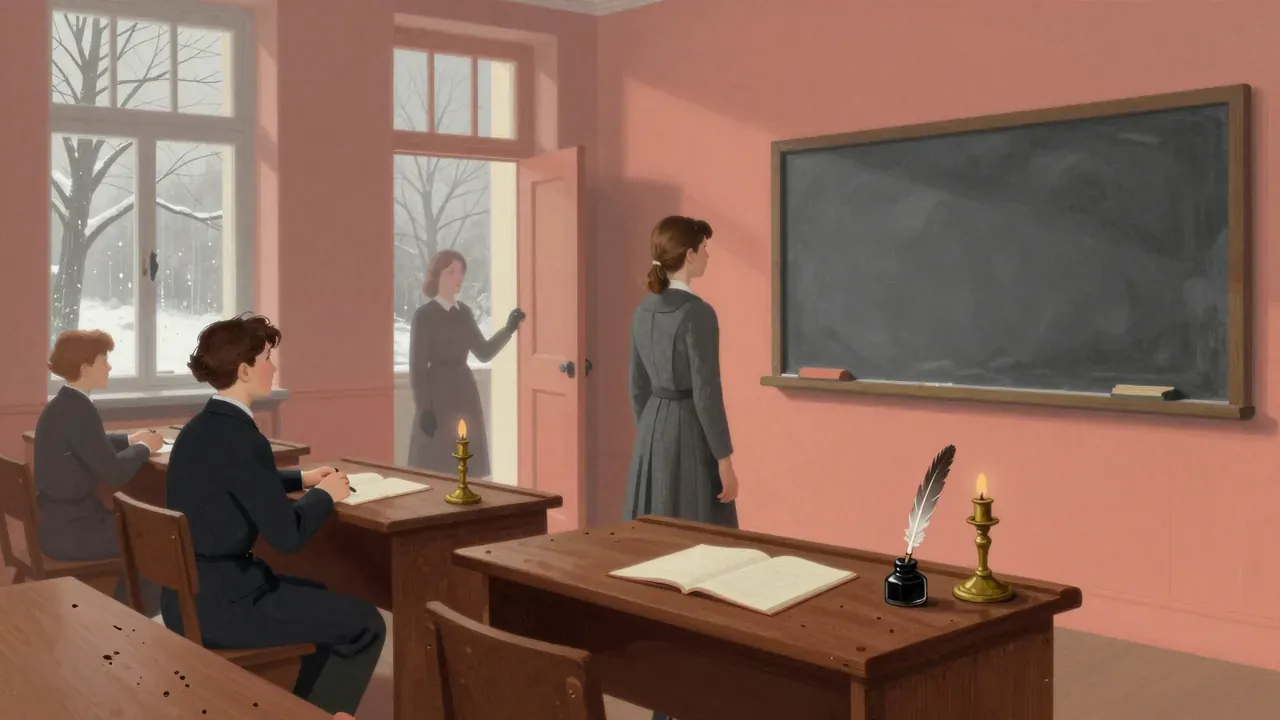
The story moves through exposition, betrayal, and retribution with deliberate, almost ritualistic pacing: Clarissa’s loyalty to Hesther at school; her coerced marriage to Lord Rohan; Hesther’s calculated seduction; Rokeby’s thwarted rescue; and the final, brutal execution of justice. Margaret Lockwood plays Hesther with coiled stillness — every glance weighted, every pause charged — while Phyllis Calvert’s Clarissa carries a quiet, unbroken dignity even in illness and grief. James Mason, though reportedly disengaged during filming, delivers a performance of icy control and physical menace, his Lord Rohan less a man than a principle made flesh: aristocratic entitlement fused with lethal pride. Stewart Granger, cast last-minute, brings raw, unvarnished urgency to Rokeby, his scenes with Calvert carrying a sincerity that cuts through the artifice. Arthur Crabtree’s cinematography favours deep shadows and tightly framed interiors, heightening claustrophobia without sacrificing period gloss. R.E. Dearing’s editing sustains momentum across the flashback structure, though the transition from 1943 auction to 1810s schoolroom remains abrupt rather than elegant.
What lands
What lands most decisively is the film’s moral architecture: the certainty with which vice is punished and virtue, however passive, is vindicated. Hesther’s downfall feels earned not because she is psychologically unravelled but because her transgressions — abandonment, deceit, poisoning — violate the film’s unspoken social contract. The climactic beating of Hesther by Lord Rohan fulfils the Rohan motto with grim, ceremonial finality, and its shock retains force precisely because it is not softened by irony or hesitation. Lockwood’s performance anchors this — her Hesther is never pitiable, only dangerous, and her elimination restores order without ambiguity. The Regency production design, though assembled under pressure and credited to Walter Murton (with Maurice Carter stepping in uncredited), achieves a convincing density of texture: candlelit ballrooms, ink-stained school desks, damp cobblestones under carriage wheels. Even the fortuneteller’s repeated warnings function less as plot device than as incantatory refrain — a reminder that fate, in this world, is not capricious but contractual.
What does not
What does not land is any sustained sense of historical plausibility or interior life beyond the central quartet. The 1810s milieu operates as backdrop, not context: no economic reality, no political tension, no sense of how empire or war shapes the characters’ choices. Lord Rohan’s ‘rakishness’ lacks dimension — he is cruel because the plot requires cruelty, not because the script or direction explores what makes him so. The framing device — 1943 Wren and RAF pilot at an auction — remains narratively inert: their presence adds thematic echo but no dramatic weight, and their final bus ride feels tacked on rather than earned. The film’s treatment of class is decorative rather than analytical: servants speak in broad strokes, Toby’s revelation arrives without preparation, and the Prince Regent’s intervention serves only to defer violence, not interrogate power. Some performances falter under the weight of exposition: Nora Swinburne’s Mrs. Fitzherbert and Helen Haye’s Lady Rohan are reduced to period-appropriate sighs and stiff-backed disapproval, their lines functional rather than revealing.
What it is really about
The themes that matter are inheritance, performance, and the gendered cost of survival. Clarissa inherits not just title and estate but expectation — to be loyal, fertile, decorous — and her compliance is rewarded with narrative continuity across centuries. Hesther, denied inheritance and education, must perform competence, charm, and submission until she can weaponise them; her ambition is punished not for being ruthless but for being unmasked. The film treats acting — on stage, in society, in love — as indistinguishable: Hesther plays Desdemona to manipulate Clarissa; Rohan performs aristocratic indifference until rage breaks through; even the fortuneteller performs prophecy as theatrical craft. This layering suggests a deeper anxiety about authenticity under duress — a wartime concern given literal form in the blackout interlude that triggers the flashback. But the film never questions whether performance is complicity or resistance; it simply assigns moral value based on outcome. Loyalty, in this schema, is the only unperformed virtue — and thus the only one that endures.
Who it is for
This film is for viewers who value strong-willed female antagonists, studio-era craftsmanship, and melodrama that resolves its conflicts with moral clarity rather than ambiguity. It rewards attention to costume detail, vocal precision, and the physical grammar of early 1940s British acting — where a lifted eyebrow or delayed blink carries more weight than dialogue. It is not for those seeking historical nuance, psychological realism, or narrative innovation: the flashback structure is conventional, the character motivations telegraphed, and the ending preordained by genre convention. Anyone put off by rigid class hierarchies presented without critique, or by the absence of working-class perspective beyond Toby’s brief, faithful service, will find little to engage beyond surface spectacle. A viewer expecting the moral complexity of later Gainsborough films like The Wicked Lady — or the formal daring of contemporaneous Powell and Pressburger — will be disappointed by its adherence to formula.
Is it worth your evening
Yes, it is worth your evening — provided you accept its terms. At 116 minutes, it moves with purpose, never dragging, and its central performances hold attention even when the script falters. It offers a coherent, self-contained world governed by clear rules, and its visual style — Crabtree’s chiaroscuro, Murton’s layered sets — remains distinct within British cinema of the period. Those who dislike studio-bound filmmaking, or who require character development beyond archetypal function, may find it hollow. But for anyone interested in how popular cinema negotiated wartime anxiety through period fantasy — or in how Margaret Lockwood forged a new kind of screen villainy — it repays close viewing. Its value lies not in transcendence, but in its precise calibration of craft, constraint, and conviction.