The premise
The Count of the Old Town is a Swedish studio comedy from 1935, adapted by Arthur Natorp from his own stage play. It aims to sustain light farce through mistaken identity, social pretension, and generational friction in Stockholm’s Gamla Stan — the ‘Old Town’ of the title. The film treats class mobility as inherently absurd: a penniless bohemian is mistaken for an aristocrat, and the confusion is not resolved through revelation but prolonged performance. Its tone is conversational, not satirical; it invites laughter at surface behaviour rather than structural irony. The production assumes familiarity with Stockholm’s civic hierarchy and the performative codes of interwar Swedish respectability — a context it does not explain but relies upon. There is no attempt at realism or psychological depth; characters function as vocal types, their motivations reduced to appetite, vanity, or inertia. The film’s ambition is modest: to occupy eighty-three minutes with rhythm, repetition, and the mild shock of seeing decorum briefly unspooled. It does not seek to reinterpret comedy, nor to interrogate its own conventions. It seeks only to land its gags cleanly, one after another, like stones dropped into still water.
The rhythm of it
The story follows Valdemar Dalquist as Greven, a down-at-heel artist who stumbles into the role of a long-lost nobleman after being misidentified at a charity gala. His improvisation is tolerated — even encouraged — by those who stand to gain from his presence, including Tollie Zellman’s Amalia, who sees marital advantage, and Sigurd Wallén’s Gurkan, who exploits the ruse for fundraising. Edvin Adolphson, co-director and co-star, plays Åke, a pragmatic journalist who documents the chaos without intervening. Ingrid Bergman appears as Elsa, a young woman whose quiet disbelief anchors several scenes, though her lines are few and her role structurally ornamental. Jules Sylvain’s score uses waltz motifs and jaunty clarinet phrases to underline comic timing, never to deepen mood. The staging is largely static, favouring medium shots and frontal delivery; editing is functional, with cuts timed to punchlines rather than rhythm or contrast. Lighting is even, interiors lit to show costume detail rather than texture or shadow. Performance style is broad but precise — Dalquist’s physical looseness contrasts with Zellman’s clipped diction and Wallén’s deliberate pauses — all calibrated to Swedish stage traditions of the period.
The timing
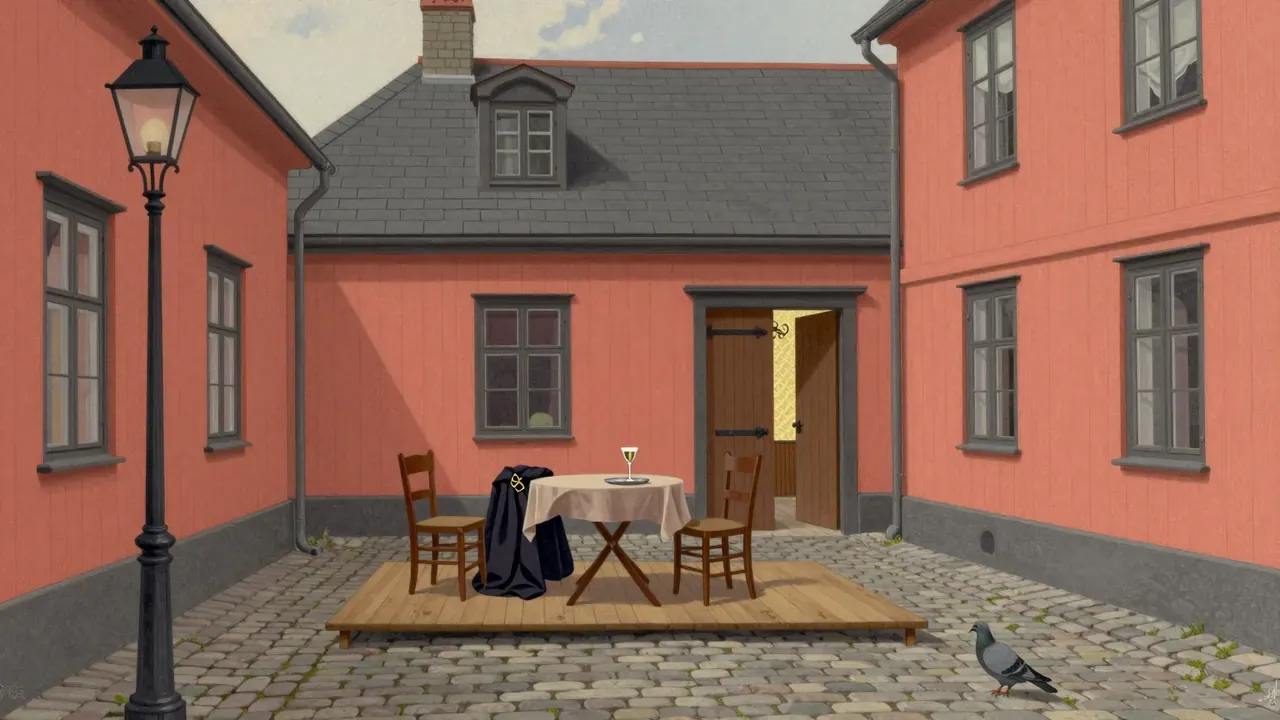
What lands most reliably is the ensemble’s shared sense of timing. Dalquist’s Greven works because he commits fully to the character’s cheerful indifference to consequence: he accepts champagne, flattery, and a borrowed coat with equal nonchalance, and that consistency makes the absurdity credible. Zellman’s Amalia lands every line about propriety and inheritance with just enough edge to suggest calculation beneath the bonnet. The film’s best moments occur when two characters speak past each other — such as when Eric Abrahamsson’s Borstis, a petty bureaucrat, recites municipal statutes while everyone else discusses romance — because the disjunction feels rooted in social reality, not writerly contrivance. The use of real locations within Gamla Stan adds quiet authenticity: narrow cobblestone alleys, timber-framed shopfronts, and the muted brickwork of 17th-century facades ground the farce in tangible space. Sylvain’s music avoids underscoring emotion and instead punctuates transitions — a cymbal crash on a slammed door, a descending glissando as someone trips — reinforcing the film’s preference for gesture over psychology.
The gaps
What does not land is the framing device: a prologue and epilogue featuring Wallén and Adolphson as themselves, breaking the fourth wall to introduce and summarise the plot. These segments feel tacked-on, tonally inconsistent with the main narrative, and undercut the internal logic the film otherwise sustains. Bergman’s Elsa, though billed prominently in later accounts, remains underwritten — her presence signals narrative importance but delivers none, and her few lines lack weight or development. The subplot involving Weyler Hildebrand’s Göransson, a tax inspector doggedly pursuing Greven’s unpaid dues, dissipates energy without payoff; his persistence is neither funny nor threatening, and the resolution arrives off-screen. Some gags rely on Swedish idioms or bureaucratic specifics — such as the distinction between ‘kommunal’ and ‘statlig’ funding — that do not translate visually or contextually. The film also assumes audience knowledge of contemporary Stockholm theatre culture, particularly references to the Royal Dramatic Theatre, which now read as inert name-dropping rather than shared shorthand.
The rules of it
The themes that matter are performance as survival, the arbitrariness of social rank, and the quiet violence of institutional expectation. Greven’s imposture succeeds not because he mimics nobility well, but because others choose to believe him — a choice rooted less in gullibility than in convenience. The film treats class not as fixed hierarchy but as a set of mutually agreed fictions, sustained by costume, address, and willingness to nod along. Amalia’s ambition and Gurkan’s civic boosterism both depend on appearances being taken at face value; when Greven slips — mispronouncing a French phrase, forgetting a family crest — the response is gentle correction, not exposure. There is no moral judgement attached to deception: the real transgression is inefficiency, not dishonesty. Age is treated as a kind of administrative category — Wallén’s Gurkan defers to tradition but adapts it; Adolphson’s Åke represents a younger pragmatism that observes but does not condemn. The film’s quietest theme is endurance: not of hardship, but of routine, of showing up, of maintaining the façade until something else comes along.
The audience for it
This film is for viewers who value craft over concept, who enjoy watching actors inhabit roles with unshowy precision, and who find pleasure in the mechanics of mid-century European studio comedy — its pacing, its vocal inflections, its reliance on ensemble rhythm rather than star charisma. It rewards attention to costume detail, regional accent, and the way a glance can hold three meanings at once. It is not for those who require narrative momentum, psychological coherence, or thematic urgency; viewers expecting satire, social critique, or emotional escalation will find it thin. Those who dislike films where characters rarely raise their voices or leave a room without permission may find it stifling. A viewer who values Bergman’s later work may be disappointed by her minimal role here — but that disappointment says more about her subsequent stature than this film’s design. To find it dull is reasonable; to call it empty is to mistake restraint for absence.
The length of it
It is worth your evening if you approach it as a specimen: a well-preserved example of Swedish interwar comedy, made with care and released before sound cinema had settled into rigid templates. Its eighty-three minutes pass without strain, its performances remain watchable decades later, and its view of social performance feels quietly prescient. It is not essential viewing, but it is coherent, unpretentious, and technically sound — qualities that matter more in minor films than in major ones. Someone who prefers tightly plotted farce with escalating stakes may find it slack; someone who values historical texture over narrative drive will find it rich. Its value lies not in what it argues, but in how steadily it holds its posture — like a man balancing a stack of plates, aware they could fall, choosing not to look down.