The premise
Robinson Crusoe on Mars is a science fiction adaptation of Daniel Defoe’s 1719 novel, relocated to the surface of Mars in 1964. It attempts a lean, plausible survival narrative grounded in mid-century space optimism — before Viking landers or Mariner flybys had ruled out breathable air or surface water. The film treats Mars not as a barren vacuum but as a hostile yet chemically workable desert planet, where oxygen can be liberated from rocks and water found in hidden caves. Its ambition is structural and philosophical: to isolate a single human, then gradually reintroduce agency, language, and reciprocity through another being — first a monkey, then a fellow captive, then a partner. It avoids spectacle-driven plotting in favour of procedural ingenuity: how to seal a spacesuit helmet with epoxy, how to distil water from plant matter, how to signal without power. This is not mythic allegory dressed in rocketry, but a deliberate, tactile reworking of Crusoe’s solitude using the vocabulary of aerospace engineering and Cold War-era planetary science.
The logic
The story unfolds with patient, unbroken logic: Draper’s descent, sheltering, resource extraction, discovery of McReady’s body and Mona, the grave, the alien ships, Friday’s arrival and slow integration. Paul Mantee carries the film with physical specificity — his gauntness, his methodical gestures, his exhaustion made visible in posture and breath. Victor Lundin’s Friday speaks little at first, communicates through gesture and shared labour, and gains linguistic footing only after weeks of implied repetition. Adam West appears only in flashbacks and as a corpse, yet his presence lingers as both foil and ghost of institutional mission. Winton Hoch’s cinematography uses Death Valley’s salt flats and Zabriskie Point ridges to forge an alien topography; he shoots wide, low, and still, letting scale and silence do the work. The red-tinged skies — achieved by overexposing blue skies in post — are not decorative but functional, reinforcing atmospheric thinness and psychological dislocation. Van Cleave’s score is sparse, mostly brass and percussion, underscoring action without emoting for it.
The texture
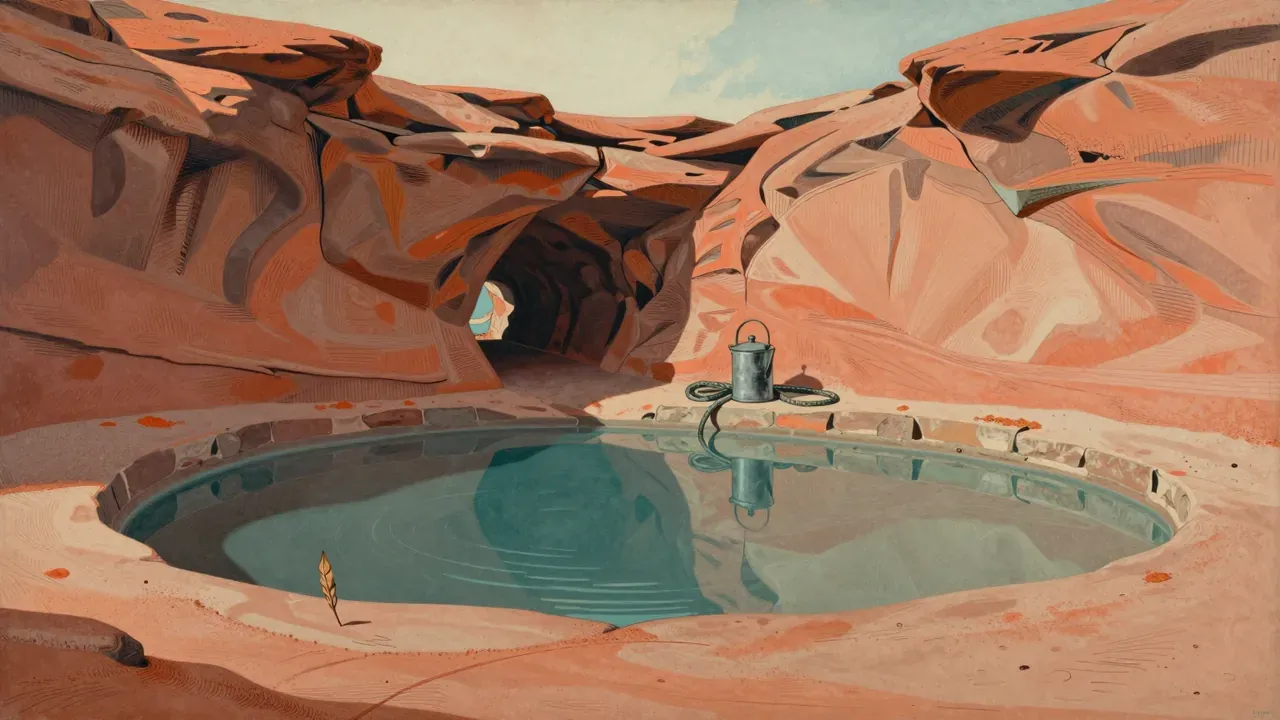
What lands is the integrity of its premise: every survival step feels earned, every discovery tethered to observable cause. Draper’s realisation that heating ‘coal’ yields oxygen is not a leap but a deduction built on earlier shots of him testing rock samples. The cave pool appears only after Mona’s behaviour — thirst, disappearance, return — has been established over several scenes. Friday’s bracelets are introduced twice before their function is revealed: first on the skeleton, then on his wrist, so their removal carries narrative and symbolic weight. The film trusts the audience to follow cause and effect without exposition. Even the monkey’s gender subterfuge — Barney the male playing Mona — becomes invisible once the creature’s role shifts from prop to co-survivor. The Martian landscape never winks or anthropomorphises; it remains indifferent, vast, and materially consistent. When the ice cap melts, it does so because a meteoroid strikes it — not because the script needs salvation, but because momentum and physics demand it.
The rupture
What does not land is the abrupt pivot from isolation to rescue. The final capsule’s arrival lacks preparation: no prior radio contact, no orbital confirmation, no visual cue beyond a distant speck. It arrives as deus ex machina, undercutting the film’s own rigour. Friday’s linguistic progress also accelerates implausibly in the last twenty minutes — from monosyllables to full sentences without the intermediate stammer or misapplied grammar that would ground it. The slave-mining sequence feels tonally detached, more like a War of the Worlds outtake than an organic extension of Draper’s world; the aliens remain faceless, their motives undefined, their technology borrowed rather than invented. The film jettisons Ib Melchior’s original monsters not just for budgetary reasons but for coherence — yet the replacement threat offers no deeper interrogation of captivity or colonialism beyond surface parallel. And while the red sky works visually, it undermines the stated thinness of the atmosphere: such colouration would require particulate density inconsistent with Draper’s ability to move unassisted outside his suit for long stretches.
The learning
The themes that matter are endurance without purpose, knowledge as embodied practice, and language as mutual construction. Draper does not wait for rescue; he builds a life, however provisional, and teaches Friday English not to impose culture but to share perception — naming objects, then actions, then abstractions like ‘cold’ or ‘safe’. The film treats technology as extension of the body: the hand pump, the wire saw, the salvaged radio — all are wielded with the same quiet focus as a flint knife in Defoe. Colonialism is present but refracted: Draper finds a murdered alien, not a native population to convert or conquer; Friday is not discovered but rescued, and his black bracelet links him to the dead, not to Draper’s authority. The film avoids moral binaries — the aliens are neither evil nor noble, merely operational — and resists the temptation to make Mars a mirror for Earthly politics. Instead, it insists on material reality as the sole arbiter: air must be made, water found, heat sustained, time measured by sunrises, not clocks.
The pact
This film is for viewers who value procedural clarity over plot velocity, who find tension in silence and texture in terrain, and who accept that a science fiction film need not explain its science to respect it. It suits those accustomed to 1960s studio craft — Techniscope grain, matte-painted horizons, miniature spacecraft with visible seams — and who read restraint as intention, not shortfall. It is not for viewers who require emotional escalation, character backstories, or thematic signposting. Those expecting the kinetic pacing of later space films or the irony of postmodern pastiche will find it slow, literal, even austere. A viewer who dislikes ambiguity in motivation or who expects alien encounters to resolve into dialogue or battle will leave unsatisfied. Its pace assumes patience; its logic assumes attention. Without those, the film reads as underplotted rather than unhurried — a distinction that hinges entirely on the viewer’s willingness to meet it on its own terms.
The measure
Yes, it is worth your evening — provided you watch it as a study in sustained attention, not as escapism. Its ninety-six minutes unfold with the weight of actual days: each sunrise matters, each failure to ignite coal is felt, each shared cracker between Draper and Friday carries the gravity of covenant. It rewards viewers who notice how Hoch frames Mantee against empty horizons not to emphasise loneliness but to measure scale against effort. Those who dismiss it as ‘dated’ or ‘slow’ are not wrong about its rhythm, but they mistake slowness for emptiness — when in fact every shot contains calibrated information about pressure, temperature, light, and time. It would fail a modern algorithmic preview, but succeed in a double bill with Solaris or First Man: not as nostalgia, but as a precise, pre-digital articulation of what survival looks like when no one is watching, and no one is coming — until they are.