A girl at an airport, deciding not to board
Persepolis, released in 2007 and co-directed by Marjane Satrapi and Vincent Paronnaud, adapts Satrapi’s own autobiographical graphic novel about growing up in Tehran during the Iranian Revolution and the war with Iraq, then living in exile in Vienna, and finally returning home again as a young woman. It is not trying to be a comprehensive history of the period, and it does not attempt to explain every political faction or event in detail; it is trying to show what that period looked like from inside one household and one child’s gradually widening understanding of it, which is a narrower and more useful ambition than the subject might suggest.
Drawn flat and deliberately imperfect
The film frames its entire story as a single afternoon spent at Orly Airport in Paris, where the adult Marjane sits down rather than boarding a flight back to Tehran and lets the rest of the film play out as an extended memory triggered by that hesitation. Satrapi and Paronnaud kept the animation hand-drawn and deliberately simple, using traditional ink techniques on paper after early digital tests looked, in the words of art director Marc Jousset, too clean and lacking in definition for what the story needed; producers had originally offered Satrapi the option of making a live-action film instead, and she turned that offer down flatly.
Why black and white, not colour
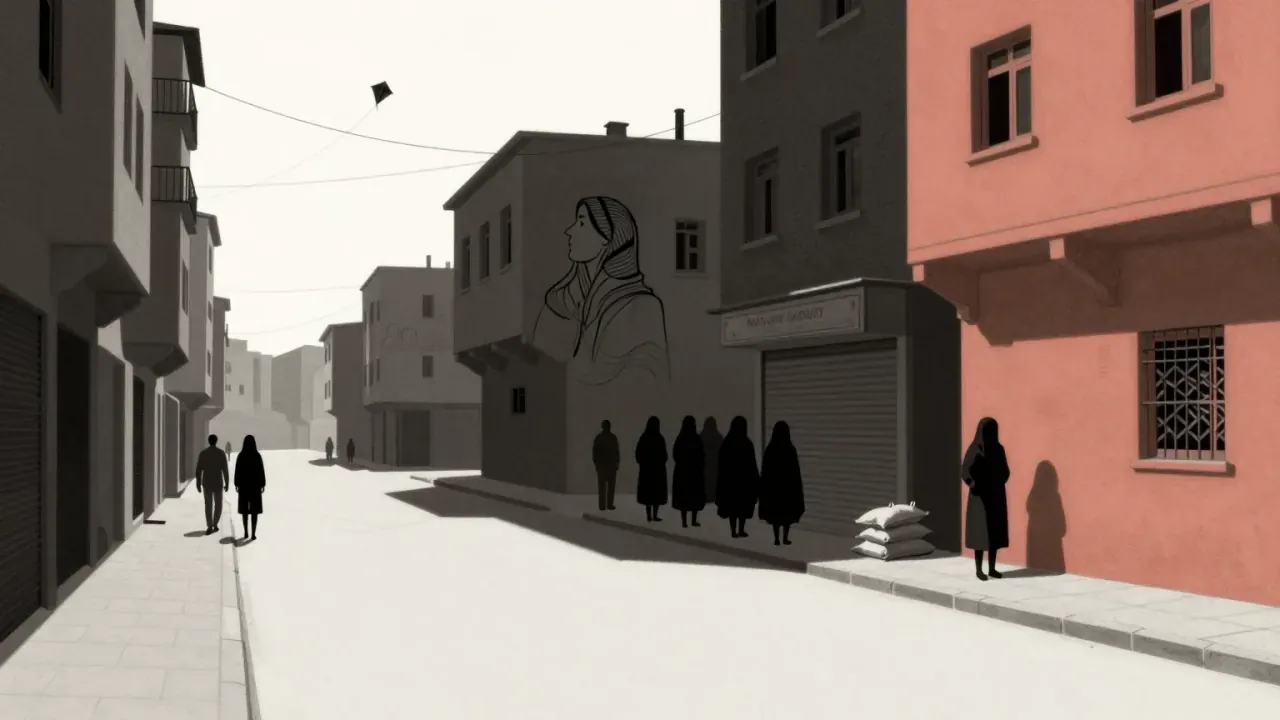
The choice to render most of the film in black and white, reserving colour only for the present-day airport scenes that bookend it, does specific work beyond simple stylisation: Satrapi has said directly that colour footage and live casting would have made her family read on screen as exotic outsiders in their own country, whereas the graphic, stripped-down line lets the audience see recognisable people rather than an unfamiliar, distancing setting. That same visual simplicity makes the political violence, when it eventually arrives on screen, land harder than it might in a more detailed style, because nothing about the animation is cushioning it with decorative visual noise.
A childhood that runs faster than the country around it
The film’s pace through the revolution itself sometimes runs faster than a viewer unfamiliar with the history can fully absorb in a single sitting; the arrest and execution of Marji’s uncle Anoosh, for instance, is compressed into a handful of scenes whose full emotional weight depends on the film having already sketched, briefly and efficiently, who he was to her and why his stories of resistance mattered. Some of that compression is simply an unavoidable cost of trying to cover roughly a decade of upheaval, migration and war within a ninety-five minute runtime without padding it out.
Exile as its own kind of danger
What the film is actually about is displacement in more than one sense at once: Marji is displaced from her country by war and government repression, and later, in Vienna, displaced again by isolation, a failed relationship with a boyfriend named Markus, and eventually a period of homelessness, before she returns to Iran no better resolved emotionally than when she originally left it. The film gives the Vienna exile section roughly as much screen time as the revolution itself, which amounts to a deliberate refusal to suggest that simply getting out of a dangerous country was ever the end of anyone’s story.
Who this is for
This suits viewers with a genuine interest in modern Iranian history told from a personal rather than a documentary or textbook angle, readers of Satrapi’s original comics curious how the adaptation compares, and anyone looking for animation made without any concession whatsoever to a younger audience. It is less suited to viewers wanting a tidy, comprehensive historical overview delivered with clear signposting, or those who prefer a gentler emotional register; the film does not soften its politics or its family’s real losses for the sake of viewer comfort. Anyone hoping for a documentary-style survey of the revolution’s causes and factions should look elsewhere for that context first.
Ninety-five minutes worth spending
At ninety-five minutes, co-winner of the Jury Prize at the Cannes Film Festival and the film that made Satrapi the first woman ever nominated for the Best Animated Feature Academy Award, Persepolis earns its considerable acclaim by trusting one specific, sometimes uncomfortable personal story over a broader, more sweeping historical account. It is a demanding but tightly efficient use of an evening, and unlike many films built around a decade of upheaval, it never once repeats a beat it has already made. It went on to become France’s official submission for the Best Foreign Language Film Oscar the same year, which says something about how thoroughly it was embraced at home despite its subject.