The question it asks
Soleil Ô is a French-Mauritanian film made in 1967 and released in 1970, written and directed by Med Hondo. It presents itself as a documentary but functions as a hybrid: part dramatised testimony, part political essay, part musical satire. Its stated aim is to trace the disorientation of a Black West African man arriving in Paris — not as a migrant seeking work, but as someone searching for ancestral roots among the Gauls, a premise that frames colonial logic as absurd from the outset. The film rejects linear narrative in favour of juxtaposition: archival footage sits beside staged scenes; spoken-word monologues interrupt song-and-dance numbers; bureaucratic documents are read aloud like incantations. It does not seek to represent immigrant life ‘realistically’ but to expose how representation itself is policed — by language, housing policy, labour law, and the camera’s gaze. Its method is forensic irony: it treats official French institutions not as neutral frameworks but as active agents of exclusion, and it uses their own forms — interviews, newsreels, legal texts — against them. The film’s urgency is structural, not anecdotal.
The shape of its time
The story follows no conventional arc. Instead, it moves through episodes: arrival at Gare du Nord, failed job applications, cramped lodging in a bidonville, encounters with employers, landlords, police, and white intellectuals. Robert Liensol plays the Visitor, a role performed with deliberate restraint — his silence often speaks louder than dialogue. Théo Légitimus appears as Afro Girl, a figure who shifts between guide, critic, and embodiment of collective memory. Bernard Fresson and Yane Barry play Friend and White Girl, characters whose liberal gestures are dissected rather than endorsed. François Catonné’s cinematography avoids naturalism: interiors are lit with flat, even light; exteriors use shallow focus and abrupt cuts. George Anderson’s score mixes West Indian folk motifs, jazz improvisation, and musique concrète — a sonic counterpart to the film’s collage form. Hondo’s narration is dry, rhythmic, occasionally sardonic, never explanatory. There are no establishing shots, no voice-of-God commentary. Every image is positioned, every sound placed. The editing — though uncredited in the fact sheet — operates like a series of interruptions: a bureaucratic letter dissolves into a tap-dance routine; a statistics chart cuts to a close-up of a sweating brow.
The weight of its pauses
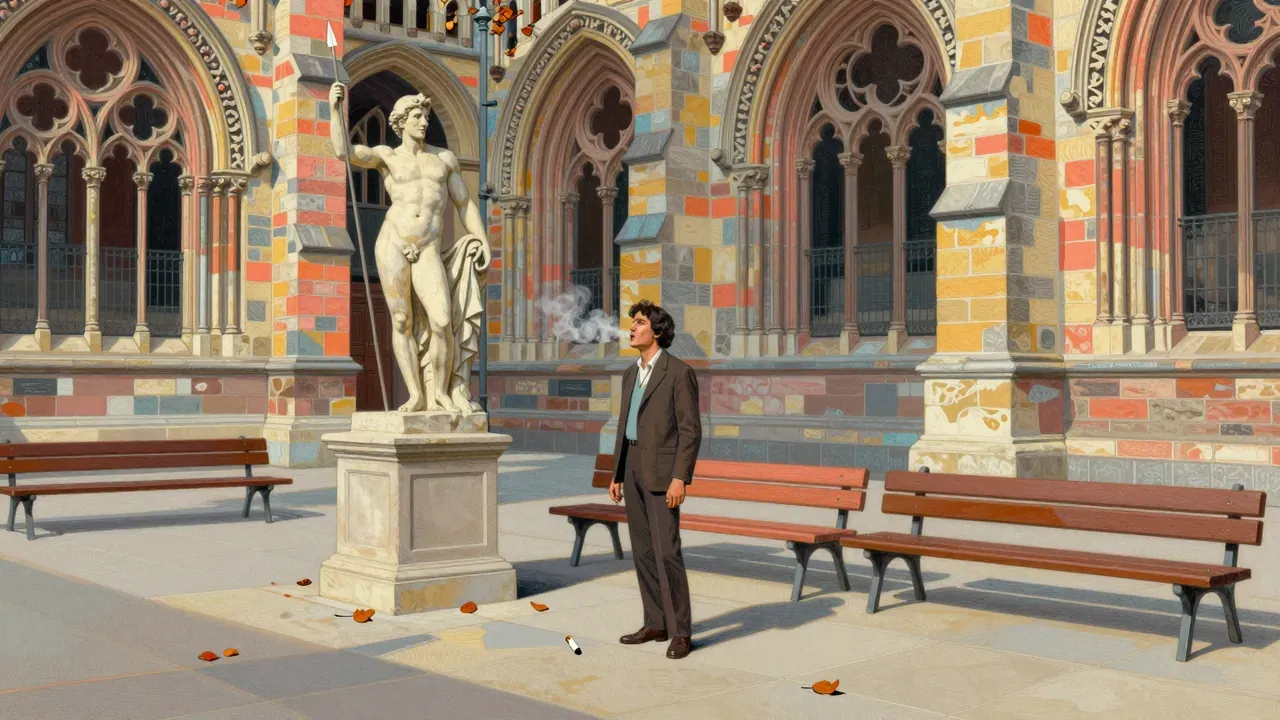
What lands most firmly is the film’s refusal to comfort its audience. Its irony is not decorative but functional — it forces viewers to notice the gap between what institutions claim to do and what they actually enforce. The musical sequences do not relieve tension; they heighten it, turning exploitation into choreography, humiliation into rhythm. A scene where the Visitor recites Latin phrases while standing before a statue of a Gaulish warrior lands with precise, quiet fury: the absurdity is historical, not comedic. The film’s use of Hassaniya Arabic — spoken by the protagonist but untranslated — is a formal act of resistance, not an aesthetic flourish. It denies non-Arabic-speaking viewers full access, mirroring the protagonist’s own linguistic alienation. The documentary interludes — grainy footage of colonial exhibitions or Parisian street protests — are not illustrative but argumentative: they anchor the fiction in material history. Even the film’s pacing works: its 98 minutes feel neither rushed nor slack, but calibrated — each pause weighted, each cut deliberate. Nothing here feels indulgent; everything feels necessary.
Where its edges blur
What does not land consistently is the film’s reliance on slapstick, particularly in early sequences involving bureaucracy. A scene where the Visitor tries to fill out a form while officials shuffle papers and speak over him risks flattening its critique into caricature — the satire becomes too broad, the targets too easily legible, and the stakes momentarily diffuse. Similarly, some of the dream sequences — especially those involving exaggerated bourgeois melodrama — lack the density of the documentary or musical passages; their symbolism feels less earned, more prescribed. The film’s rejection of psychological realism also means that emotional escalation can appear abrupt rather than cumulative: moments of rage or despair arrive without the interior scaffolding that might make them resonate beyond their ideological function. This is not a flaw in intent — Hondo clearly chooses fragmentation over coherence — but it does mean that viewers accustomed to character-driven arcs may find the Visitor’s transformation opaque. The film assumes its audience shares its frame of reference, and when that frame is missing, some sequences read as cryptic rather than concentrated.
The architecture of exclusion
The themes that matter are not migration or racism as discrete subjects but the architecture of erasure: how language, law, urban planning, and pedagogy jointly produce invisibility. Colonialism is treated not as a past event but as a present infrastructure — visible in the layout of Parisian hostels, the wording of employment contracts, the tone of university lectures. The film interrogates genealogy not as lineage but as inheritance: what is passed down is not blood but constraint. Its treatment of music is thematic, not ornamental — songs are weapons, archives, and counter-archives all at once. The title Soleil Ô references a West Indian slave lament, but the film refuses to treat that lament as heritage; instead, it asks what happens when the sun rises on a system that still names its victims ‘immigrants’ while denying them history. Class and race are inseparable here, but the film never reduces one to the other: a white working-class character appears briefly, dismissed just as swiftly as the Visitor, suggesting that hierarchy is not merely racial but systemic — and that solidarity must be built, not assumed. The film’s central question is not ‘what is it like to be Black in Paris?’ but ‘what does it cost to be seen as human under this regime?’
Who it speaks with
This film is for viewers who approach cinema as a site of argument, not escape — those willing to sit with unresolved tension, to parse irony without needing reassurance, and to accept that some silences in the soundtrack are deliberate, not omissions. It suits readers of Frantz Fanon or Aimé Césaire, viewers familiar with Chris Marker’s essay films or the early work of Ousmane Sembène. It is not for those who require narrative continuity, psychological exposition, or tonal consistency — viewers who expect satire to clarify rather than complicate, or who need protagonists to ‘grow’ in ways recognisable to mainstream drama. Someone who finds Godard’s Week-end exhausting or Akerman’s Jeanne Dielman alienating may find Soleil Ô similarly resistant. That said, its accessibility is not purely stylistic: its politics are direct, its anger precise. A viewer who disagrees with its verdict on French integration policy would need to engage with its evidence — the documents, the statutes, the spatial arrangements — not just its tone. Without that engagement, dismissal is a choice, not a conclusion.
What it leaves behind
Yes, it is worth your evening — not as entertainment but as recalibration. Its 98 minutes do not pass quickly, but they accumulate: by the end, the banality of a Parisian bus ticket or a landlord’s signature feels newly charged. It demands attention, not passive viewing, and rewards rewatching — not to ‘get’ a hidden meaning but to notice how its techniques shift emphasis across viewings. Those who value craft as argument will find Catonné’s framing, Anderson’s scoring, and Hondo’s editing all operating at a high level of intention. It is not a film to consume lightly, but it is one that stays with you precisely because it refuses to be consumed. Some will call it didactic; others will call it urgent. Neither label is wrong, but the difference lies in whether you see instruction as antithetical to art — and Soleil Ô insists they are the same thing. Its restoration in 2017 was not merely technical but ethical: it returns a voice that had been marginalised not just in distribution but in film history itself. To watch it now is to witness a method of resistance that remains current, not archival.