Saved
Director · Cinematographer · 1928–2018

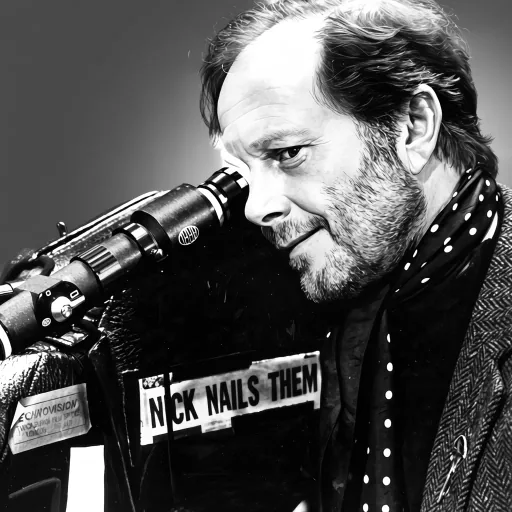
Nicolas Roeg

7
briefs
13:00
average
91 min
in total
On film.briefs7
13:00

Bad Timing

Nicolas Roeg · 1980

Nicolas Roeg’s 1980 psychological thriller Bad Timing follows an inspector’s investigation into a woman’s suicide attempt, using non-linear editing and restrained cinematography to dissect the obsessive, destructive relationship between a psychoanalyst and his lover. Set in Vienna and shot by Anthony B. Richmond, it stars Art Garfunkel and Theresa Russell, with Harvey Keitel as the investigator. Adapted by Yale Udoff from an Italian story, the film was controversial on release — rejected by its UK distributor and X-rated in the US — yet won the Toronto International Film Festival People’s Choice Award. Its formal rigour and emotional austerity have secured its status as an arthouse landmark.
13:00

Don't Look Now

Nicolas Roeg · 1973

Don’t Look Now (1973), directed by Nicolas Roeg, follows a British couple in Venice after their daughter’s death. As John restores a church and Laura encounters clairvoyants, reality blurs: red coats recur, water rises, time folds. Shot by Roeg and Anthony B. Richmond, edited by Graeme Clifford, and scored by Pino Donaggio, it treats mourning as a perceptual disorder — not a story to resolve, but a condition to inhabit.

13:00

Insignificance

Nicolas Roeg · 1985

Nicolas Roeg’s 1985 Insignificance adapts Terry Johnson’s play into a tightly wound, non-linear encounter between four archetypal figures — a movie star, a physicist, a baseball player and a politician — over one night in a New York hotel. Starring Theresa Russell, Tony Curtis, Gary Busey and Michael Emil, it uses fragmentation, silence and precise physical performance to explore how public identity obscures private reality. Though uneven in its treatment of power and consequence, it remains a singular, unsentimental meditation on visibility, vulnerability and the cost of being known.

13:00

Performance

Donald Cammell, Nicolas Roeg · 1970

A violent East London gang enforcer, on the run after killing a rival, hides in the Notting Hill home of a reclusive rock star. What follows is less a thriller than a psychological and formal investigation into performance, identity, and the porous line between role and self. Directed by Donald Cammell and Nicolas Roeg, and starring James Fox and Mick Jagger, the 1970 British film uses fractured editing, dissonant sound, and deliberate ambiguity to unsettle narrative expectation and challenge assumptions about masculinity, class, and authenticity.

13:00

The Man Who Fell to Earth

Nicolas Roeg · 1976

Nicolas Roeg’s 1976 adaptation of Walter Tevis’s novel follows Thomas Jerome Newton (David Bowie), an alien who lands in New Mexico to secure water for his drought-ravaged planet. Using advanced knowledge, he amasses wealth and builds a rocket — but becomes entangled in human relationships, addiction, and surveillance. Shot by Anthony B. Richmond in New Mexico, with a fragmented, atmospheric score by John Phillips, the film treats estrangement as perceptual, not biological. Its power lies in cumulative mood, not plot mechanics.

13:00

Walkabout

Nicolas Roeg · 1971

Walkabout (1971), directed by Nicolas Roeg, follows a teenage girl and her younger brother after their father’s suicide in the Australian desert. They meet an Aboriginal boy who helps them survive, but communication remains partial and understanding elusive. Shot by Roeg himself, edited by Antony Gibbs, and scored by John Barry, the film uses stark imagery, elliptical structure, and near-silence to explore mutability, colonial distance, and the limits of language. Its power lies in what it withholds — names, motives, explanations — making it a landmark of arthouse cinema and a persistent subject of ethical debate.

13:00

Doctor Zhivago

David Lean · 1965

David Lean’s 1965 adaptation of Pasternak’s novel follows physician-poet Yuri Zhivago across Russia’s collapse, centring his love for Lara amid revolution and war. Filmed mostly in Spain with Freddie Young’s wintry cinematography and Maurice Jarre’s iconic score, it prioritises atmosphere and endurance over exposition or ideology. Though criticised for length and historical vagueness, its tactile realism and emotional restraint have secured its place as a benchmark of romantic epic filmmaking.