The look of it
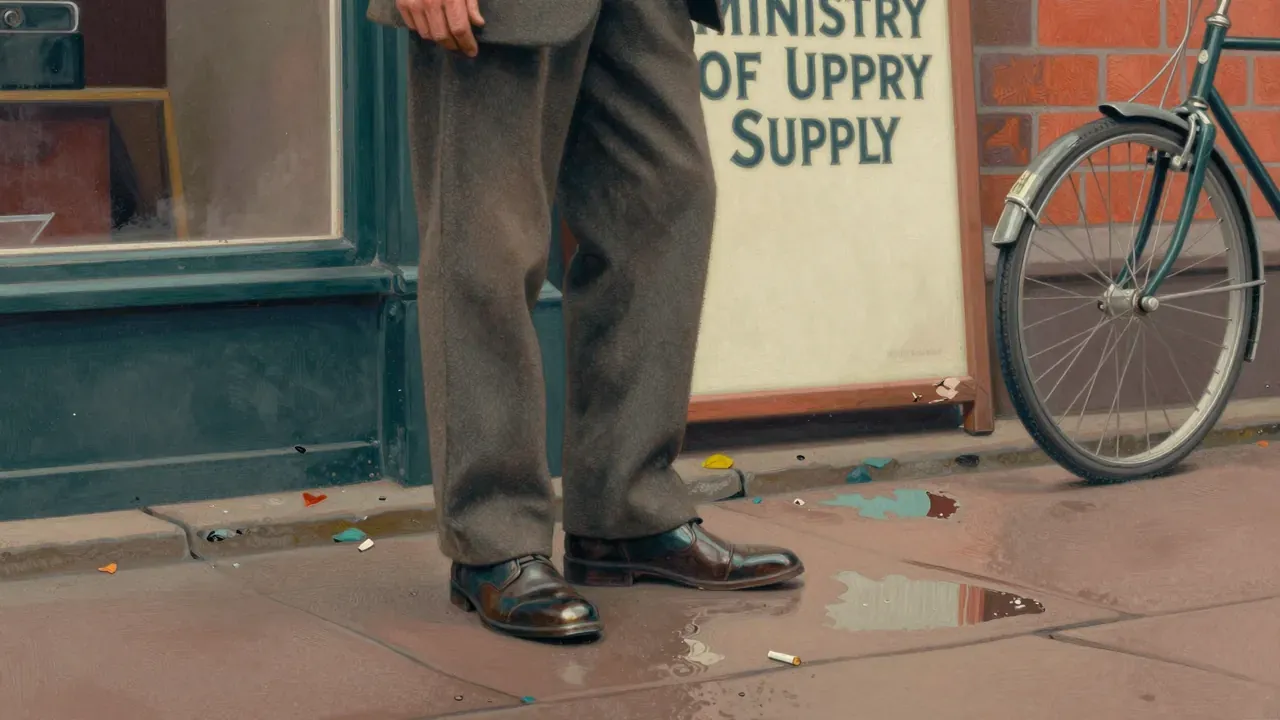
The Small Back Room is a wartime drama set in London during the closing years of the Second World War, adapted from Nigel Balchin’s 1943 novel. It follows Sammy Rice, a weapons scientist with a prosthetic foot and chronic pain, working in an under-resourced government department that evaluates new ordnance. The film attempts to dramatise the quiet, unglamorous labour of civilian scientists — the ‘back room boys’ — whose work was vital yet invisible, bureaucratic, and psychologically corrosive. Powell and Pressburger shift away from the heightened visual stylisation of Black Narcissus or The Red Shoes toward a muted naturalism: interiors are drab, lighting restrained, pacing deliberate. The aim is not spectacle but accumulation — of fatigue, frustration, moral compromise and slow-burning dignity. It seeks to locate heroism not in action but in endurance, not in command but in competence regained after collapse. The film’s ambition lies in its fidelity to a specific historical mood: post-blitz exhaustion, institutional inertia, and the grinding weight of responsibility without recognition. It is less about victory than about holding on, and less about war than about what war does to the mind when it is asked to stay still and think.
The weight of it
The story unfolds in three phases: professional stasis, personal rupture, and technical reckoning. David Farrar plays Sammy Rice with physical specificity — his limp is weighted, his posture defensive, his speech clipped and sardonic. Kathleen Byron’s Susan is patient but never passive; her restraint reads as agency, not submission. Cyril Cusack and Jack Hawkins lend quiet authority to minor roles, their presence anchoring scenes in lived bureaucracy. Christopher Challis’s cinematography avoids flourish: he uses tight framing in offices, shallow focus in domestic interiors, and long takes during dialogue to sustain unease. Brian Easdale’s score is sparse, mostly piano and strings, underscoring tension without melodrama. The editing is precise but unobtrusive, letting silences linger — particularly in the final disarming sequence, where cuts tighten as Rice’s breathing grows audible. There is no voiceover, no symbolic montage beyond one brief, contested expressionist interlude (a whisky bottle looming like a hallucination), and no narrative shortcuts. Every plot turn emerges from character choice or institutional constraint, not contrivance.
The pace of it
What lands most firmly is the texture of mid-war London — not as backdrop but as pressure system. The locations feel inhabited: the cramped Ministry office with its stacked files and flickering lights, the rain-slicked Victoria Embankment at dusk, the chalky desolation of Chesil Bank. These are not picturesque; they are damp, cold, and bureaucratically indifferent. The film’s central tension — between Rice’s self-loathing and his irreplaceable skill — holds because Farrar refuses to soften the character’s bitterness or make his recovery sentimental. The climax, on the Dorset coast, works through accumulation: the dead colleague’s taped notes, the double booby trap, the physical toll of kneeling on shingle while manipulating delicate mechanisms. It is tense not because it is flashy, but because every gesture feels consequential and irreversible. The ending avoids triumphalism: Rice accepts a commission not as reward but as reintegration, and Susan’s return is quiet, practical — she has repaired the flat, not the man. This restraint gives emotional weight without recourse to catharsis.
The friction of it
What does not land is the film’s middle stretch, where bureaucratic infighting and departmental squabbles stretch thin. Scenes of committee meetings and inter-departmental memos lack dramatic propulsion, and their repetition risks monotony rather than verisimilitude. The film assumes familiarity with wartime administrative culture — a context now distant — and offers little exposition to orient the viewer. Some supporting characters blur into types: the obstructive civil servant, the weary superior, the loyal secretary — functional but under-drawn. The romantic arc, though grounded, suffers from imbalance: Susan’s patience borders on implausibility without deeper exploration of her own stakes or limits. The film also misjudges tone in its single expressionist passage — the surreal whisky hallucination — which jars against the prevailing naturalism and feels like a stylistic indulgence rather than psychological insight. That moment, singled out by contemporary reviewers, remains the film’s most conspicuous misstep: a rupture in its own aesthetic contract.
The craft of it
The themes that matter are competence as moral anchor, disability as persistent condition rather than narrative device, and institutional neglect as slow violence. Rice’s prosthetic foot is not metaphorical; it aches, chafes, and limits him physically — and the film refuses to let him transcend it. His value lies not in overcoming impairment but in mastering his craft despite it. The film treats bureaucracy not as comic foil but as structural antagonist: red tape delays decisions, careerism overrides safety, and merit is buried under protocol. There is no villain, only systems that erode agency. Another theme is the gendered division of emotional labour: Susan absorbs Rice’s volatility without reciprocity for much of the film, and her eventual return is not reconciliation but recalibration — she waits, but only after he has done the work. Finally, the film quietly insists on science as embodied practice: knowledge is not abstract but tactile, dangerous, and inseparable from the body that applies it — whether handling explosives or enduring chronic pain.
The repair of it
This film is for viewers who value psychological realism over plot velocity, who find tension in silence and precision in performance, and who are willing to sit with discomfort without narrative reassurance. It suits those familiar with mid-century British social history or interested in the ethics of expertise under pressure. It is not for viewers who require clear antagonists, rapid pacing, or emotional resolution within a scene — the film’s rhythms are cumulative, not episodic. Those expecting Powell and Pressburger’s more flamboyant visual grammar may find it austere, even withholding. Critics who dismissed its ‘gloom’ — Halliwell, for instance — would likely object to its refusal to uplift. A different verdict would follow if the film had tightened its middle act or deepened Susan’s interiority; as it stands, its rewards are earned slowly, and its exclusions are deliberate, not accidental.
The worth of it
Yes, it is worth your evening — provided you approach it as a study in restraint, not release. Its 106 minutes unfold with the weight of real time, and its power lies in what it refuses: no grand speeches, no heroic music swells, no redemption arcs that erase consequence. It asks for attention to detail — the way Farrar shifts his weight, the sound of a typewriter fading into rain, the exact angle of a bomb casing in sunlight — and repays that attention with quiet conviction. It is not entertainment in the conventional sense, but it is deeply humane. Those who dislike procedural realism or find prolonged psychological strain exhausting will not warm to it. But for anyone interested in how films can register the cost of competence, or how post-war Britain imagined its unsung workers, this remains singular. Its modesty is not weakness; it is discipline — and that discipline holds up, sixty years on.