The setting and the frame
All Night Long is a British black-and-white drama that transposes Shakespeare’s Othello into the London jazz world of 1961, confining its action to a single night at a Thames-side warehouse party. It aims to fuse classical tragedy with contemporary social texture: racial dynamics are muted but present in casting and framing; psychological realism is anchored in mid-century anxieties about authenticity, ambition, and self-deception; and the jazz milieu is treated not as backdrop but as structural logic — improvisation, repetition, tension-and-release mirroring dramatic construction. The film does not disguise its source, nor does it flinch from modernising motive: Johnny Cousin’s envy is professional, not racial; his manipulation relies on tape recorders and drug-laced cigarettes, not Iago’s rhetoric alone. It seeks coherence through constraint — one location, one night, a tight ensemble — and through musical counterpoint: dialogue, score, and diegetic performance all operate in overlapping registers. Its ambition is formal and thematic alignment: a tragedy where the rhythm section drives the plot, and where every solo risks derailing the harmony.
The weight of a glance
The story unfolds with deliberate, almost theatrical pacing: exposition arrives in overlapping conversations, motivations in glances and silences. Patrick McGoohan’s Johnny Cousin is tightly coiled — restless, verbally precise, physically contained until he erupts. Keith Michell’s Cass Michaels carries the weight of recovery and loyalty without sentimentality; Betsy Blair’s Emily speaks little but registers each betrayal in posture and pause. Edward Scaife’s cinematography avoids expressionist distortion: light falls flat on brick walls and polished piano lids, the camera moves only when necessary — a slow dolly past musicians, a high-angle shot over the balcony rail before the fall. Philip Green’s score underscores but never swells; the jazz numbers are diegetic, performed live on set, their duration dictated by narrative function, not runtime padding. Editing by John D. Guthridge sustains continuity without flash — cuts land on reactions, not revelations. The script by Paul Jarrico (credited under pseudonym) tightens Shakespearean structure without flattening ambiguity: motives remain partial, outcomes unresolved, even in reconciliation.
The acoustics of place
What lands is the film’s rhythmic discipline. The warehouse setting feels lived-in and acoustically plausible — footsteps echo, glass clinks, bass notes vibrate in floorboards. The performances avoid caricature: Richard Attenborough’s Rod Hamilton is affable but unillusioned; Marti Stevens’ Delia conveys quiet resolve beneath vocal restraint; Paul Harris’ Rex balances authority and fragility without tipping into hysteria. The jazz sequences are integrated, not inserted: Brubeck’s ‘It’s a Raggy Waltz’ plays during a lull in conversation, its off-kilter time signature underscoring emotional dissonance; Mingus and Brubeck’s improvised ‘Non-Sectarian Blues’ coincides with Johnny’s first lie — the music doesn’t illustrate, it participates. McGoohan’s physicality remains persuasive throughout: his drumming is tense, economical, never showy; his stillness before violence is more unsettling than any outburst. The final walk along the embankment works because it is underlit, wordless, and refuses closure — fingers on a throat linger longer than any kiss.
The mechanics of mistrust
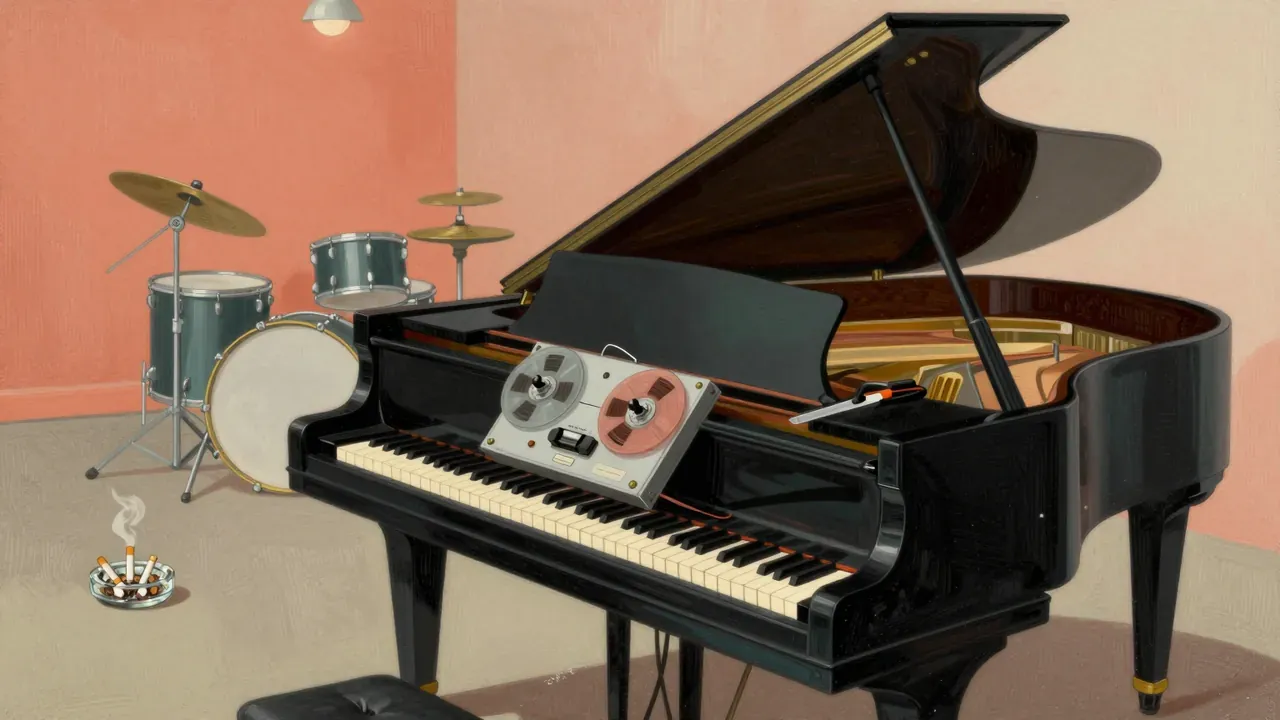
What does not land is the script’s occasional reliance on exposition disguised as banter. Mid-Atlantic accents — adopted by British actors playing American-influenced jazz figures — sit uneasily beside naturalistic delivery, creating tonal friction rather than period texture. Some plot mechanics feel dated not in conception but execution: the doctored tape hinges on cassette splicing so crude it strains credulity, even for 1962; Cass’s marijuana-induced volatility lacks grounding in character, serving plot more than psychology. The film’s attempt to compress Othello’s moral architecture into domestic friction occasionally flattens consequence — Rex’s violence is shocking, but its aftermath is smoothed over too quickly, the ambulance arrival feeling procedural rather than cathartic. Jazz fans may find the musicians underused: Brubeck and Mingus appear briefly, their presence symbolic rather than functional; Dankworth and Hayes get clearer runs, but Tubby Hayes’ ‘The Chase’ arrives after the central crisis has passed, its urgency mismatched to narrative timing. The ending’s tentative reconciliation feels earned emotionally but structurally abrupt.
Who holds the microphone
The themes that matter are control, translation, and the unreliability of mediation. Johnny manipulates sound — editing tape, misrepresenting speech — just as the film itself translates Shakespeare into jazz, English into mid-Atlantic inflection, stage tragedy into cinematic intimacy. Every act of communication is filtered: Cass’s voice is cut and spliced; Delia’s song is rehearsed in private, then misread in public; Emily’s final ‘I love you’ is met with rejection that feels less like nihilism than exhaustion with performance. Ambition here is not upward mobility but authorship — Johnny wants to write the narrative, not just play in it. Race operates as subtext, not subject: the casting of Black musicians alongside white actors in positions of creative authority (Rex as bandleader, Mingus as bassist) is quietly radical for 1962, yet the script avoids direct engagement with systemic barriers, focusing instead on interpersonal corrosion. The warehouse itself becomes a theme: a repurposed industrial space where art, commerce, and private life collide — temporary, functional, acoustically honest.
The tempo of attention
This film is for viewers who value structural rigour over emotional immediacy — those attuned to how rhythm governs both music and narrative, who find tension in restraint, and who accept that a tragedy can end without death but not without cost. It rewards attention to craft: the placement of a microphone, the duration of a silence, the way a tracking shot follows a drink being poured rather than a face reacting. It is not for those seeking psychological realism unmediated by form, or for viewers who require clear moral binaries — Johnny is neither monster nor victim, Rex neither fool nor tyrant. Those expecting either a jazz documentary or a faithful Shakespeare adaptation will be disappointed; this is neither. A viewer who dislikes long takes, low-key lighting, or unresolved endings should look elsewhere. The film’s 1962 British context matters: its quiet challenges to censorship, its integration of Black American musicians, its treatment of addiction and marital strain — all register more strongly if one knows the constraints under which it was made.
The walk along the embankment
Yes, it is worth your evening — provided you watch it as a composed object, not a story to be consumed. Its ninety-five minutes unfold with the inevitability of a minor-key sonata: repetitions vary, developments surprise, resolutions withhold finality. It repays rewatching not for plot clarity but for shifts in emphasis — how a glance from Benny changes meaning once the tape’s deception is known; how the same drum pattern sounds different before and after the balcony fall. Those who dismiss it as a ‘gimmick’ mistake its method for its motive: the jazz is not decoration, but grammar. Critics who called it ‘ludicrous’ were right about its audacity, wrong about its execution. It does not work as pure drama or pure concert film — but it works precisely as the hybrid it sets out to be. To ask whether it succeeds as Othello is to miss that it succeeds as something else entirely: a study in how sound, space, and suspicion shape human behaviour in real time.