The shape of the story
Brief Encounter is a tightly wound domestic tragedy in monochrome, adapted from Noël Coward’s one-act play Still Life and set in pre-war England. It does not aim to surprise, escalate or divert. Instead, it holds steady on the quiet erosion of self-control in two married people who meet by accident and fall into a love that is felt entirely in restraint — in glances held too long, in pauses before speech, in the way a teacup is set down with undue care. The film’s ambition is structural and psychological: to make the interior life visible without voiceover, to render moral conflict as physical discomfort, and to locate grandeur not in gesture but in the refusal to act. It treats fidelity not as a virtue but as gravity — an unseen force that bends every choice, every silence, every train timetable. There are no villains, no betrayals beyond the self, no dramatic reversals. Its project is to show how deeply ordinary people can be unsettled by feeling something true, and how much courage it takes to return to the life they chose. It assumes its audience will understand that the greatest tension lies not in what happens, but in what is withheld.
The look of it
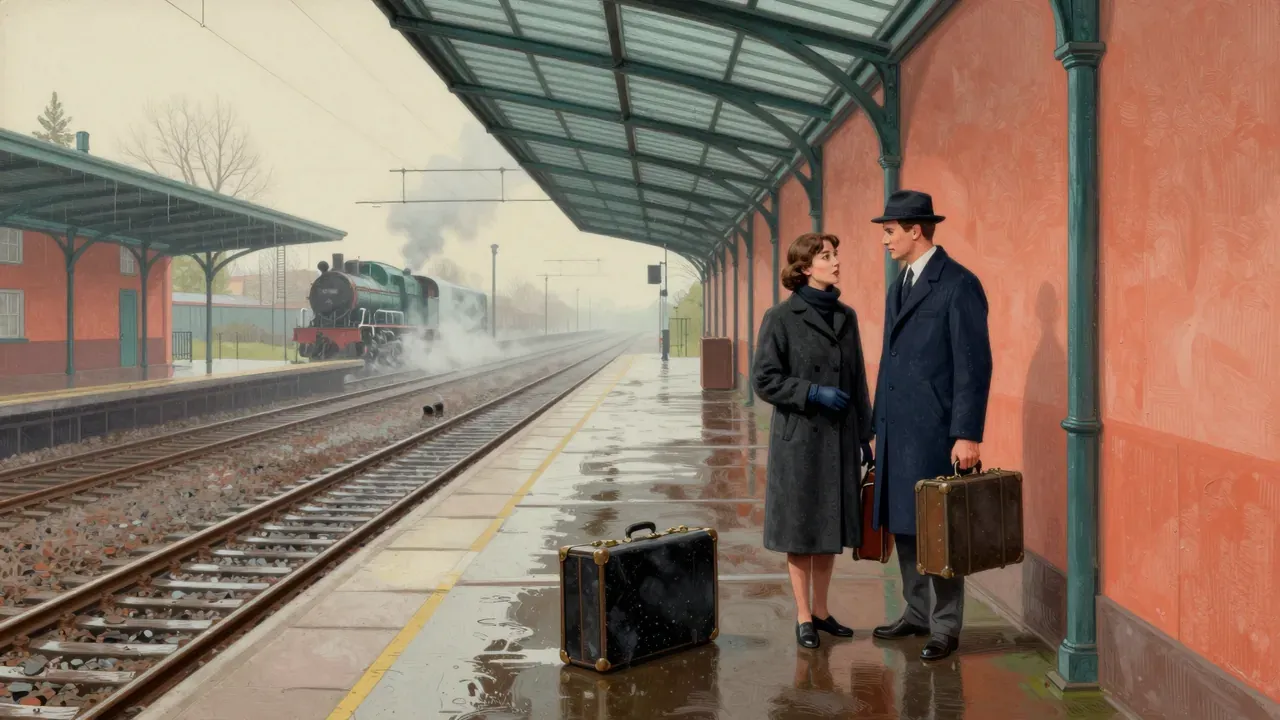
The story unfolds in strict chronological order within a frame: Laura Jesson’s confession to her husband, told as memory after a final parting at Carnforth station. Robert Krasker’s cinematography keeps the railway interiors damp and low-lit, the steam perpetually blurring glass, the refreshment room’s linoleum worn thin by repetition. Celia Johnson and Trevor Howard perform with minimal inflection — their faces register shifts in weight, not expression; their hands tremble only when unobserved. Jack Harris edits with surgical precision: no reaction shot lingers longer than necessary, no cut distracts from the accumulation of small decisions. The Rachmaninoff concerto recurs not as commentary but as physiological pulse — rising when Laura’s breath catches, falling when she forces calm. Dialogue avoids exposition; motivations are implied through hesitation, through what is left unsaid when Dolly Messiter interrupts or Fred Jesson offers tea. Even the country bridge at Dungeon Ghyll feels less like location than emotional topography — a place where time slows just enough for honesty to surface, then recedes.
What holds
What lands is the sheer, unembellished credibility of the central relationship. Laura and Alec never kiss with passion, never speak of forever, never even touch beyond a shoulder squeeze at the platform edge — yet their connection reads as absolute. This works because the film refuses to flatter them: Johnson’s Laura is neither radiant nor tragic, just tired and attentive; Howard’s Alec is earnest but unremarkable, his charm lying in his willingness to listen. The railway setting grounds everything — the hiss of steam, the clatter of luggage, the public anonymity of shared waiting — makes their privacy feel earned, not illicit. The repeated use of Carnforth’s real signage (Leeds, Lancaster) does not jar; it anchors the fiction in lived geography. Even the Keats quotation functions not as literary ornament but as a quiet admission of vulnerability — a man reaching for words he cannot quite own. The film’s emotional logic holds because every beat obeys the same rule: nothing is heightened unless it is first contained. When Laura nearly steps onto the tracks, it follows three hours of walking, not a single tear — and that is why it lands.
Where it thins
What does not land is the framing device’s second layer: Fred Jesson’s quiet, ambiguous awareness of Laura’s distress. The script implies he may suspect, but gives him no line, no glance, no action that confirms it — leaving his final ‘thank you for coming back’ suspended between tenderness and irony. Without clearer calibration, the moment risks sentimentality rather than ambiguity. Similarly, the supporting characters — Stanley Holloway’s Albert, Joyce Carey’s Dolly — remain firmly functional: they exist to enable or interrupt, not to complicate. Their warmth feels theatrical rather than lived-in, especially beside Laura’s internal austerity. The film also leans heavily on period-specific social codes — the impossibility of divorce, the weight of reputation — which modern viewers may register as historical distance rather than moral pressure. And while the Rachmaninoff score is integral, its recurrence begins to function less as emotional rhythm and more as sonic punctuation, occasionally flattening the very subtlety it was meant to underscore. These are not flaws in execution, but limits of scope: the film chooses intimacy over complexity, and some edges inevitably blur.
What it’s really about
The themes that matter are loyalty as inertia, love as interruption, and decency as discipline. It treats marriage not as romance’s antithesis but as its slow, daily counterpart — a structure built of habit, duty and quiet reciprocity, against which passion appears sudden and unsustainable. The film locates morality not in rules but in consequence: Laura’s anguish stems not from guilt about infidelity but from the realisation that acting on desire would unravel not just her marriage, but her sense of self. Time is another theme, rendered physically — in train schedules, in Thursday matinées, in the way a single afternoon stretches under unspoken tension. The railway itself becomes a metaphor for inevitability: platforms are thresholds, not destinations; departures are foregone conclusions. Even the poem Laura and Alec discuss — Keats on the fear of ceasing to be — reframes their affair not as escape but as confrontation with mortality, with the brevity of feeling, with how little time there is to be truly seen. There is no critique of convention here, only an exacting portrait of what it costs to live inside it.
Who it’s for
This film is for viewers who value precision over propulsion, who find emotional resonance in stillness, and who trust that a single glance across a crowded refreshment room can carry more weight than a chase sequence. It rewards attention to texture — the grain of Krasker’s film stock, the cadence of Coward’s dialogue, the way Johnson’s fingers tighten around a teaspoon. It is not for those who require narrative escalation, psychological exposition or moral clarity — anyone expecting catharsis, revelation or resolution will leave unsatisfied. Some critics have argued its restraint borders on repression, particularly in its treatment of class and gender; others find its emotional economy outdated. A viewer who needs motivation spelled out, or whose engagement depends on plot turns, will find it inert. But change the context — remove the wartime setting, flatten the social constraints, add a voiceover explaining Laura’s thoughts — and the film collapses. Its worth depends entirely on accepting its terms: that feeling deeply is not the same as acting freely, and that restraint can be its own form of truth.
Is it worth your evening?
Yes, it is worth your evening — not as diversion, but as calibration. Its 85 minutes ask for sustained attention, not passive consumption; they offer no release, only recognition. You will not leave energised, but possibly quieter, more aware of the weight carried in ordinary choices. It suits viewers who have known longing they could not name, or loyalty they could not abandon, or both at once. Those who prefer stories where emotion is declared, conflict resolved and endings definitive will find it withholding — and they are not wrong. But the film’s power lies precisely in its refusal to yield. To watch it is to sit alongside Laura in that station, hearing the distant whistle, feeling the vibration in the floorboards, knowing the train is coming and nothing will be said. That is not evasion. It is the film’s clearest statement: some truths are held, not spoken. Some farewells happen in silence. Some evenings are worth keeping, not because they end well, but because they end honestly.