The arrival
Zatoichi in Desperation is the fifteenth entry in the twenty-five-film Zatoichi series, and the fourth directed by its star, Shintarō Katsu. It is a period drama set in mid-nineteenth-century Japan, centred on the blind itinerant masseur and swordsman Zatoichi as he intervenes in a provincial town’s power struggle between a corrupt magistrate, a gang of extortionists, and a family of indebted farmers. The film attempts to narrow the scope of the series: less spectacle, fewer duels, more sustained attention to moral exhaustion and quiet complicity. It does not seek to reinvent the character but to test his endurance—not of violence, but of witnessing. The script by Minoru Inuzuka avoids myth-making; Zatoichi speaks little, acts late, and his interventions are neither triumphant nor cleanly redemptive. There is no tournament, no rival swordsman with a matching philosophy, no musical interlude. What it tries to do is hold still long enough for the weight of silence, debt, and deferred justice to settle—not as backdrop, but as substance.
What is left unsaid
The story unfolds across three days in a single rural district, its structure built around withheld information: who killed the farmer’s son, why the magistrate’s ledger is blank, what the blind man hears that others ignore. Shintarō Katsu’s performance is restrained—his Zatoichi moves with habitual economy, his voice low and uninflected, his pauses weighted not with menace but fatigue. Kiwako Taichi, as the farmer’s daughter, carries much of the emotional texture: her grief is internalised, her resistance passive until it is not. The cinematography avoids flourish: compositions are often frontal and shallow, interiors lit with flat, even tones, daylight diffused through paper screens. Editing is unhurried—scenes linger past narrative necessity, particularly those involving waiting, washing, or counting rice. Sound design privileges ambient noise over score: wind in bamboo, the scrape of sandals on packed earth, the hollow tap of Zatoichi’s cane on stone. There is no music until the final five minutes, and then only a single shamisen phrase, repeated twice, unresolved.
The weight of action
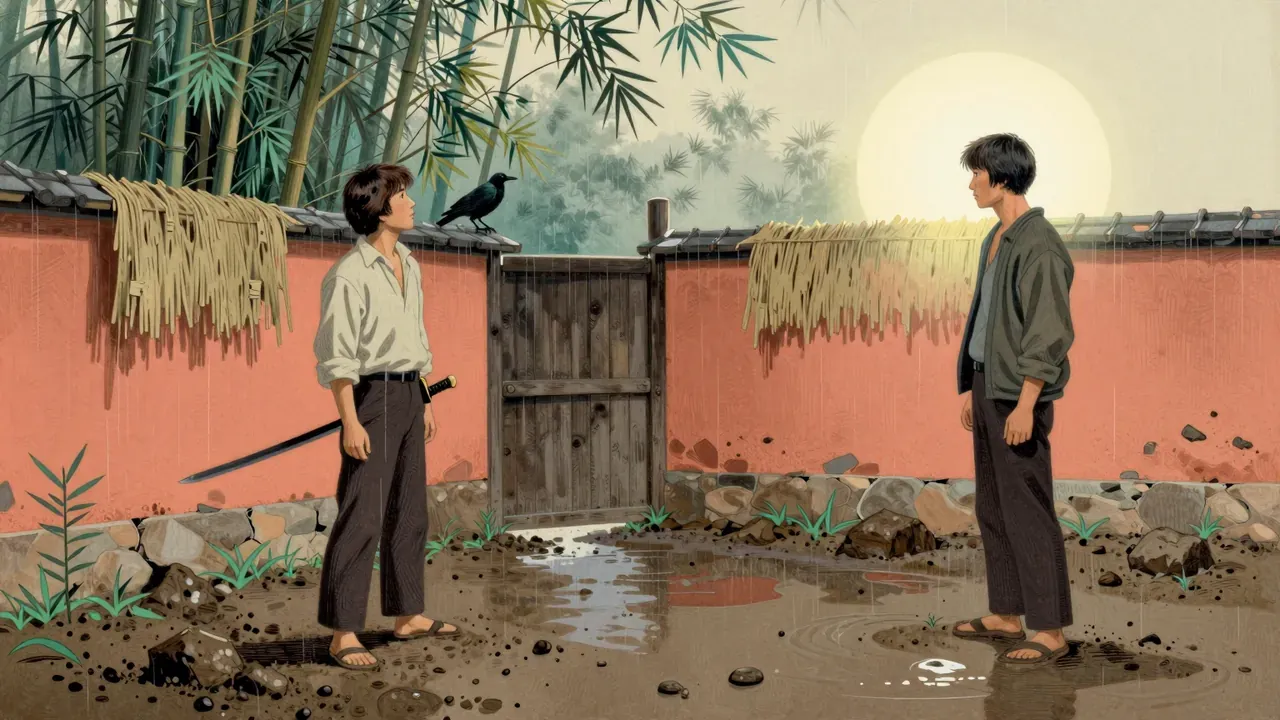
What lands is the cumulative pressure of small betrayals—the magistrate’s clerk who looks away when asked to sign, the innkeeper who serves tea to both sides without comment, the way Zatoichi’s cane hesitates before stepping into a puddle that reflects a man watching him from a window. These moments accrue because the film refuses to name them as significant. The physicality of blindness is rendered without metaphor: Zatoichi navigates by echo and scent, misreads distance, mistakes a child’s laugh for a bird’s call. His swordplay, when it comes, is brief, functional, and followed by silence—not applause, not music, not even a cutaway. The film’s restraint works because it is consistent: no sudden close-ups, no dramatic zooms, no flashbacks to explain motivation. Even the violence feels procedural, almost administrative. This consistency allows the viewer to register how rarely anyone in the film chooses outright evil—and how often they choose silence instead. That distinction holds up under scrutiny, and it is where the film earns its gravity.
The ledgers
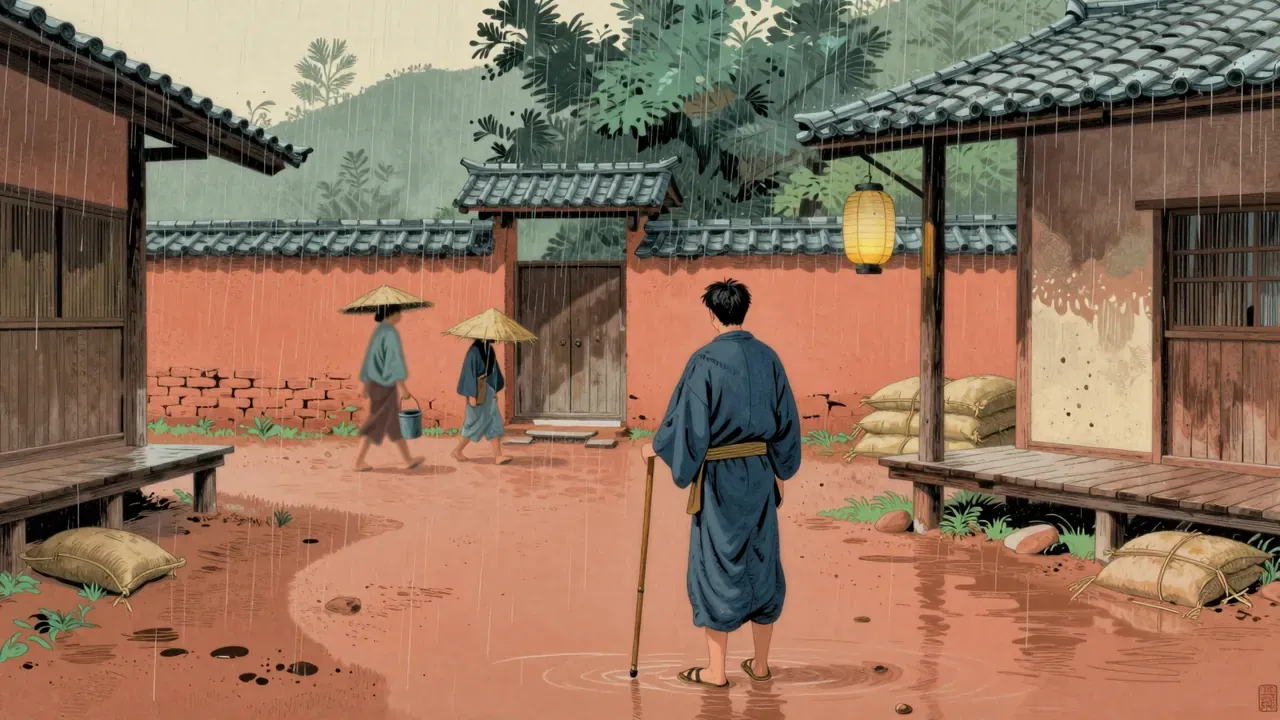
What does not land is the structural reliance on narrative ellipsis as moral ambiguity. Several key relationships—between the magistrate and his aide, between the gang leader and the farmer’s widow—are sketched but never deepened, leaving motivations opaque rather than suggestive. A subplot involving forged tax receipts dissolves without consequence, its implications unexamined. The film assumes familiarity with Zatoichi’s code, but offers no anchor for viewers new to the series: there is no exposition of his past, no reference to earlier films, no explanation of why he remains in this town beyond inertia. The pacing, while deliberate, becomes indistinguishable from stasis in two extended sequences—one in a rain-soaked courtyard, another in a shuttered storehouse—where nothing changes except light. These passages do not build tension; they dilute it. A viewer expecting the series’ customary rhythm of repose-and-release may find the film’s refusal to pivot feels less like austerity and more like omission.
What justice looks like
The themes that matter are debt—not only financial, but the debt of witness, of memory, of unspoken obligation. Zatoichi is not repaying a favour; he is settling an account he did not open. The film treats justice not as restoration but as subtraction: removing one corrupt official does not restore the harvest, nor return the dead. Ageing is present not as decline but as recalibration—Zatoichi’s body remembers sword forms his mind no longer rehearses, and his hesitation is not fear but recalibration of risk. Class operates without rhetoric: the magistrate’s robes are cleaner than the farmer’s, but both men measure rice in the same wooden scoop; the difference is in whose hand holds the scale. There is no utopian vision here, no suggestion that fairness can be institutionalised—only the repeated, quiet act of choosing where to stand, even when standing changes nothing. These are not abstract ideas; they are embedded in posture, in the length of a pause, in who pours the tea and who receives it first.
Who walks with him
This film is for viewers who value narrative patience over momentum, who find resonance in understatement, and who have either seen at least three earlier Zatoichi films or are prepared to accept Zatoichi as a given—a figure whose ethics need no exposition. It is not for those who rely on plot propulsion, clear antagonists, or cathartic resolution. Someone who values tight cause-and-effect storytelling, or who expects genre conventions to be honoured—even subverted with wit or energy—will likely find the film inert. A viewer who dislikes long takes or ambient sound will feel adrift. But the verdict shifts if watched as part of the full series: then the slowness reads as accumulation, not absence. Without that context, the film asks more of its audience than it gives back—yet that imbalance is itself a thematic choice, not a failure.
The road ahead
It is worth your evening if you are prepared to sit with unresolved tension and accept that some endings are not conclusions but continuations—of rain, of debt, of silence. It rewards attention to gesture over dialogue, to duration over event. Someone who watches primarily for entertainment, for clarity, or for emotional release will leave unsatisfied; the film offers none of those as gifts—it requires them to be earned through sustained observation. Its value lies in how it refuses to flatter the viewer’s desire for closure. That refusal is deliberate, coherent, and rare in mainstream Japanese cinema of the early 1970s. It is not a film to love easily, but one that stays with you precisely because it resists being loved. Whether it is worth your time depends not on its quality—which is consistent and controlled—but on whether you want to spend ninety-five minutes inside a world where justice is measured in inches, not miles, and where the most dangerous thing a man can do is stop walking.