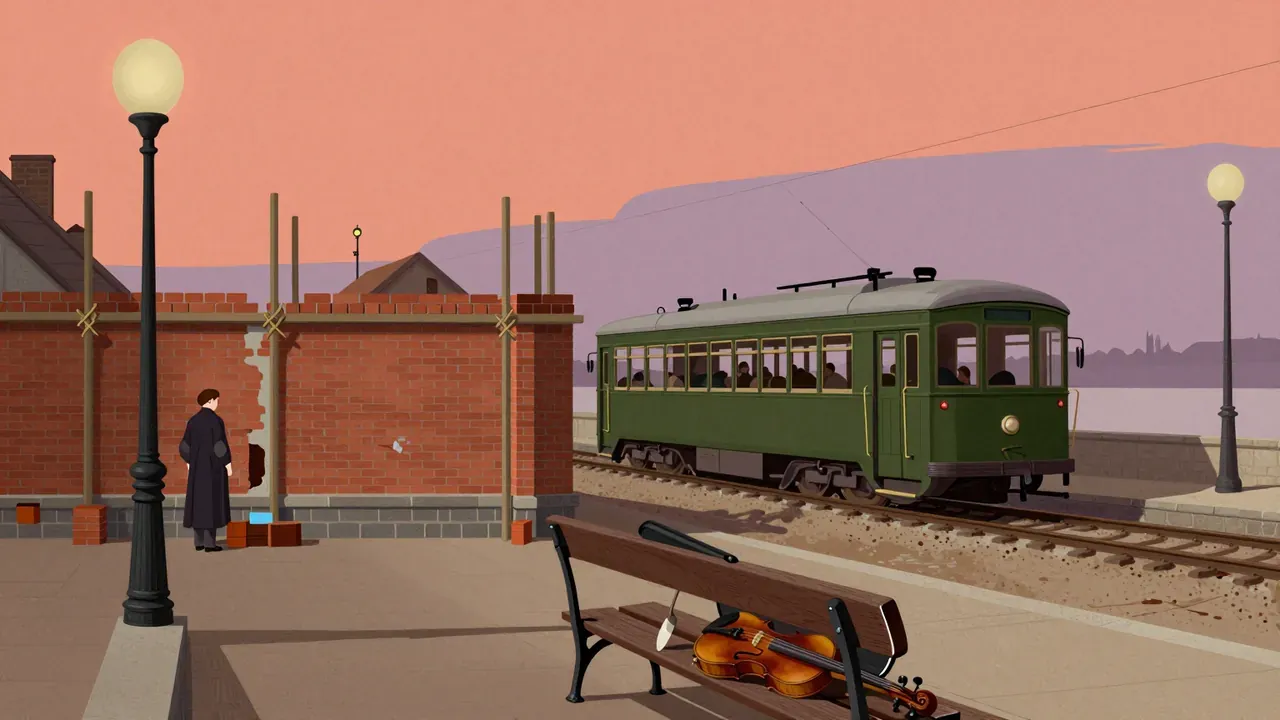
The leaving
Two Girls on the Street is a Hungarian studio comedy from 1939, directed by André de Toth in his first feature assignment. It sets out to trace parallel paths of two young women — one a violinist, the other a bricklayer — as they leave their provincial village for Budapest, seeking work, independence, and romantic possibility. The film works within the conventions of popular interwar Central European light drama: episodic structure, modest production scale, dialogue-driven scenes, and a tone that balances gentle satire with earnestness about female aspiration. Its ambitions are local and immediate: to amuse, to reflect urban transition in late-Hungarian monarchy society, and to affirm resilience without sentimentality. It does not attempt social realism or formal innovation, nor does it position itself as political critique; its frame is domestic, occupational, and relational. The script adapts a stage play by Tamás Emöd and Rezsö Török, retaining theatrical pacing but opening up space for street-level observation of Budapest’s architecture and rhythms. At its core, it is a modestly scaled portrait of mobility — geographic, economic, gendered — at a moment just before Europe’s rupture.
The work
The story unfolds through contrast: the musician’s world of rehearsal rooms and concert halls versus the bricklayer’s scaffolding and building sites, both rendered with functional specificity. Performances are grounded, neither broad nor stylised — the leads carry quiet determination rather than comic exaggeration. De Toth’s direction favours medium shots and fluid continuity, avoiding flourish but sustaining clarity across shifts in location and mood. Lighting is naturalistic for the era, with interiors lit to suggest lived-in spaces rather than theatrical sets. Editing is unobtrusive, matching the tempo of everyday life — pauses linger, conversations overlap slightly, exits feel unscripted. The score, though not credited in the fact sheet, functions as punctuation rather than commentary: brief motifs accompany transitions, never swelling to underscore emotion. Costume and set design anchor the film in late-1930s Budapest — tram lines, café awnings, workshop tools — without fetishising period detail. There is no voiceover, no symbolic framing, no visual metaphor; the craft serves narrative transparency, not authorial emphasis.
The city
What lands is the film’s quiet fidelity to its characters’ ordinary stakes. The bricklayer’s pride in mastering a new technique, the musician’s frustration with an unresponsive instrument, their shared exhaustion after long days — these register because they are shown, not declared. The humour arises from situational friction: miscommunications between tradespeople and artists, generational gaps in advice-giving, bureaucratic hurdles in housing applications. Budapest itself lands as a presence — not picturesque, but textured: the sound of hammers on iron girders, the smell of wet plaster implied by damp walls, the rhythm of trams passing under bridges. The restoration preserves this tactility: grain is visible but unintrusive, contrast balanced so that shadowed stairwells retain detail without flattening. The film’s modesty becomes its strength — it refuses to overstate, and in doing so earns trust. Its emotional register stays low, but consistent; when the two women sit together on a park bench at dusk, silent and tired, it feels earned, not sentimental.
The bond
What does not land is any sustained tension around the women’s ambitions. Their goals remain vague — ‘a proper job’, ‘a real performance’ — and the obstacles they face lack structural weight. No employer questions the bricklayer’s gender directly; no conductor dismisses the violinist for her origins. Conflict arrives as minor misunderstandings or coincidental delays, never as systemic resistance. The romantic subplots resolve with improbable ease, relying on chance encounters rather than character-driven choice. The film also struggles to integrate its two protagonists’ worlds: their friendship anchors the narrative, but their professional spheres rarely intersect meaningfully — there is no shared project, no mutual learning, no friction that reshapes either woman’s understanding of her own work. The play adaptation shows in places: some scenes pivot on exposition that would read clearly on stage but feels static on screen, particularly courtroom and office sequences where blocking is tight and camera movement minimal. The result is a film that feels honest in texture but thin in consequence.
The jokes
The themes that matter are vocational dignity and urban belonging. The bricklayer’s hands are shown handling trowels, mixing mortar, measuring walls — each action treated with the same attention as the violinist’s finger placement or bow pressure. Neither profession is framed as aspirational or provisional; both are presented as legitimate claims to identity and income. The city is not a backdrop but an active condition: its transport networks enable mobility, its housing shortages create shared predicaments, its cafés and parks become neutral ground where class and training temporarily recede. The film treats friendship as infrastructure — not decorative, but practical, reciprocal, and resilient across setbacks. There is no grand statement about gender, but the simple fact of two women navigating male-dominated workplaces without apology or explanation carries quiet force. Ambition here is not heroic but iterative: small decisions, repeated — showing up, asking questions, correcting mistakes. The film’s moral centre lies in persistence as routine, not triumph as climax.
The stakes
This film is for viewers who value understated craft over narrative velocity, who find interest in how people move through cities and occupations, and who appreciate mid-century Central European cinema outside the canon of expressionism or exile. It suits those comfortable with subtlety in performance and willing to sit with unemphatic endings. It is not for viewers who require clear antagonists, escalating stakes, or psychological revelation — the film offers no inner monologues, no flashbacks, no dramatic reversals. Those expecting satire with bite or social critique with teeth will find its tone too even, its conflicts too muted. A viewer who values thematic density over atmosphere, or who reads every scene for subtext, may leave underwhelmed. Its appeal rests on patience with the ordinary — and that patience is not universally shared. Without that baseline, the film’s restraint reads as omission, not discipline.
The print
Yes, it is worth your evening — provided you approach it as a document of tone and texture, not plot or revelation. Its seventy-nine minutes pass without strain, anchored by credible performances and a coherent sense of place. You gain nothing urgent or transformative, but you do absorb something rare: a pre-war Hungarian perspective on work, gender, and urban life, preserved intact and restored with care. It rewards attention to detail — how light falls on a brick wall, how a violin case is carried, how two women share a single pastry without speaking — and those details accumulate into quiet coherence. Someone who watches only for narrative payoff or thematic argument may feel short-changed; but someone open to the weight of small choices, the rhythm of daily labour, and the unspoken solidarity of shared struggle will find it quietly resonant. Its value lies not in what it declares, but in what it observes — and that observation remains precise, humane, and unhurried.