What it is
Merrily We Go to Hell is a pre-Code Paramount drama that tests the limits of marital reciprocity under social and physiological strain. It does not aim to resolve its central conflict with moral clarity but to hold up a mirror to the asymmetry of consequence in a marriage where one partner’s self-destruction is treated as temperament, the other’s retaliation as scandal. Dorothy Arzner frames this not as farce nor tragedy alone, but as a tightly wound social experiment: what happens when fidelity is declared optional by one party only after the other has already forfeited it? The film adapts Cleo Lucas’s novel with deliberate fidelity to its structural irony — Joan’s ‘modern marriage’ vow arrives only after Jerry has made his own surrender to Claire irreversible. Its ambition is formal and ethical: to let the camera linger on Sylvia Sidney’s face as she absorbs each betrayal, while keeping Fredric March’s drunkenness physically unglamorous, never picturesque. It tries, and largely succeeds, to make the audience feel the weight of silence between lines more than the punch of dialogue.
How it works
The story moves with calibrated momentum: courtship, collapse, counter-strike, crisis, and quiet reconciliation — all within eighty-eight minutes. Fredric March plays Jerry Corbett with a restless physicality that avoids caricature; his intoxication is conveyed through slumped posture and delayed reactions, not slapstick or shouting. Sylvia Sidney’s Joan is quieter but never passive — her stillness reads as calculation, then exhaustion, then resolve. David Abel’s cinematography keeps interiors dim but legible, favouring medium shots that frame both characters in shared space even as they drift apart. Arzner uses staging to underline imbalance: Jerry often enters a room first, Joan waits; he speaks over her, she pauses before answering. Cary Grant appears briefly as a suave foil, his presence underscoring the film’s awareness of performance — how men are cast as flawed artists, women as loyal audiences. The editing avoids flourish, trusting rhythm and pause. There are no musical cues to signal emotion; the score, if any, is absent from the record, and the film proceeds without it.
What lands
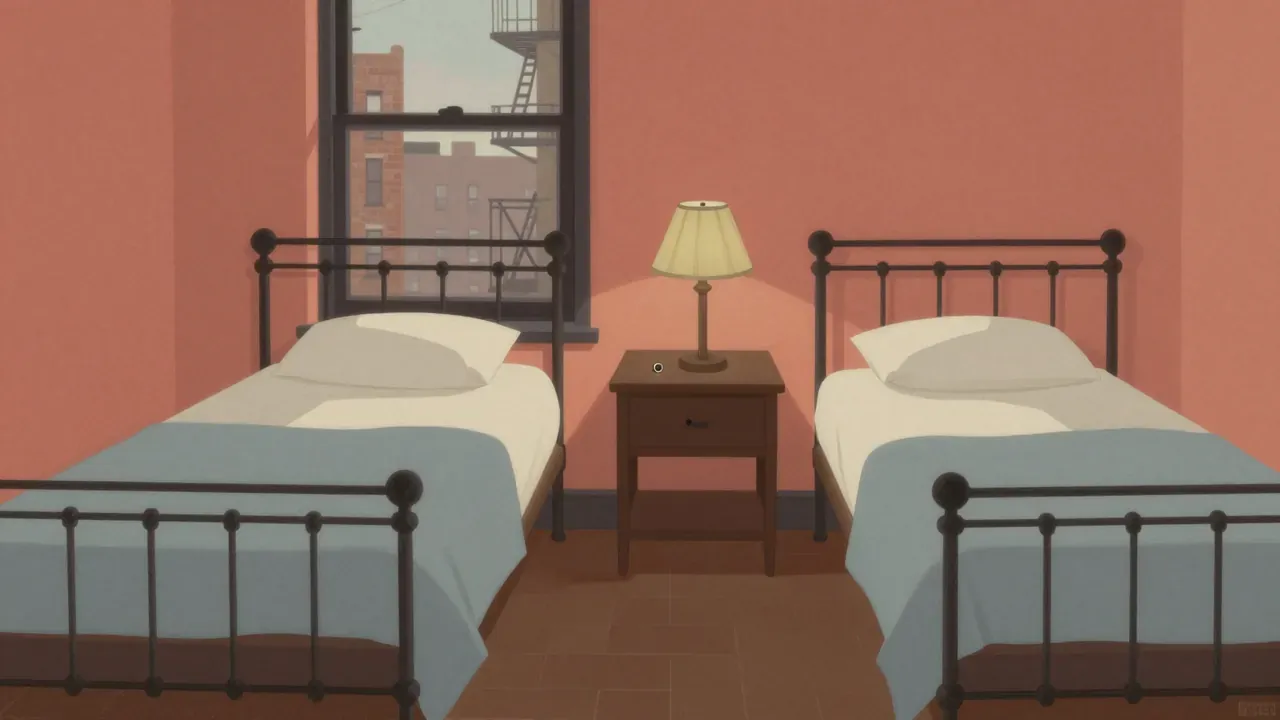
What lands most firmly is the film’s refusal to flatter its male lead. Jerry’s charm is never allowed to excuse his negligence, and March’s performance ensures that his remorse feels earned only because his earlier indifference was so thoroughly shown. The hospital climax works not because it offers redemption, but because it reasserts Joan’s agency: her plea for Jerry is not submission, but the last assertion of a voice previously muted by decorum. The toast sequences — Jerry’s ‘Merrily we go to hell’, Joan’s brittle reply about ‘twin beds and triple bromides’ — land with dry precision, their irony sharpened by delivery and framing rather than exposition. Arzner’s direction sustains tonal control across shifts in register: the Chicago scenes feel grounded and slightly grimy, New York more theatrical but no less consequential. Even minor roles — Esther Howard’s pragmatic nurse, George Irving’s stern father — avoid stereotype, functioning as calibrated pressure points in the emotional architecture. The film’s pacing gives each betrayal time to settle before the next arrives, making the cumulative effect less sensational than sobering.
What does not
What does not land is the script’s occasional retreat into theatrical exposition, particularly in Jerry’s monologues about his creative struggles, which lack the specificity needed to ground his frustration. Some transitions feel abrupt — Joan’s decision to begin an affair follows too closely on her eviction of Jerry, giving insufficient space for her interior shift. The pregnancy subplot arrives late and is resolved off-screen except for its emotional fallout, weakening its narrative weight. Richard ‘Skeets’ Gallagher’s character serves little function beyond reinforcing Jerry’s circle of enabling peers, and his presence dilutes focus without adding thematic resonance. The film also struggles with tone in its final stretch: the hospital reunion risks sentimentality, though Sidney’s restrained delivery pulls it back from melodrama. Contemporary reviewers noted the unevenness of March’s intoxicated scenes — not because they are badly acted, but because the writing fails to anchor them in psychological cause, leaving them feeling like isolated set-pieces rather than part of a sustained arc.
The stakes of marriage
The themes that matter are not love or infidelity in the abstract, but the gendered distribution of consequence in marriage: how Joan’s suffering is medicalised (her poor health, the baby’s death), while Jerry’s is aestheticised (his failed plays, his public humiliations). Addiction here is not framed as pathology but as privilege — Jerry drinks because he can, and because no institution holds him to account until Joan withdraws her consent. The film treats ‘modernity’ as a hollow term when applied to relationships: Joan’s proposal of a ‘modern marriage’ is met with Jerry’s continued absence, revealing the asymmetry in who gets to define terms. Arzner’s irony lies in showing how both characters perform — Jerry as the tortured artist, Joan as the stoic wife — until performance collapses under real stakes. The title itself functions as thematic shorthand: a toast that doubles as surrender, a joke that masks despair, a phrase that circulates freely among men but costs women their health, autonomy, and voice.
Who should watch it
This film is for viewers who value precise, unsentimental direction and performances that withhold rather than declare. It rewards attention to gesture, silence, and spatial composition — those attuned to Arzner’s economy of means will find it richly layered. It is not for those seeking narrative closure or moral resolution; the ending offers reconciliation but no guarantee, no lesson, no uplift. Viewers expecting Cary Grant to carry the film will be disappointed — his role is brief and functional. Those who require clear authorial judgment on the characters’ behaviour may find the film’s detachment frustrating. A viewer who prefers exposition over implication, or who expects addiction narratives to follow clinical or redemptive arcs, will likely feel distanced rather than engaged. The film assumes familiarity with pre-Code conventions — its restraint only reads as strength if you recognise what it is choosing not to show.
Is it worth your evening
Yes, it is worth your evening — not as light diversion, but as a compact, controlled study in relational asymmetry. Its eighty-eight minutes pass without slack, and its emotional logic remains coherent even where its plot mechanics falter. You will not leave entertained, but unsettled in a productive way: aware of how much the film trusts you to read between lines, and how little it explains. Those who dismiss it as dated or didactic have likely missed Arzner’s method — her detachment is not neutrality, but calibration. A viewer who values Sidney’s performance above March’s, or who finds power in understatement over declaration, will consider it time well spent. It would fail the test only for someone needing affirmation, catharsis, or clear moral signposting — but those are not its aims. Its worth lies in its rigour, not its comfort.