The day before
I Wanna Hold Your Hand is a tightly wound, single-day comedy set in New York City on the morning of 9 February 1964, built around the Beatles’ first live US television appearance. It does not dramatise the band’s performance or show them performing — they remain off-screen throughout — but instead tracks six teenagers from New Jersey as they converge on the Plaza Hotel and Ed Sullivan Theatre, each pursuing access, proof, or personal rebellion. The film aims to reconstruct Beatlemania not as spectacle but as collective nervous energy: the queuing, the lying, the sprinting, the hiding, the bargaining, the near-misses. Its ambition is historical verisimilitude through farce, using period detail — clothing, radio ads, newspaper headlines, car models — not for nostalgia’s sake but as pressure points that shape behaviour. It treats fandom as social physics: mass, velocity, friction, and sudden acceleration. The script by Robert Zemeckis and Bob Gale treats the event as a cultural singularity, around which ordinary teenage motives — romance, status, autonomy, curiosity — orbit and collide. It is less about the Beatles than about what their presence does to the architecture of authority, consent, and possibility in early-1960s America. (158 words)
The look of it
The story unfolds in parallel threads, intercut with increasing urgency, held together by Donald M. Morgan’s crisp, mobile camerawork — tracking shots down hotel corridors, low-angle pushes into elevator doors, handheld scrambles across pavement. Performances are pitched at a heightened but grounded register: Nancy Allen’s Janis anchors the film with dry watchfulness, Bobby Di Cicco’s Larry offers hangdog sincerity, Theresa Saldana’s Grace commits fully to escalating absurdity without tipping into caricature. Wendie Jo Sperber’s Pam and Eddie Deezen’s Tony provide tonal counterweights — one earnestly adrift, the other ideologically rigid — while Marc McClure’s Peter gives the film its quietest emotional pivot. Frank Morriss’s editing sustains momentum without smoothing over narrative gaps; scenes end mid-breath, often on a cutaway or a slammed door. The Beatles’ music functions diegetically and structurally: heard from radios, jukeboxes, and passing cars, it pulses beneath action rather than scoring it. There is no orchestral underscore — only source sound and silence, which makes the moments when a song swells feel earned, not imposed. The production design avoids pastiche, favouring functional authenticity: wallpaper patterns, cigarette brands, typewriter fonts, all sourced to early 1964. (159 words)
The rhythm of it
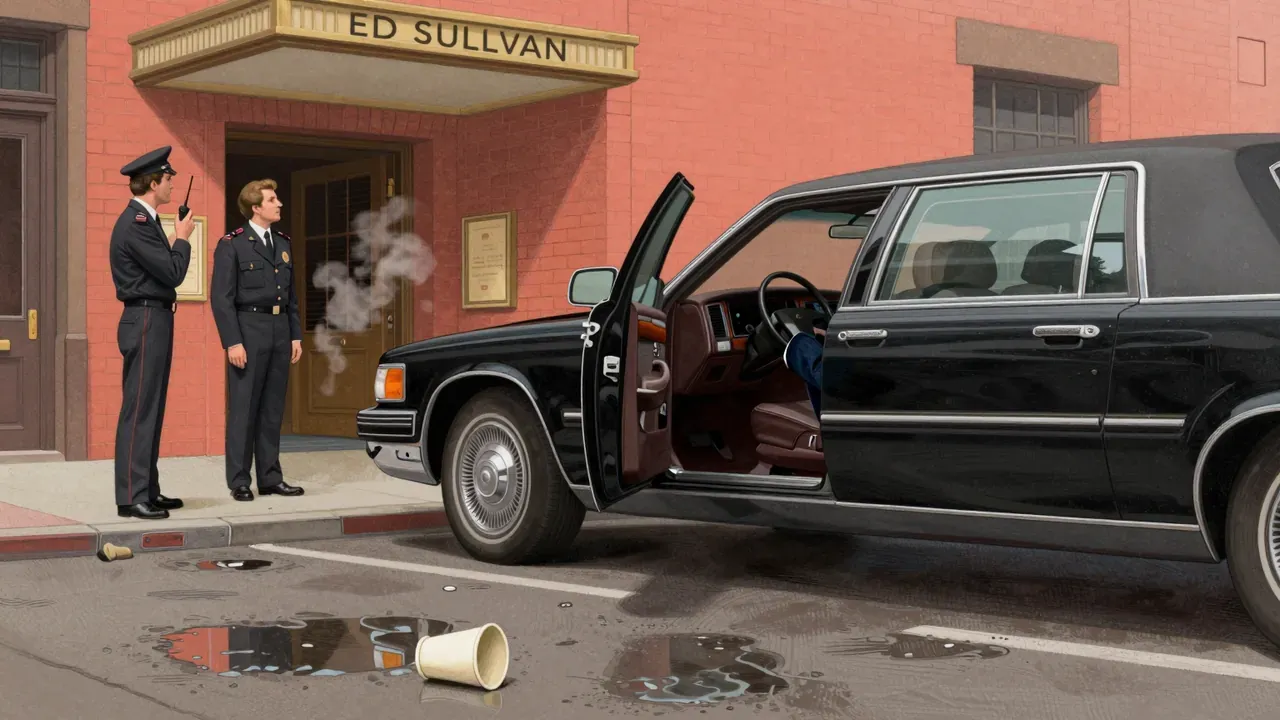
What lands is the texture of collective anticipation — the way a crowd’s mood shifts from hopeful to frantic to resigned in under ten minutes, how a lie told to a security guard echoes three scenes later in a different voice, how a limousine becomes both status symbol and prison cell. The film’s best sequences rely on physical logic: Pam hiding in a food cart, Grace negotiating with a sex worker’s client, Tony climbing the transmitter tower — each works because the stakes are clear, the obstacles tangible, and the consequences immediate. The humour arises from character-driven escalation, not setup-punchline rhythm: Larry’s drunkenness isn’t played for gags but for its real-world consequence — he stumbles into violence just as he stumbles into heroism. The absence of the Beatles never feels like a gimmick because the film replaces them with something more durable: the mechanics of belief. When fans chant outside the Plaza, it is not devotion to four men but to the idea that something irreversible is happening — and that they must be inside the room where it begins. That conviction carries the film, even when plot contrivances strain. The final image — the Beatles accidentally boarding the limo — lands precisely because it arrives unannounced, uncelebrated, and utterly matter-of-fact. (157 words)
The logic of it
What does not land is the structural slack in the first thirty minutes: exposition is parcelled out in overlapping voiceover and clunky exposition scenes that slow the film’s pulse before it has found its rhythm. Some characters — particularly Dick Miller’s cameo as a hotel manager — exist only to be outwitted, their authority hollowed out for comic effect without psychological weight. The subplot involving Tony’s sabotage attempt lacks grounding: his anti-Beatles ideology is stated but never developed beyond adolescent contrarianism, making his rooftop climax feel arbitrary rather than inevitable. Similarly, the resolution of Grace’s blackmail scheme hinges on a man’s sudden, unmotivated capitulation — a narrative convenience that undermines the film’s otherwise careful cause-and-effect logic. The film also struggles with tonal consistency: moments of genuine anxiety — Pam’s claustrophobia in the basement closet, Janis’s quiet confrontation with her own resistance to change — are followed too quickly by broad slapstick, leaving little room for emotional resonance to settle. The editing, though generally propulsive, occasionally sacrifices clarity for pace: a key transition between the hotel and theatre is disorienting, not dynamic. These are not fatal flaws, but they do create pockets of drift in an otherwise tightly coiled film. (159 words)
The rules of it
The themes that matter are not generational conflict or musical taste but access, agency, and the architecture of permission. The film treats 1964 America as a series of locked doors — hotel lobbies, theatre wings, radio studios, even parental expectations — each guarded by someone who controls entry. Teenagers do not rebel against authority so much as they learn its grammar: how to mimic credentials, exploit loopholes, impersonate legitimacy, and time their breaches. Janis’s arc is not about converting to Beatlemania but about choosing to act within its logic — helping Peter get in not because she loves the band but because she recognises the cost of exclusion. Grace’s photos are not trophies but evidence of passage; Pam’s departure from her fiancé is not rejection of marriage but refusal of a life pre-approved. Even Tony’s sabotage is less ideological than procedural: he wants to stop the broadcast not because he hates the Beatles but because he cannot tolerate being excluded from the mechanism that decides what matters. The film’s quietest theme is the dignity of minor victories — a shared ticket, a snapped photo, a ride home — none of which change history but all of which alter a life. (158 words)
The feeling of it
This film rewards viewers who value craft over catharsis, structure over sentiment, and period specificity over period glamour. It suits those who find pleasure in watching how a story’s gears mesh — the way a stolen limo key enables a blackmail scheme that funds a bribe that secures a backstage pass — rather than in watching characters ‘grow’. It will frustrate anyone expecting emotional arcs with clean resolutions or a soundtrack that swells at the right moment. Those who require the Beatles to appear on screen, or who read teen films as allegories of liberation rather than studies in constraint, will find its restraint alienating. A viewer who values Janet Maslin’s observation that the film’s genius lies in its evasion of the band may well love it; one who shares Kevin Thomas’s view that it aims too low for its own good may dismiss it as crass. The verdict changes if you accept that the film’s subject is not youth but systems — and that its comedy comes from watching people try, and mostly fail, to bend those systems just enough to let light in. (159 words)
The absence of it
Yes, it is worth your evening — provided you approach it as a precision-engineered farce rather than a sentimental period piece. Its 104 minutes move with the urgency of a countdown, and its pleasures are cumulative: noticing how a costume detail recurs across three scenes, how a line of dialogue reappears in altered form, how the same hallway appears from six different angles. It repays attention not because it hides meaning but because it layers function: every prop, every cut, every background radio bulletin serves the central question — who gets in, and how? It is not for viewers who need closure, catharsis, or confirmation that things worked out. But for those who find satisfaction in watching competence — in writing, editing, timing, performance — operating at a high, unshowy level, it remains unusually sustaining. Those who disliked it on first release often cite its box-office failure as proof of its misfire; yet its cult status rests on the opposite truth — that it was made for a specific kind of attention, one that has grown rarer, not more common, in the decades since. Its value is not retrospective but operational. (159 words)