The world it imagines
Born in Flames is a low-budget, self-produced science fiction film set in an alternate United States ten years after a peaceful socialist-democratic revolution. It is not speculative in the sense of imagining future technology, but in reconfiguring political reality to expose contradictions in gendered, racialised and class-based power. Lizzie Borden constructs this world not as allegory but as documentary-fiction: news broadcasts, street protests, radio transmissions and newspaper edits are all staged yet grounded in real tactics of 1970s–80s feminist, Black liberation and labour organising. The film’s aim is structural diagnosis — to show how state socialism, without intersectional analysis, replicates patriarchy, white supremacy and heteronormativity. It treats ideology as infrastructure: wages for housework, workfare eligibility, media control and police impunity are not background details but active forces shaping women’s lives. Its method is agitprop, not persuasion: it assumes the viewer already knows the stakes, and builds its argument through accumulation — of voices, interruptions, failures and coordinated actions. It does not ask whether change is possible; it shows how it is already being made, unevenly, urgently, and at risk.
The way it tells
The story unfolds across overlapping, loosely connected threads: two pirate radio stations run by women with divergent politics; a newspaper staffed by three editors whose reporting is progressively silenced; a Women’s Army carrying out direct action; and FBI surveillance that tracks them all. Performances are deliberately unpolished — many cast members were activists, musicians or artists (Florynce Kennedy, Adele Bertei, Eric Bogosian) rather than professional actors — and their delivery leans into speech as collective practice rather than individual expression. Cinematography shifts between handheld immediacy and composed static shots, often using available light and real New York locations. Editing is associative and rhythmic: scenes cut on sound or gesture, not narrative logic, and music — from The Staple Singers to The Slits — functions as counterpoint, not underscore. There is no score in the conventional sense; diegetic sound dominates, including radio static, street noise and overlapping dialogue. The film was shot over several years with minimal funding, and that constraint shapes its texture: grain, jump cuts, mismatched exposures and visible splices are not flaws but features of its material honesty.
Where it connects
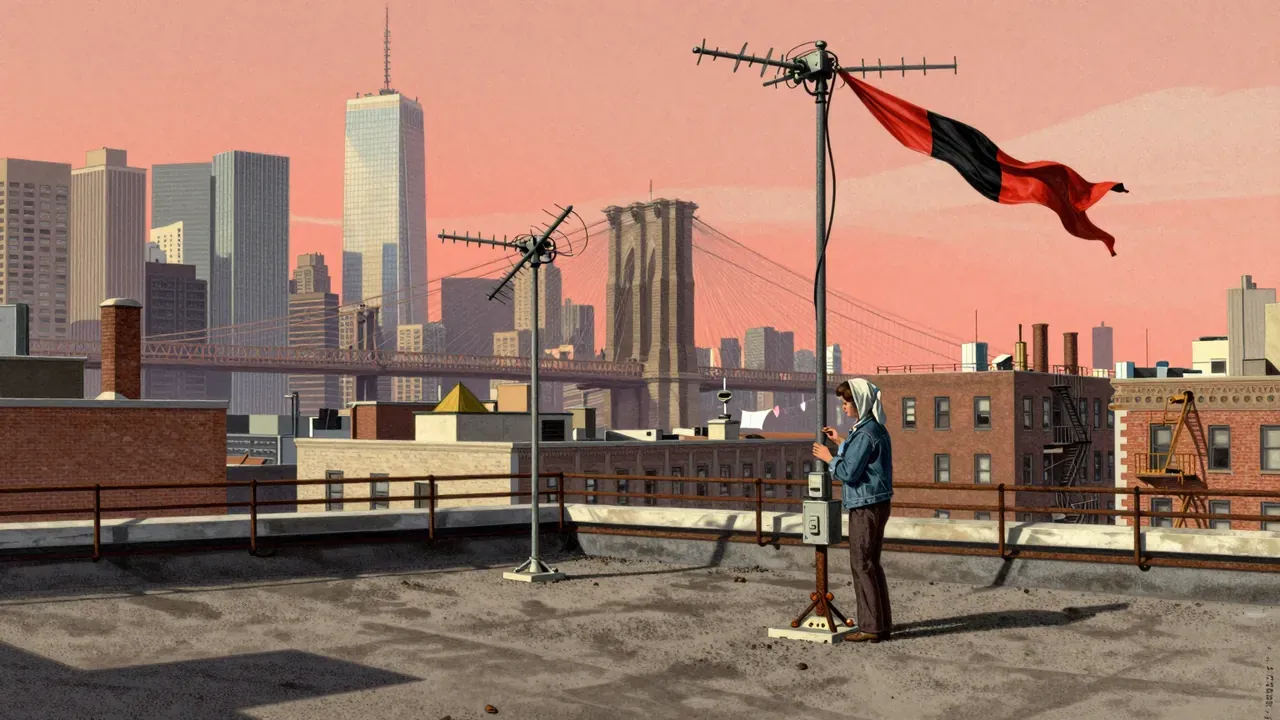
What lands most firmly is the film’s refusal to flatten difference among women. Honey and Isabel do not reconcile; they coordinate. Their radio stations remain distinct in tone and audience even as they merge under duress. The film gives space to disagreement — between Black feminists and white lesbians, between journalists and militants, between theorists and street organisers — without resolving it into harmony. This is rare in political cinema, which often defaults to unity as virtue. Also effective is its use of real-world reference points: the wages-for-housework proposal, the Workfare programme, the Combahee River Collective’s influence — these are not namedropped but dramatised as lived conditions. The bicycle brigade scene, where women swarm to interrupt a street assault, works not as catharsis but as demonstration: organisation is tactical, immediate, and reproducible. The ending — the antenna bombing — avoids triumphalism. It is presented as necessary, risky, and incomplete: one act among many, not a climax but a continuation. The film’s urgency feels earned because its stakes are local, tangible and historically legible.
Where it slips
What does not land is the film’s structural looseness when viewed outside its political frame. Characters like Zella Wylie or Hilary Hurst appear with strong presence but little interiority; their function is ideological, not psychological. This is intentional, but it can read as schematic to viewers unfamiliar with the specific debates the film engages — the distinctions between socialist feminism, Black feminism and lesbian separatism are assumed, not explained. Some scenes — particularly the talk-show segments — feel didactic, their arguments delivered with rhetorical force but limited dramatic tension. The newspaper editors’ arc ends abruptly when they are fired, and their subsequent absence weakens the thread of institutional critique. The FBI agents remain flat, more symbol than character, and their surveillance feels underdeveloped compared to the richness of the women’s networks. The film’s rejection of conventional narrative pacing means it offers few anchor points for viewers who expect cause-and-effect progression or emotional resolution. Its resistance to exposition is a strength, but also a barrier: it demands prior knowledge or willingness to infer meaning from juxtaposition rather than exposition.
What it insists on
The themes that matter are those the film treats as inseparable: the entanglement of race, gender, class and sexuality within state structures. It shows how ‘socialist’ policy can reinforce oppression when designed without input from marginalised women — for example, employment programmes that prioritise ‘male heads of families’, or media regulation that silences radical Black feminist voices while tolerating liberal feminism. The film treats language as terrain: the naming of Adelaide Norris’s death as ‘suspicious’ rather than ‘murder’, the framing of women’s direct action as ‘terrorism’, the co-option of feminist slogans by state broadcasters — all are shown as acts of power. It also foregrounds reproductive labour not as private duty but as political economy: the President’s wages-for-housework proposal is not progressive but a mechanism of containment. And it insists on the materiality of resistance: radio equipment, stolen vans, whistles, posters, bicycles — these are not metaphors but tools. The film’s enduring relevance lies in its refusal to separate theory from practice, or analysis from action.
Who it meets
This film is for viewers who approach cinema as a site of political thought — those familiar with 1970s–80s feminist theory, Black liberation movements, or independent media history, or who are willing to engage with those contexts alongside the film. It rewards attention to texture, sound design and editorial rhythm, not just plot. It is not for viewers seeking narrative cohesion, psychological realism or cinematic polish; those expecting conventional character arcs or resolution will find it frustrating. It is also not for those who require historical distance from political conflict: the film’s urgency is unmediated, its anger unsoftened. Someone who values formal innovation but dislikes overt ideology may admire its craft while resisting its commitments. A viewer who believes political art must persuade the undecided will find its stance too certain, too embedded. What would change the verdict? If the film had been made with access to mainstream resources — better sound recording, longer takes, deeper character development — it might broaden its reach without diluting its politics. As it stands, its constraints are part of its argument.
What it leaves behind
Yes, it is worth your evening — but only if you are prepared to meet it on its terms. It is not relaxing, nor is it designed to be. Its eighty minutes move quickly, but demand active listening and contextual patience. You will not leave with answers, but with sharper questions about how power operates in daily life, and how resistance is built in fragments. Its value lies in its specificity: it names policies, cites movements, uses real locations and real voices. That makes it durable in a way more polished political films are not — it cannot be absorbed into mainstream discourse because it refuses the grammar of that discourse. Those who dismiss it as dated miss how precisely it diagnoses mechanisms still operating today: surveillance of dissent, media gatekeeping, the criminalisation of mutual aid. Its limitations — the uneven performances, the abrupt edits, the didactic stretches — are not failures of skill but consequences of its mode of production and purpose. To watch it is to witness a particular kind of intellectual and aesthetic labour: urgent, under-resourced, and unwavering.