The house as memory
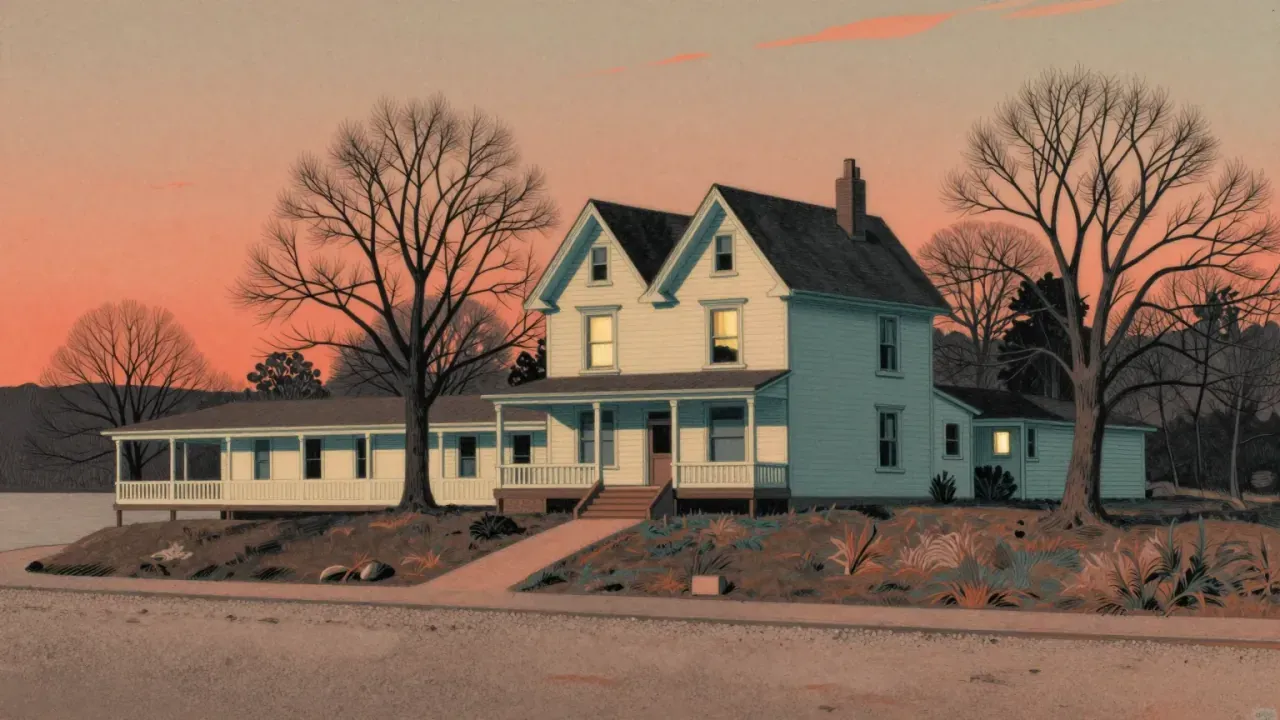
The Uninvited is a 1944 American supernatural horror film that treats hauntings as psychological fact rather than metaphor or camp. It follows a brother and sister who buy a coastal house in Cornwall — though the film was shot near Fort Bragg, California — and encounter disturbances they cannot rationalise: cold spots, disembodied sobs, roses wilting mid-air. Its ambition is quiet conviction: to sustain dread not through shock or gore but through accumulation — of silence, of off-kilter framing, of narrative gaps left deliberately unfilled. It avoids exposition about the rules of its ghostly logic; the haunting feels real because the characters treat it as real, and the film refuses to undercut their certainty with irony or explanation. Dodie Smith’s script, revised by Frank Partos under Charles Brackett’s supervision, anchors the uncanny in domestic detail: tea trays left askew, piano keys depressed without hands, a portrait whose gaze shifts when unobserved. The film belongs to no gothic tradition of crumbling castles or mad baronets; its horror lives in the texture of lived-in rooms and the weight of unspoken grief.
The look of it
Charles Lang’s cinematography keeps interiors dim and layered — walls recede into shadow, doorways hold darkness like reservoirs, and light falls only where it must. Doane Harrison’s editing sustains rhythm without urgency: scenes breathe, pauses linger, and transitions avoid emphasis. Victor Young’s score introduces ‘Stella by Starlight’ as diegetic piano music before weaving it into the underscore, giving the theme emotional weight before it becomes thematic shorthand. Ray Milland grounds the film with understated authority, his performance calibrated to register doubt, then dawning belief, then resolve — all without broad strokes. Gail Russell’s acting is uneven, her line delivery often tentative, yet her physical presence — pale, still, watchful — serves the role’s vulnerability. Ruth Hussey and Donald Crisp lend gravity as figures entangled in the house’s past, while Cornelia Otis Skinner adds brittle wit as a sceptical neighbour. Allen directs with restraint: no camera tricks, no jump cuts, no musical stings — just sustained attention on what lingers just outside the frame.
How it holds its breath
What lands is the film’s tonal consistency: a slow, low-pressure build that makes the first whisper of a voice in an empty room land with physical force. The house itself functions as the most credible character — its layout, its acoustics, its history — and the production design renders it plausibly lived-in and quietly wrong. The ambiguity around Stella’s death and Miss Holloway’s attachment to her remains unresolved, and that refusal to clarify deepens the unease rather than undermining it. The film’s restraint with the supernatural pays off in moments like the repeated image of falling rose petals — simple, repeated, unexplained — which accrue emotional and eerie weight across viewings. Even the radio adaptations that followed confirm how tightly the original’s atmosphere depends on suggestion over spectacle. Critics in 1944 noted this novelty: horror presented not as fantasy but as a condition of perception, one that demands the audience lean in rather than flinch back.
Where the seams show
What does not land is the unevenness in performance texture — particularly Gail Russell’s line readings, which at times break the film’s carefully maintained realism. Her delivery can sound rehearsed, hesitant, or emotionally flattened, and while Allen later described her work as ‘manufactured’, the result is a protagonist whose interiority feels inaccessible rather than fragile. The script’s reliance on exposition in the final act — explaining family history and motive through dialogue rather than implication — dilutes the earlier ambiguity. Some supporting performances verge on caricature: Barbara Everest’s housekeeper speaks in arch, theatrical cadences that clash with the film’s naturalistic grain. The attempt to ground the haunting in psychology occasionally slips into psychologism — reducing the uncanny to repressed guilt or trauma without fully integrating that reading into the visual or sonic language. And though the lesbian subtext surrounding Miss Holloway and Mary is handled with discretion, its suppression leaves emotional contours vague rather than resonant.
What the house remembers
The themes that matter are inheritance — of property, memory, and grief — and the porous boundary between mourning and possession. The house is not haunted by a ghost so much as by the persistence of unresolved feeling: love denied, loss unprocessed, time misaligned. The film treats emotion as architecture — something that shapes space, alters temperature, bends perception. It also explores the limits of rationalism: the brother begins as a man of science, but his certainty erodes not through evidence he cannot refute, but through sensations he cannot ignore — cold air, a scent, a sound that has no source. There is no exorcism, no ritual, no triumph over the supernatural. Resolution comes through acknowledgment, not conquest. The film’s quiet insistence on emotional continuity across generations — Stella’s longing, Mary’s devotion, Miss Holloway’s vigil — suggests that some attachments outlive the bodies that hold them, and that houses, like people, retain the imprint of what was felt within them.
Who it lets in
This film is for viewers who value atmosphere over action, ambiguity over explanation, and sustained mood over plot mechanics. It rewards patience, attention to composition, and tolerance for pacing that mirrors the rhythm of apprehension — slow, deliberate, punctuated by stillness. It suits those familiar with mid-century studio craft, especially Paramount’s restrained approach to genre material. It is not for viewers who require clear stakes, defined antagonists, or narrative closure — the film ends not with answers but with a return to quiet, the haunting absorbed into daily life. Those expecting jump scares, elaborate set pieces, or even conventional suspense will find little here. Nor is it for viewers who dislike ambiguity in motivation or sexuality: the film’s reticence on both counts is structural, not evasive. A viewer who values psychological realism over supernatural logic may find the ending unsatisfying; one who accepts the uncanny as a condition of memory may find it deeply resonant.
Why it stays
Yes, it is worth your evening — provided you watch it on a screen large enough to register Lang’s gradations of shadow, with sound that carries the hush between notes. Its 99 minutes unfold with the weight of a held breath, and its power accumulates cumulatively: the third viewing reveals textures missed the first, the fifth confirms its coherence as a study in emotional residue. It is not ‘entertaining’ in the sense of diversion, but it is absorbing in the way a half-remembered dream is — persistent, elusive, emotionally precise. Those who dismiss it as ‘slow’ mistake deliberation for inertia; those who call it ‘dated’ overlook how its restraint prefigures later art-horror. It would lose its effect if rushed, if scored more insistently, or if its central performances were more technically polished — its imperfections are part of its authenticity. To miss it is to miss a pivot point: the moment American studio horror began treating the unseen not as threat, but as truth.