An heir exiled by his own guilt
The Lion King retells a straightforward succession story as a musical: Simba, heir to Pride Rock, is manipulated into believing he caused his father Mufasa’s death, exiles himself out of guilt, and grows into adulthood before deciding whether to return and challenge the uncle who actually arranged the killing. Roger Allers and Rob Minkoff share directing credit after an unusually long development process; the project passed through several writers and titles, including King of the Jungle, before Irene Mecchi, Jonathan Roberts and Linda Woolverton settled the script that reached production. Producer Don Hahn later described his job as finding the story’s theme once earlier drafts felt unfocused, landing on leaving childhood behind and confronting the world as it actually is.
From nature documentary to Broadway musical
Original director George Scribner envisioned a nature-documentary-style film and left the project once the decision was made to turn it into a full musical with songs by Elton John and Tim Rice, a split that reoriented the whole production toward Broadway-style staging rather than observational realism. Rob Minkoff replaced him in 1992, and Hahn, Allers, Minkoff and story artist Brenda Chapman spent two weeks rewriting the plot with help from Kirk Wise and Gary Trousdale, who had just finished Beauty and the Beast. Studio chairman Michael Eisner pushed for a structure modelled on King Lear, while Jeffrey Katzenberg asked the team to load in as much Hamlet as they could; the writers ultimately found both too forced and looked instead to the stories of Joseph and Moses for Simba’s exile and return.
Katzenberg wanted more Hamlet than the writers would give him
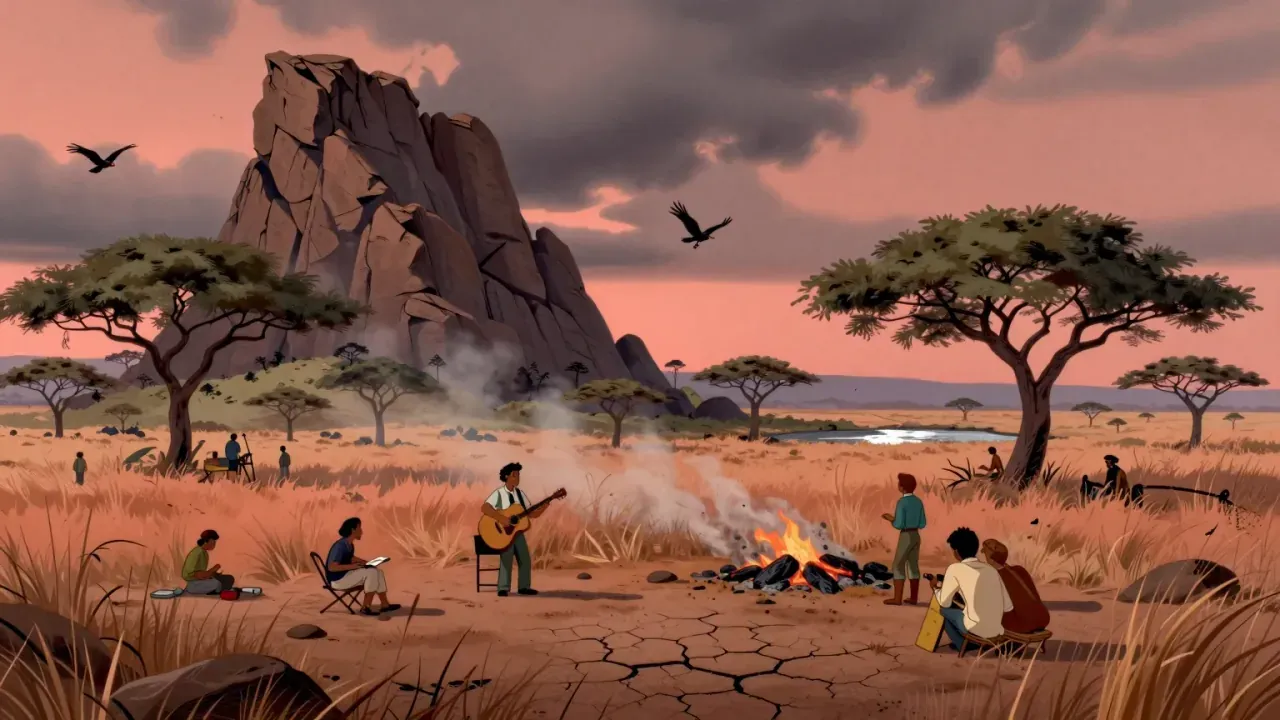
What lands is how directly the film commits to the exile-and-return structure once it settles on one: Mufasa’s death is staged with enough weight that Simba’s subsequent avoidance of home reads as genuine trauma rather than a plot device waiting to be resolved. Hans Zimmer’s score and the John-Rice songs carry scenes that would otherwise rely on dialogue to establish stakes, particularly around Mufasa’s ghost, an idea the crew added specifically during the two-week rewrite to give Simba a clear push back toward Pride Rock. The research trip to Kenya’s Hell’s Gate National Park shows up in specific, observed detail in the landscape and animal movement, giving the film’s Africa a texture that generic safari imagery usually lacks.
A ghost, a rewrite, and a title that finally matched the setting
What doesn’t land as cleanly is Scar himself, whose motivation for wanting the throne is mostly asserted through his own bitterness rather than dramatized through anything Mufasa or Simba’s family did to provoke it, leaving the family betrayal at the story’s centre feeling more like a fairy-tale given than an earned conflict. The film’s decision to make Mufasa and Scar brothers, adopted specifically so the threat would come from inside the family, raises stakes without much interrogation of what actually broke that relationship long before the plot begins. Timon and Pumbaa’s hakuna matata interlude, while giving the middle stretch its lightest material, arrives so abruptly after Simba’s exile that the tonal gearshift can feel like the film changing subjects rather than developing one.
Guilt, not succession, holds the plot together
Power and inheritance run through the film more than its jungle-adventure trappings suggest: Scar’s claim to the throne depends entirely on Simba believing himself responsible for his father’s death, which makes guilt, not the succession dispute, the actual mechanism holding the plot together. Katzenberg has said the story drew on his own political career setbacks, and that personal stake shows in how squarely the film treats grief as something that has to be worked through rather than simply survived, giving Mufasa’s death and Simba’s eventual return equal narrative weight instead of rushing past the loss to reach the comeback. Family here isn’t automatically safe; it’s the site of both the betrayal and the eventual reconciliation.
Who this still speaks to
This suits family audiences first, but also viewers interested in how thoroughly a Disney musical can commit to genuine loss without softening it for children, since Mufasa’s death remains one of the studio’s more direct depictions of grief. Fans of large-scale film scoring will find Zimmer’s work among his most structurally integrated with a story rather than layered over it afterward. It’s a weaker choice for anyone wanting the nature-documentary tone Scribner originally envisioned, since nothing of that observational approach survives into the musical the film became, and for viewers who want their villains motivated by more than assumed entitlement to power.
A record-breaking gamble that paid off completely
The film earned $968.5 million against a $45 million budget, a 21.5-times return, and became the highest-grossing traditionally animated film ever made, a record it still holds decades after release, plus the Academy Award for Best Original Score and an Annie Award for Best Animated Feature. Its scale doesn’t answer every question about how thin Scar’s motivation is, but on its own terms, as a family musical willing to sit inside a child’s fear of losing a parent, it stays convincing well after the songs end. Worth the evening for the Kenya-informed visuals and Zimmer’s score, particularly for anyone revisiting it as an adult rather than out of pure nostalgia.