The wager
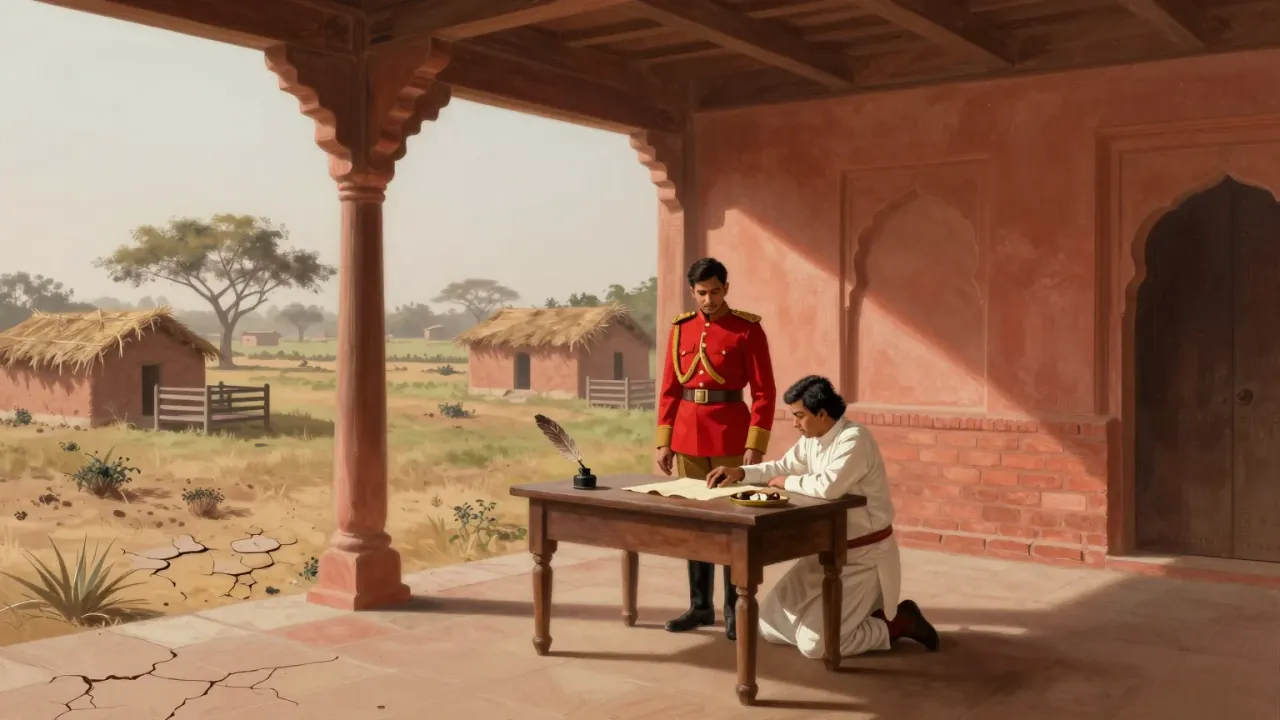
Lagaan is a Hindi-language musical period drama set in colonial India in 1893, centred on a wager between villagers and British officers over a cricket match to suspend land tax. It attempts an epic synthesis: a sports narrative as national allegory, rooted in vernacular speech and agrarian hardship, yet structured like a classical Hollywood underdog story. The film seeks to dramatise resistance not through violence but through collective discipline, linguistic authenticity, and rule-bound contest — turning cricket, imported and weaponised by empire, into a site of cultural reclamation. Its ambition is structural as much as thematic: to sustain emotional investment across 224 minutes while embedding historical texture — drought, caste hierarchy, colonial bureaucracy — without didacticism. It does not aim for realism in the documentary sense, but for verisimilitude in gesture, costume, and social friction. The language is deliberately hybrid — Awadhi-based but smoothed for intelligibility — and the music, though modern in orchestration, anchors itself in folk motifs and devotional cadence. This is not folklore pastiche; it is myth-making with archival awareness.
The look of it
The story unfolds in measured arcs: drought, tax demand, challenge, training, betrayal, crisis, and final match. Ashutosh Gowariker directs with patient symmetry — long takes in sun-baked fields, deliberate framing of group formations, minimal close-ups until emotional rupture. Anil Mehta’s cinematography avoids gloss: dust hangs in low light, sweat glistens without sheen, shadows pool thickly under thatched roofs. A. R. Rahman’s score interweaves dhol, sarangi, and choir, its motifs recurring like seasonal rhythms. Aamir Khan’s Bhuvan balances quiet resolve with visible fatigue; Gracy Singh’s Gauri moves with grounded grace, not starlit poise. Rachel Shelley and Paul Blackthorne avoid caricature — their British characters are rigid, not cartoonish, their authority procedural rather than pantomime. Supporting performances anchor the ensemble: Raghubir Yadav’s poultry farmer carries weary dignity; Daya Shankar Pandey’s Kachra embodies marginality without pleading; Amin Hajee’s Bagha communicates volume and rhythm through silence alone. Dialogue, shaped by K. P. Saxena, lands with weight because it breathes — pauses matter more than flourishes.
The sound of it
What lands most firmly is the film’s central paradox: that a game governed by English rules becomes the vessel for Indian self-assertion. The cricket match itself — staged over forty minutes — works not as spectacle but as cumulative tension, each over weighted with communal stakes. The villagers’ learning curve feels earned: early mis-hits, confusion over lbw, the slow dawning of strategy. Their unity is never seamless — caste lines persist, suspicion flares, leadership is contested — making cohesion feel hard-won, not imposed. The music integrates organically: songs arise from ritual, labour, or longing, not narrative interruption. ‘Radha Kaise Na Jale’ is sung mid-harvest, not in a studio set; ‘Ghanan Ghanan’ arrives as monsoon hope, not exposition. Costume and production design avoid museum stiffness: Bhanu Athaiya’s garments show wear, Nitin Desai’s sets bear the imprint of use and weather. Even the British uniforms carry starched exhaustion. The film’s anti-imperialism registers not in slogans but in glances withheld, in the time it takes for a villager to meet an officer’s eye, in the quiet refusal to name the tax ‘lagaan’ until the final reckoning.
The learning
What does not land is the film’s length when momentum dips — particularly in the middle third, where training montages repeat rhythmic patterns without deepening character or stakes. Some supporting arcs — notably Ismail the potter and Lakha the woodcutter — accrue symbolic weight but lack interior development. The British officers, though restrained, remain functionally monolithic: their motivations hinge on pride and precedent, not psychology. The film avoids colonial complexity — no Indian collaborators, no bureaucratic nuance beyond Captain Russell’s arrogance — which simplifies the system it critiques. The romantic thread between Bhuvan and Gauri stays dutiful rather than urgent; their bond is affirmed by shared duty, not intimacy. The climactic match, while structurally sound, leans on late reversals that border on contrivance — a dropped catch, a sudden rain delay — moments that serve plot over plausibility. And though the language is historically informed, its dilution risks flattening regional specificity: Awadhi’s cadence blurs into standard Hindi, losing some of its earthy particularity.
The play
The themes that matter are taxation as extraction, sport as pedagogy of sovereignty, and silence as resistance. Lagaan treats land revenue not as background but as bodily fact — cracked earth, shrivelled crops, children’s hollow cheeks. Cricket becomes a grammar through which the villagers learn to read intention, calculate risk, and claim agency within imposed rules. The film’s deepest political act is its insistence on collective competence: no single hero wins the match; victory emerges from Bhura’s stamina, Bagha’s timing, Guran’s intuition, Kachra’s nerve. Caste is present but not resolved — Kachra bowls last not as triumph over hierarchy but as tactical necessity accepted by all. Faith appears not as doctrine but as endurance: the villagers pray not for miracles but for focus. Colonialism is rendered as routine — the tax collector’s ledger, the officer’s clipped vowels, the way British soldiers move through space unchallenged — making resistance feel less like rebellion than recalibration. The film’s quietest theme is time: the slowness of drought, the patience of training, the weight of centuries compressed into one summer’s afternoon.
The cost
It is for viewers who tolerate long durations in service of world-building, who value craft over velocity, and who find emotional resonance in communal effort rather than individual catharsis. It suits those familiar with Indian cinematic syntax — the integration of song, the weight of silence, the rhythm of rural speech — but also rewards newcomers willing to sit with its pace. It is not for those who require tight plotting, psychological granularity in antagonists, or irony as a default mode. Those who reject allegory as simplification, or find musical interludes disruptive to narrative flow, will resist its architecture. Anyone expecting gritty realism — say, the moral ambiguity of Gandhi or the urban grit of Salaam Bombay! — may find its uplift too orchestrated. Its ideal viewer accepts that 224 minutes is not indulgence but duration necessary to make drought, discipline, and dignity feel inseparable.
The sky
Yes, it is worth your evening — provided you watch it whole, in one sitting, without distraction. Its power accumulates: early scenes feel distant, almost formal; by the second hour, the village’s rhythms seep in; by the match’s final overs, breath catches not for outcome but for what the outcome represents. It repays attention to detail — the way light shifts across a mud wall, how a drumbeat syncs with a heartbeat, the exact pitch of a child’s laugh after rain. Those who dismiss it as ‘overlong’ or ‘old-fashioned’ mistake scale for slackness; its length is structural, not decorative. Anyone who values cinema as a medium of sustained attention, of communal storytelling rooted in place and language, will find it rich. To call it dated is to miss how deliberately it resists contemporary pacing — not as nostalgia, but as counter-rhythm. Its worth lies not in novelty, but in density: every frame holds ground.