What it is
In a Lonely Place is a 1950 American drama produced by Humphrey Bogart’s Santana Productions and released by Columbia Pictures. It adapts Dorothy B. Hughes’ 1947 novel, though the screenplay — credited to Edmund H. North and Dorothy B. Hughes but substantially rewritten by Andrew P. Solt with input from director Nicholas Ray and producer Robert Lord — departs significantly from its source. The film sets out to examine how suspicion, isolation, and self-deception corrode intimacy, using Hollywood not as backdrop but as diagnostic environment: a place where reputation is currency, perception is evidence, and violence is both professional hazard and personal reflex. It does not aim to resolve the murder mystery at its centre; that plot device serves only to tighten the vise on its central relationship. Its ambition lies in psychological fidelity — in rendering the slow, reversible collapse of trust between two people who recognise themselves in each other’s damage. It treats noir conventions — the late-night drives, the rain-slicked streets, the morally ambiguous detective — not as genre signifiers but as extensions of interior states. The film’s title names its subject before its plot: it is about being alone inside a shared life.
How it works
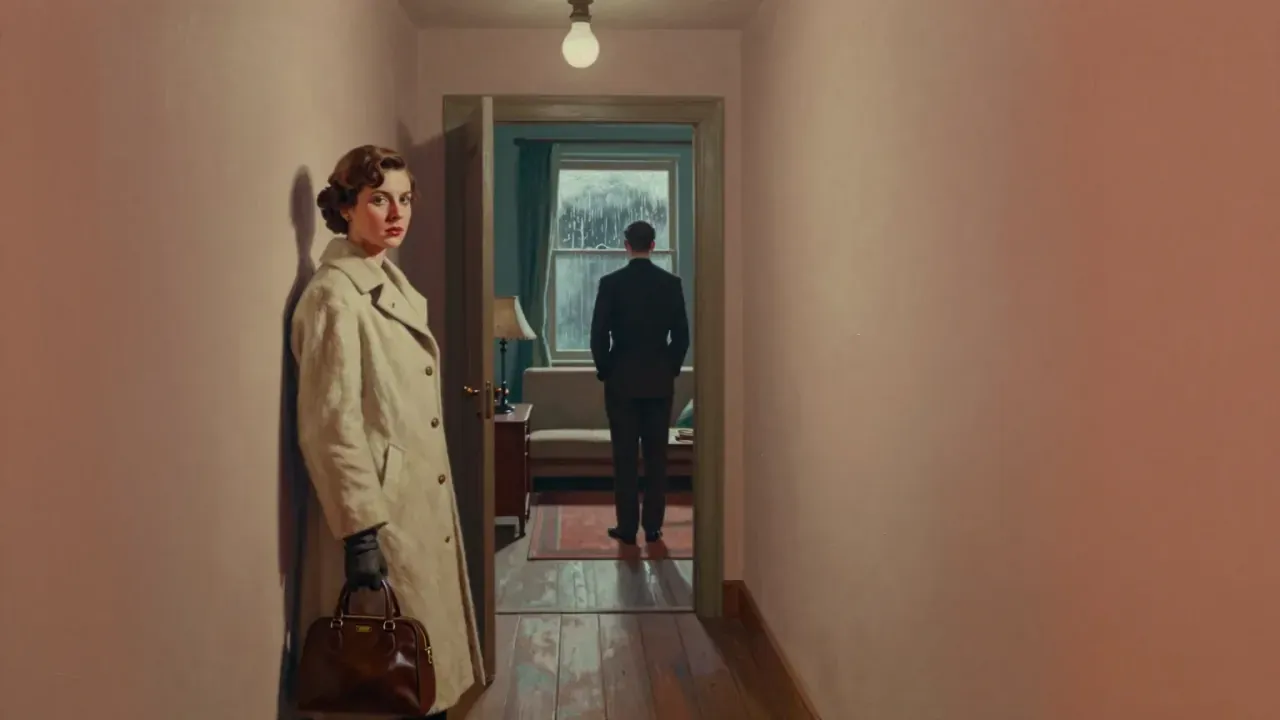
The story unfolds in tight, deliberate increments: Dix Steele’s volatile temperament surfaces early, then deepens through repeated slippages — his misreading of Laurel’s caution as betrayal, his projection of surveillance onto Ted Barton, his escalating defensiveness when confronted with his own history. Burnett Guffey’s cinematography keeps faces half in shadow, especially in interiors, and frames characters through doorways or windows to suggest entrapment even in open space. Viola Lawrence’s editing avoids rhythm for its own sake; cuts land where tension peaks or recedes, often holding on Bogart’s face just long enough to register doubt before he masks it. Bogart modulates Steele’s charm and menace without tipping into caricature; Gloria Grahame matches him beat for beat, her Laurel never merely reactive — she watches, recalibrates, withdraws, returns. George Antheil’s score is sparse and dissonant, avoiding leitmotif in favour of ambient unease. Ray directs not for pace but for pressure: scenes build not toward revelation but toward the moment one character stops believing the other — and then stops believing themselves.
What lands
What lands most firmly is the film’s refusal to flatter its protagonists or its audience. Steele’s intelligence and wit are never allowed to redeem his cruelty; Laurel’s empathy is never permitted to override her self-preservation. Their attraction feels earned because it is rooted in mutual recognition — not romantic idealism but the grim comfort of seeing your own fractures mirrored. The car argument near the end, where Laurel follows Dix into his vehicle and he drives erratically until they sideswipe another car, works not as spectacle but as physical manifestation of their shared instability: no words needed, only motion, proximity, and consequence. The final scene — shot after Ray discarded the original scripted ending — lands with quiet force: Laurel leaves, Dix stands alone in the doorway, the camera holds on his face as he watches her go. There is no music, no close-up on tears, no voiceover. The silence is not empty; it is full of everything unsaid, everything undone. That restraint, that willingness to leave motive unresolved and emotion unvoiced, gives the film its enduring weight.
What does not
What does not land is the peripheral plotting — the subplot involving Mildred Atkinson’s murder remains functionally inert beyond its catalytic role, and the police procedural elements feel perfunctory, serving exposition rather than insight. Frank Lovejoy’s Brub Nicolai is written and performed with decency but lacks the moral ambiguity that would make his loyalty to Dix genuinely fraught. Martha Stewart’s Sylvia Nicolai registers more as narrative device than person — her doubts about Dix arrive too neatly, too conveniently timed to accelerate Laurel’s crisis. The beach party sequence, meant to heighten tension, instead flattens tone with its broad social awkwardness, momentarily breaking the film’s tightly controlled psychological register. The script’s reliance on coincidence — Laurel happening to pass Dix’s courtyard just as Mildred arrives, Sylvia accidentally revealing the Lochner meeting — strains credibility without yielding thematic payoff. These moments do not undermine the central relationship, but they dilute the film’s otherwise rigorous focus on internal causality.
The themes that matter
The themes that matter are not those of crime or detection but of performance, complicity, and the unreliability of self-knowledge. The film treats Hollywood as a system that rewards surface coherence while punishing emotional honesty — Steele writes dialogue he cannot live by, Laurel performs availability while withholding consent. Their romance becomes a rehearsal for mutual destruction: every gesture of care is shadowed by the possibility it is also a test. Loneliness here is not absence of company but the erosion of shared reality — the point at which two people can no longer agree on what constitutes truth, kindness, or threat. The film interrogates how violence becomes habitual not through malice but through repetition: Dix’s temper is less a flaw than a reflex trained by years of professional rejection and personal withdrawal. His pride in his craft is inseparable from his contempt for others’ judgment — a duality that makes his vulnerability legible, not excusable. This is not a film about innocence or guilt, but about the slow, mutual dismantling of belief — in love, in art, in oneself.
Who should watch it
This film is for viewers who value psychological precision over plot propulsion, who find tension in stillness and meaning in withheld information. It suits those accustomed to mid-century American drama’s pacing and willing to sit with ambiguity — particularly viewers familiar with Bogart’s later roles or Ray’s work in Rebel Without a Cause, where restraint carries emotional freight. It is not for those who require narrative resolution, clear moral alignment, or sustained action. Viewers expecting a conventional noir thriller will find its pacing glacial and its climax anticlimactic; those seeking romantic affirmation will be unsettled by its portrait of love as recursive self-examination. Some critics argue the film’s power depends on period context — its critique of Hollywood’s machinery loses sharpness without knowledge of Bogart’s real-life studio tensions or Ray’s marital breakdown during production. That context enriches but does not anchor the film; its psychology remains legible regardless. Remove the 1950 setting, and the dynamics hold.
Is it worth your evening
Yes, it is worth your evening — provided you watch it as a study in relational erosion, not as a whodunit or love story. Its 94 minutes unfold with unhurried gravity, each scene calibrated to deepen rather than divert. The performances, direction, and editing cohere so tightly that even minor exchanges — a pause before a reply, a glance held too long — accrue significance. It repays attention not through complexity of plot but through density of implication. Those who dislike films where mood supplants momentum may find it inert; those who expect catharsis or closure will leave unsatisfied. But for anyone willing to sit with discomfort, uncertainty, and the quiet devastation of a door closing without sound, it offers rare formal control and emotional exactness. Its endurance is not nostalgic — it feels newly pertinent in an age of perpetual performance and curated intimacy. A viewer who watches it once may miss its architecture; a second viewing reveals how little is wasted, how much is implied, how deliberately every frame sustains its central question: what happens when the person who knows you best decides they no longer trust what they see?