The shape of the night
Collateral is a Los Angeles night-shift thriller that confines itself to a single evening and a cab’s interior, using that tight frame to explore professional detachment, moral erosion, and the quiet violence of routine. It sets out to rework noir conventions—not through flashback or voiceover, but by holding the camera close to two men in motion: one who kills for hire, the other who drives for survival. The film avoids exposition about motive or backstory, trusting gesture, lighting, and rhythm to imply character. Its ambition is structural as much as thematic: to make the city feel like a character shaped by surveillance, transit routes, and artificial light; to treat a hitman not as a caricature but as a technician whose precision masks an absence of self; and to ask whether empathy can survive under pressure when no one is watching. It does not aim to explain Vincent or redeem Max, but to place them in friction long enough for both to shift—imperceptibly, irrevocably.
The men in the cab
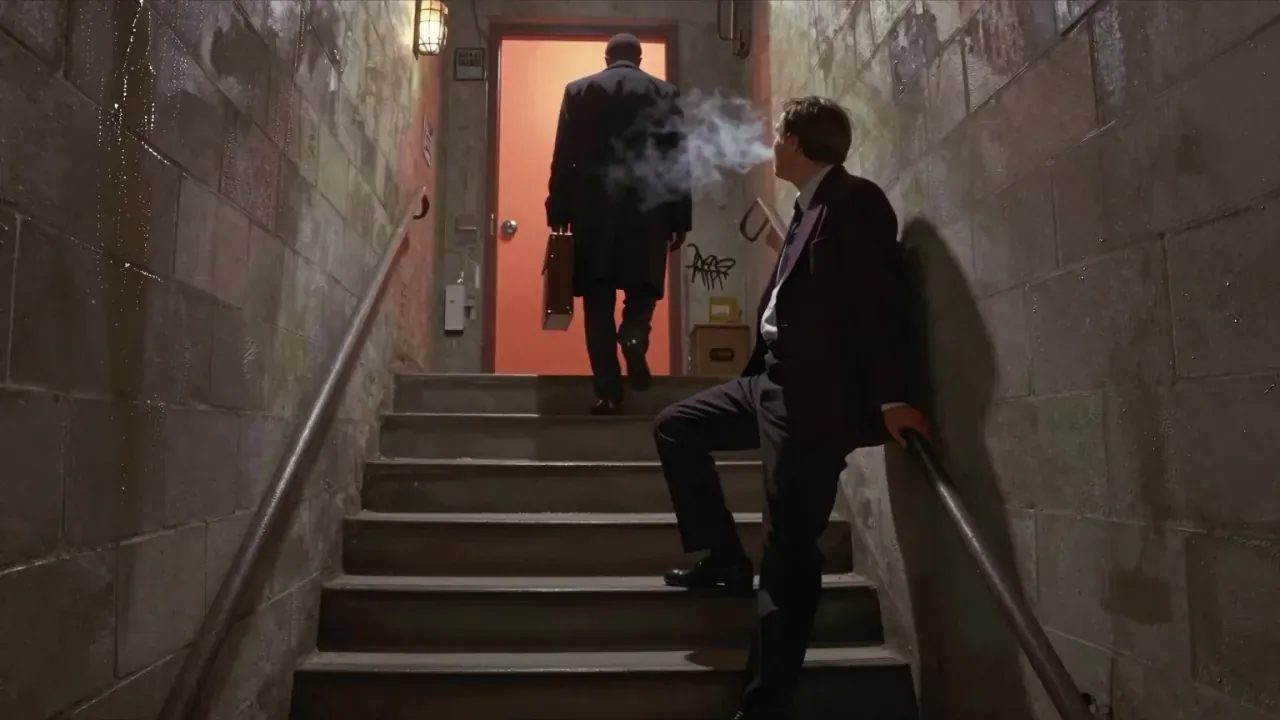
The story unfolds across eight stops over six hours, each location a node in Vincent’s contract list and a test for Max’s complicity. Jamie Foxx grounds Max in physical detail—the way he adjusts his rear-view mirror, checks fares on his meter, flinches at sudden noise—while Tom Cruise’s Vincent moves with unnerving stillness, his posture calibrated, his speech economical. Mann’s direction favours long takes and shallow focus, often keeping faces half-obscured in car interiors lit by sodium-vapour streetlamps or neon signs. Dion Beebe and Paul Cameron (who left after three weeks) use the Viper digital camera to capture low-light grain without sacrificing clarity, letting shadows pool where dialogue drops away. James Newton Howard’s score is sparse, tense, built from pulses and dissonant strings, while diegetic sound—traffic, distant sirens, club bass—anchors each scene in geography. Editing by Jim Miller and Paul Rubell sustains momentum without rushing; cuts land where breath catches, not where plot demands.
The look of it
What lands is the texture of the night: the heat haze off tarmac at 2 a.m., the flicker of a flickering sign outside a Koreatown bar, the way Max’s knuckles whiten on the steering wheel when Vincent first draws his gun. The film’s restraint pays off in small moments—the pause before Vincent answers a question, the way Max hesitates before turning the cab onto the freeway, the silence after a body hits the floor in the jazz club. Foxx’s performance gains weight not through monologue but through accumulation: his exhaustion, his recalibration of risk, his dawning realisation that professionalism can be weaponised. Cruise’s Vincent works because it refuses caricature; his menace comes from consistency, not volume. The city itself lands as a presence—Los Angeles rendered not as postcard glamour but as a network of arteries and dead ends, lit by sources that never quite reach the ground. The editing earns its Satellite Award: transitions between locations feel like shifts in consciousness, not geography.
The edges of the frame
What does not land is the supporting cast’s functional status. Jada Pinkett Smith’s Annie exists primarily to articulate Max’s deferred life, her courtroom scenes feeling detached from the film’s kinetic logic. Mark Ruffalo’s Detective Fanning operates in procedural shorthand, his arc resolved off-screen. Javier Bardem’s Felix appears late and leaves little imprint beyond visual contrast—his flamboyance sits uneasily beside Vincent’s austerity. The nightclub sequence, shot on 35mm, stands apart tonally, its saturated colours and choreographed chaos breaking the film’s controlled palette without deepening its ideas. Some plot mechanics strain credulity: Max’s repeated failure to flee, Vincent’s unchallenged access to secure locations, the FBI’s abrupt arrival at Fever—all serve pacing over plausibility. The film’s refusal to explain Vincent’s past risks flattening him into archetype, especially when the script offers no counterweight in lived history or memory.
The rules of the job
The themes that matter are professionalism as moral camouflage, the invisibility of service labour, and the illusion of control in urban systems designed for surveillance. Vincent treats killing as logistics—timings, exits, cover stories—mirroring how Max treats driving: route optimisation, fare calculation, passenger management. Both men navigate infrastructures they did not build but must obey. The film interrogates what happens when those infrastructures collapse—not catastrophically, but incrementally: a missed call, a delayed response, a misread expression. It also traces the slow erosion of Max’s passivity, not as heroism but as recalibration: he stops waiting for permission to act and begins reading the city as terrain rather than transit map. Race is present but not foregrounded; Max’s Blackness shapes how he is seen by police and passengers, yet the film declines to make that the axis of its argument. Instead, it treats identity as context, not conflict—something embedded in gesture, not declared in speech.
Who it is for
This is for viewers who value sustained mood over exposition, who find tension in silence and rhythm in repetition, and who trust craft over explanation. It suits those familiar with Mann’s work—Heat, Miami Vice—or with neo-noir’s lean syntax: the viewer who watches a man adjust his cufflink and reads it as threat. It is not for those needing clear moral binaries, psychological backstories, or narrative closure; the ending offers resolution but no catharsis, no summation, only a change in posture. Someone who found Heat’s final shootout emotionally unsatisfying may find Collateral’s restraint alienating. A viewer expecting Cruise to emote or Foxx to ‘break out’ will be disappointed. What would change the verdict? A tighter integration of the supporting roles—or a decision to cut them altogether—would sharpen its focus. But as it stands, its narrow aperture is deliberate, not deficient.
What remains after sunrise
Yes, it is worth your evening—not as escapism, but as immersion. Its 120 minutes unfold with the inevitability of a shift ending at dawn: tiring, precise, quietly consequential. You leave not with answers but with residue—the echo of a bassline, the afterimage of a streetlamp, the sense of having ridden shotgun through a moral inflection point. It rewards attention to composition, to timing, to the weight of a glance held half a second too long. Those who watch films for plot turns or emotional release may find it withholding. But for anyone willing to sit with discomfort, ambiguity, and the quiet hum of a city that never sleeps, it holds its ground. Its value lies not in what it says, but in how relentlessly, coherently, it shows. It is not a film you consume; it is one you inhabit—briefly, intensely, and with lingering awareness of the light outside your own window.