The place of it
The Kid Brother is a 1927 silent comedy feature produced and starring Harold Lloyd, made under his own banner for Paramount Pictures. It attempts something precise: to anchor slapstick in sustained character logic, placing Lloyd’s familiar ‘glasses’ persona — earnest, physically unimposing, socially underestimated — within a rural, family-centred world where muscle and reputation dominate. Unlike his earlier urban thrill-comedies, this film builds its gags from domestic hierarchy and small-town suspicion rather than skyscraper ledges or clock towers. The script, credited to John Grey but developed by eight writers and gagmen, aims for density — more comic set-pieces per reel than any previous Lloyd vehicle — while also threading through romance, moral stakes and a father-son reconciliation arc. Its ambition is structural integration: not just laughs, but laughs that advance plot, deepen relationships, and reconfigure status. It treats the Hickory household as both stage and social microcosm, testing whether wit can earn legitimacy where brawn has long held sole claim.
The logic of it
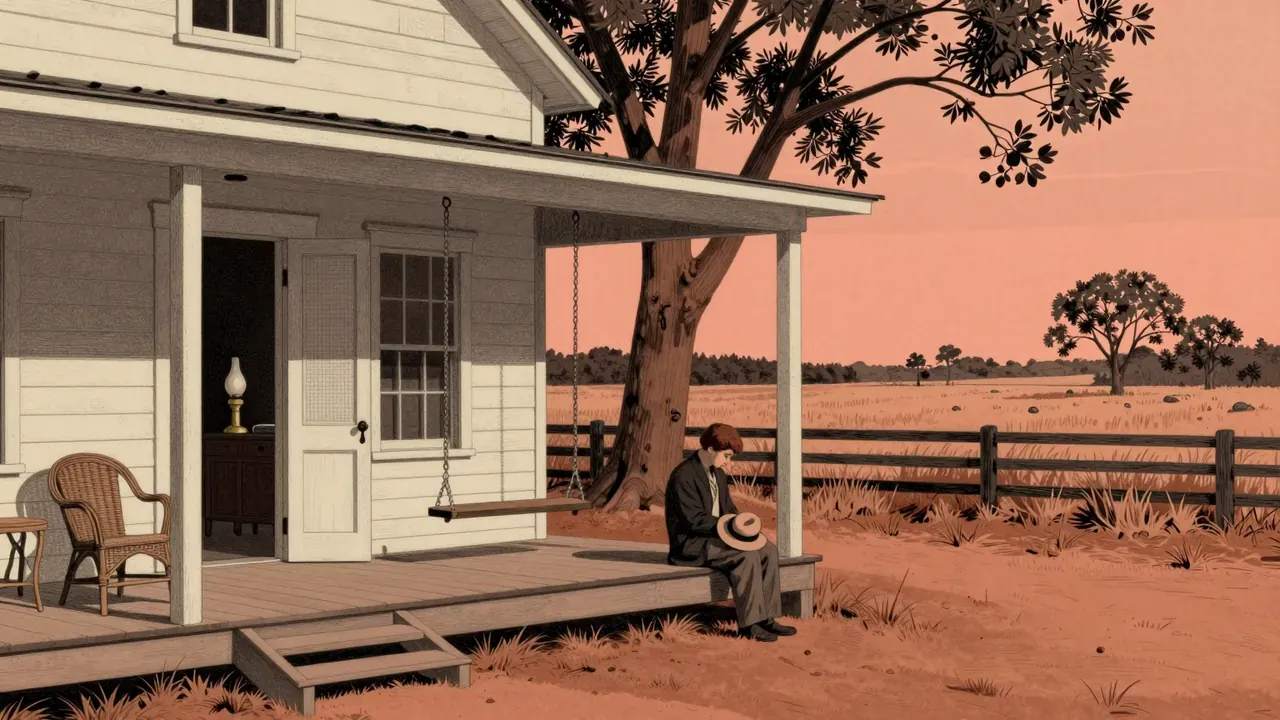
The story follows Harold Hickory’s slow, often humiliating ascent from family joke to trusted agent of justice, pivoting on two parallel thefts — one imagined, one real — and a shipboard climax that repurposes physical comedy as narrative resolution. Lloyd’s performance sustains a narrow register: flustered but never frantic, resourceful without seeming preternatural. Jobyna Ralston gives Mary Powers quiet agency — she chooses Harold early, resists Sandoni without melodrama, and speaks plainly when others shout. Walter Lundin’s cinematography favours medium shots and shallow depth, keeping faces legible and reactions immediate; exteriors in Glendale and Altadena are shot with natural light and minimal artifice, grounding the farce in tangible dirt roads and wooden porches. Lewis Milestone’s uncredited direction (on most scenes) lends rhythmic control to ensemble sequences, while Ted Wilde handles the more elaborate stunts. The editing avoids rapid cutting, trusting timing and spatial continuity — a chase across the beached Palmyra ship unfolds in long takes, letting the geography of pursuit register clearly.
The shape of it
What lands is the film’s calibrated sense of scale. Harold’s vulnerability feels earned because his brothers’ strength is shown, not asserted: Leo Willis and Olin Francis move with weight and ease, their dismissals of Harold land with physical and tonal authority. The medicine-show sequence works because it balances satire — Farrell’s huckster patter, Sandoni’s inflated ego — with genuine warmth toward Mary’s grief and Harold’s clumsy sincerity. The shipboard climax lands not just as spectacle but as consequence: every gag there — slipping on rigging, hiding in barrels, using pulleys against Sandoni — grows from Harold’s earlier failures and observed mechanics. Even minor characters hold purpose: Ralph Yearsley’s Hank Hooper is neither cartoon nor cipher, but a persistent, petty antagonist whose final defeat feels like a settling of accounts, not a flourish. The film’s rhythm — unhurried but never slack — allows emotional beats room to breathe: Harold’s confession to Mary, Jim’s exhausted silence before the lynching threat, the quiet pride in his final line — all register because they are given time, not undercut by a gag.
The climax of it
What does not land is the structural strain between the film’s dual ambitions: dense gag construction and coherent dramatic throughline. Several early sequences — particularly the town meeting setup and the permit-signing — rely on exposition so compressed it blurs motivation. Harold’s decision to impersonate the sheriff lacks the clear internal logic of his later actions; it reads as plot necessity rather than character impulse. Some supporting roles remain flat: Frank Lanning’s Sam Hooper voices accusation but offers no texture beyond obstruction, and Eddie Boland’s Flash Farrell, though amusing, never escapes the limits of his type. The dam subplot — introduced with weight, then sidelined — never regains narrative traction, leaving the town’s collective stakes vague. The restoration’s Carl Davis score, while lush and period-appropriate, occasionally overstates emotion in scenes that benefit from restraint — a pause after Harold is knocked out, for instance, gains more from silence than strings. These are not fatal flaws, but they reveal where the film’s assembly prioritised volume over seamlessness.
The weight of it
The themes that matter are legitimacy, inheritance, and the labour of becoming. Harold is not trying to prove he is strong, but that competence need not wear the same face as his brothers — that observation, memory, and patience constitute forms of strength too. The Hickory name carries weight not because it is inherited, but because it must be upheld; Harold earns it not by replacing Jim, but by extending what the office means. The rural setting is thematic, not decorative: the open fields and barns contrast with Lloyd’s usual cityscapes, making space literal — Harold must navigate terrain, not just traffic. Class operates quietly: the Hickorys’ respect rests on civic duty, not wealth, while Farrell and Sandoni exploit mobility and spectacle to bypass local trust. Even romance is grounded in reciprocity — Mary sees Harold before he sees himself, and her faith is active, not passive. The film treats masculinity as practice, not physiology: courage is measured in returning to the boat, not in throwing the first punch.
The pace of it
This film is for viewers who value craft over velocity — those willing to sit with silent-era pacing, read intertitles without impatience, and attend to how a glance or a hesitation builds meaning. It rewards attention to physical detail: how Harold adjusts his glasses before a lie, how Sandoni’s shoulders shift when challenged, how light falls across a porch at dusk. It is not for those who require narrative efficiency or psychological realism on modern terms; the motivations are archetypal, the resolutions clean, and the emotional arcs follow classical symmetry. Those expecting Lloyd’s vertiginous set-pieces may find the rural setting a letdown, and viewers unused to silent-film syntax may struggle with the lack of expository dialogue. But anyone open to comedy as architecture — built on repetition, variation, and payoff — will find its structure rigorous and satisfying. Disagreement would come from fans of pure slapstick or contemporary irony; the film assumes sincerity as its operating principle, and that assumption cannot be bent.
The look of it
Yes, it is worth your evening — provided you watch it whole, undistracted, and with the Criterion Blu-ray’s 4K restoration. Its 84 minutes unfold with a deliberation that feels generous, not slow: every scene serves either character, plot or theme, and none exists solely for filler. The restoration makes visible textures — grain, fabric, weathered wood — that deepen immersion, and the Carl Davis score, though occasionally emphatic, supports rather than overrides. You will not mistake it for a modern film, nor should you: its pleasures are in clarity of intention, economy of gesture, and the quiet triumph of an underdog who wins not by changing himself, but by being seen fully. Those who skip it miss a key pivot in American comedy — where the everyman stops reacting to chaos and begins shaping it. To dismiss it as ‘old-fashioned’ is to mistake form for limitation; its discipline is its distinction.