The commission
Redes is a fiction film made in Mexico in 1935, commissioned by the Secretariat of Public Education to depict the material conditions of fishermen in Alvarado on the Gulf Coast. It is not a documentary, though it began as one; Paul Strand’s initial footage gave way to a scripted narrative about collective resistance to exploitation. The film attempts something precise: to render poverty not as spectacle but as structural fact, and solidarity not as sentiment but as practical response. Its political intent is unambiguous — it shows wage theft, debt bondage, and the failure of individual petition before authority — yet avoids didactic speechifying. Instead, it relies on duration, repetition, and physical detail: the weight of nets, the rhythm of rowing, the silence after a refusal. It seeks neither catharsis nor uplift, but alignment: between viewer and subject, image and condition, form and function. This is not agitprop with music; it is a measured, almost forensic dramatisation of economic coercion, made under state patronage but outside official propaganda channels.
The performance
The story follows a fisherman named Silvio Hernández — the only credited actor — whose family falls ill after wages are withheld by the local merchant-cooperative. His appeals fail; his neighbours hesitate; then a storm breaks, and the community acts together to seize control of the boats and nets. Performances are non-professional, restrained, grounded in gesture rather than expression: hands gripping rope, backs bent over oars, faces turned away from the camera. Gordon Willis is not involved; Paul Strand’s cinematography keeps the light low and the grain visible, favouring medium shots that hold groups in shared space rather than isolating individuals. Emilio Gómez Muriel edits with deliberate pacing — long takes, minimal cuts — while Fred Zinnemann, who spoke no Spanish, shaped rhythm and composition on location. Silvestre Revueltas’ score enters late and often alone, swelling beneath silence or rising above sparse dialogue. Sound was added post-production, so music and ambient noise — wind, waves, creaking wood — carry narrative weight where speech does not.
The look of it
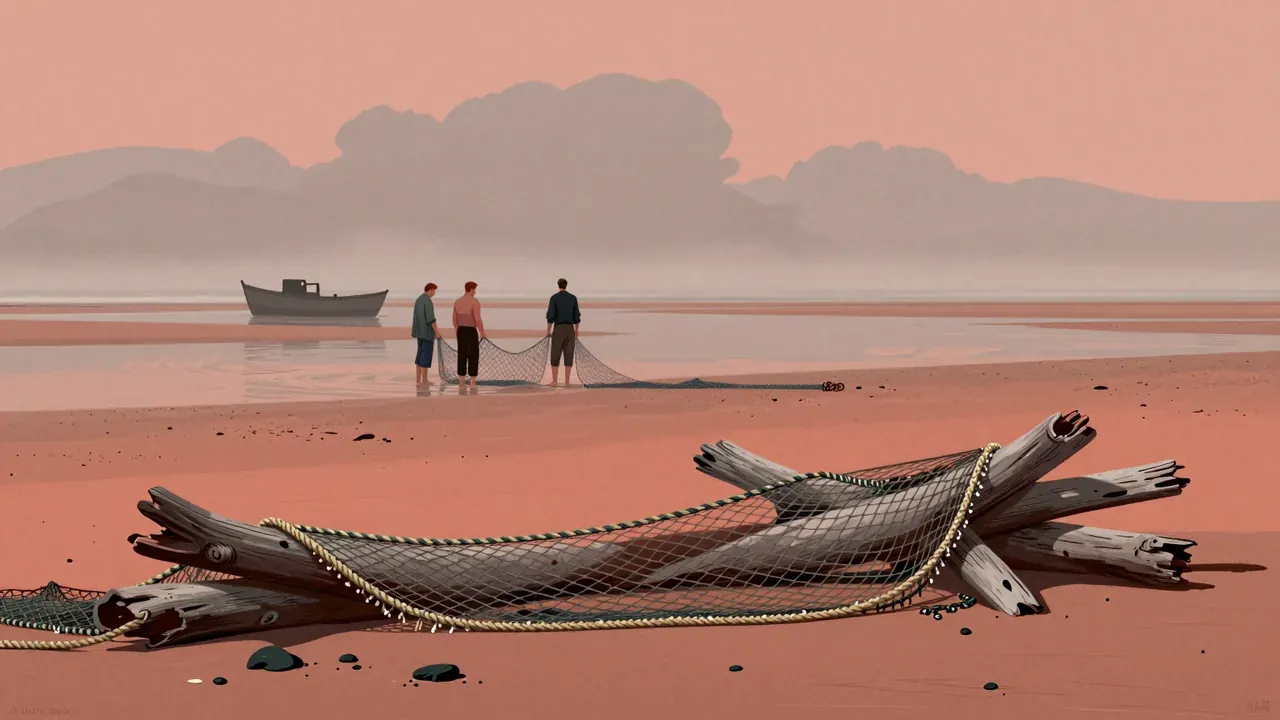
What lands is the film’s physical conviction: the texture of salt-crusted rope, the dampness of clothes clinging to skin, the way light falls across water at dawn. Strand’s camera refuses abstraction — every frame asserts presence, not metaphor. The fishermen’s labour is shown as cumulative effort, not heroic exertion: hauling, mending, waiting, repeating. Revueltas’ music lands with equal force, not because it illustrates emotion but because it mirrors structure — dissonant brass mimicking the groan of hulls, strings flickering like disturbed surface water. The final sequence, where nets are cast not for fish but as symbols of collective action, avoids triumphalism; the wave referred to in the English title arrives not as resolution but as elemental inevitability. Even the non-actors’ stillness reads as lived knowledge, not amateurish hesitation. This is not realism as approximation but realism as adherence — to place, to rhythm, to consequence. The film’s coherence comes from its refusal to separate aesthetic choice from social fact.
The story told
What does not land is the narrative scaffolding. The script, revised multiple times by Rodakiewicz and others, remains functional rather than fluent: motivations are implied but rarely dramatised, relationships sketched in silhouette. Silvio Hernández carries emotional weight by default, not by design — there is little interiority granted to him or anyone else. Dialogue is sparse and often expository, delivered flatly, as if sound recording limitations forced compression rather than stylistic choice. Some scenes — particularly those involving the cooperative’s clerk or the schoolteacher — feel inserted to name injustice rather than embody it. The political argument is clear, but its dramatic articulation lacks tension: resistance emerges not from conflict but from weather, not from debate but from exhaustion. This is not a flaw in intention — the film avoids melodrama — but in execution: the script never fully reconciles its documentary origins with its fictional aims, leaving gaps that neither performance nor editing fully bridges.
The weight of it
The themes that matter are not abstract but anchored: the weight of debt, the temporality of labour, the geography of dependence. Fishing is not a vocation here but a cycle of extraction — of fish from sea, of value from workers, of time from life. The net is both tool and metaphor: it gathers, restrains, connects, entangles. Class is shown through proximity — the merchant’s dry veranda versus the fishermen’s flooded huts — not through speech. Colonial continuity appears in the cooperative’s structure, modelled on foreign capital but locally administered. Education is present but peripheral: a schoolroom appears briefly, its chalkboard blank, its purpose ambiguous. What matters most is the film’s insistence on collectivity as material necessity, not ideology — decisions are made in clusters, actions taken in unison, consequences borne jointly. There is no lone hero, no villainous caricature, no redemptive arc. The theme is endurance as practice, not virtue; solidarity as logistics, not feeling.
The watching of it
This film is for viewers who attend to craft as evidence — those who watch how light falls on wet timber, how music punctuates silence, how editing shapes duration. It rewards patience with texture, not plot. It is not for those who require narrative propulsion, psychological exposition, or moral clarity. Anyone expecting Italian neorealism’s later fluency will find Redes structurally raw; anyone seeking socialist realism’s rhetorical certainty will find it too quiet, too observational. Its pace and restraint alienate viewers trained on exposition-driven storytelling. But those who accept its terms — that meaning resides in accumulation, not climax — will find its coherence deepening with each rewatch. A viewer who values Revueltas’ score or Strand’s photography may approach it as a document of mid-century modernist synthesis, not as drama. Its audience is narrow but not niche: it is for anyone who believes cinema can be a form of witness without being a form of testimony.
The staying with it
Yes, it is worth your evening — provided you watch it as it asks to be watched: slowly, without expectation of payoff, with attention to how things look and sound before they mean. At 65 minutes, it makes no demand beyond presence. Its power lies in what it refuses: explanation, ornament, relief. Those who find it inert are not wrong — its rhythms are anti-dramatic, its silences unbroken by score or voice. But that is its point: to make visible the labour that sustains invisibility. It is not a film to enjoy, but one to register — like tide, like debt, like heat. You would need to want something else — faster pacing, clearer character arcs, louder politics — to reject it outright. Its value is not historical curiosity but formal consistency: every choice serves the same end. To dismiss it as ‘dated’ mistakes its rigour for limitation. It remains urgent not because it predicts the future, but because it names a present that has not changed.