The first surviving film
Flunky, Work Hard is a 29-minute Japanese silent film from 1931, directed and written by Mikio Naruse. It is his first surviving work, made early in his career at Shochiku’s Kamata studio. The film attempts a tight, socially grounded comedy-drama about economic pressure in interwar Tokyo: a low-ranking insurance salesman’s efforts to secure income, maintain domestic dignity, and navigate neighbourly friction amid rent arrears and child-rearing strain. Its ambition lies not in spectacle or narrative expansion but in compression—using the short-form format to sharpen class anxiety, paternal failure, and the brittle line between farce and tragedy. Naruse works within the conventions of shoshimin-eiga (‘common people’s film’) but pushes against them with abrupt tonal shifts and an unsentimental eye for how money shapes gesture, speech, and silence—even in a silent film. It does not aim to entertain broadly or affirm comfort; it tests how much social tension can be held in a single afternoon’s missteps.
The shape of the day
The story unfolds across three domestic and semi-public spaces: the Okabe apartment, Mrs. Toda’s house, and the street outside both. Naruse structures scenes with economical cuts and recurring motifs—the toy airplane, the train, the rent ledger—each gaining weight through repetition and reversal. Isamu Yamaguchi plays Okabe with restrained physicality: shoulders hunched under imagined scrutiny, hands fumbling with policy papers, posture collapsing after each setback. Tomoko Naniwa’s wife registers financial dread not through outbursts but through stillness and withheld glances. The editing—decoupage described by Catherine Russell as ‘flamboyant’—uses rapid juxtapositions: a child’s scuffle cut against a slammed door, then a close-up of a train schedule pinned to a wall. Intertitles are sparse and functional, never explanatory. There is no musical score credited on the fact sheet, so any accompaniment heard in modern screenings is external to the film’s original construction. Lighting and set design follow Shochiku’s Kamata studio norms for early 1930s realism: shallow depth, practical interiors, unadorned walls, visible floorboards.
The logic of falling
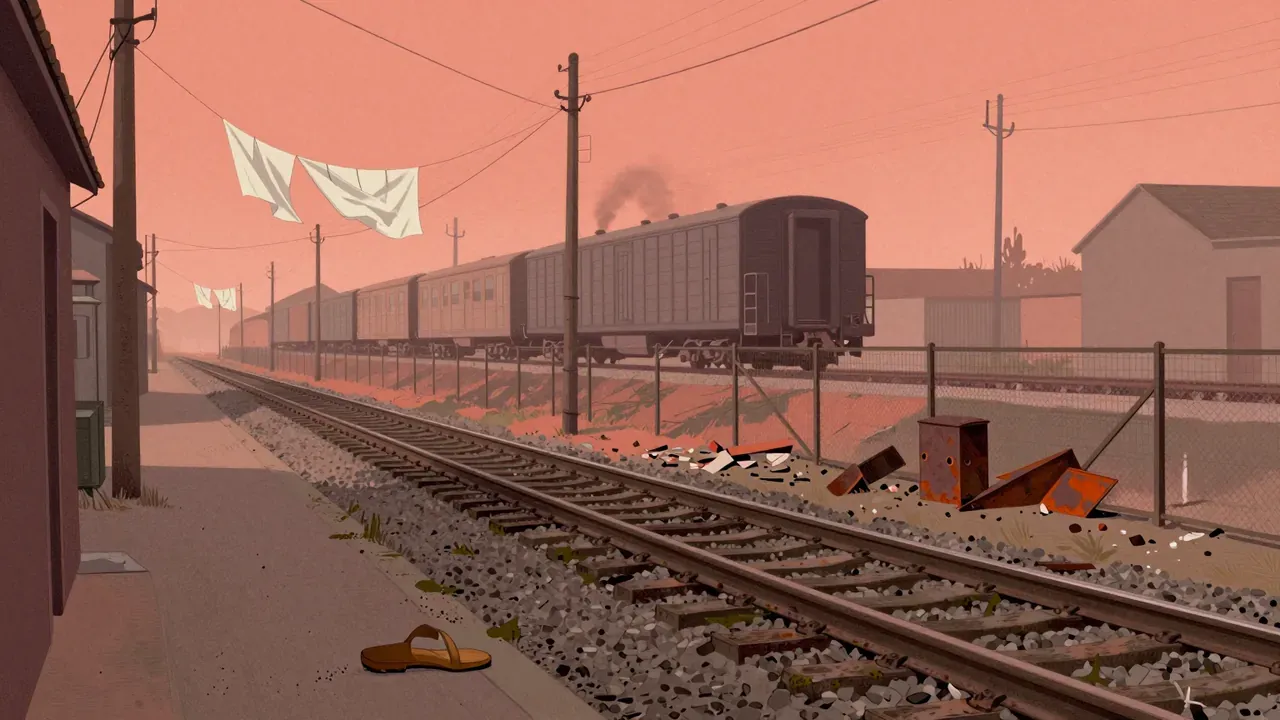
What lands is the film’s structural irony: every action Okabe takes to restore control accelerates his loss of it. His attempt to placate Mrs. Toda by comforting her son directly precedes the revelation that his own son has been struck by a train—a pivot achieved without melodramatic music or exaggerated reaction, just a shift in framing and a long pause before he runs. The toy airplane functions precisely: it begins as a symbol of aspiration, becomes a token of appeasement, then a cruel object of misdirected hope. Naruse holds shots just long enough for discomfort to settle—Okabe’s face after being thrown out, Susumu’s small hand gripping the windowsill before the fight, the empty space where the boy stood moments before the train sound is implied. The film’s brevity works in its favour: there is no time for digression, so every glance, every prop, every cut carries consequence. Even the title—Koshiben ganbare—carries layered irony: ‘flunky’ names his status, ‘work hard’ his futile injunction, and the exclamation mark his society’s hollow cheer.
The gap between laughs and tears
What does not land is the film’s attempt to sustain nansensu comedy as a consistent register. The slapstick elements—the argument with Nakamura, the children’s scuffle—are underdeveloped, their timing flattened by the absence of synchronous sound and the constraints of intertitle pacing. The competing salesman Nakamura remains a cipher, his presence functional rather than felt; Tokio Seki’s performance offers no distinguishing trait beyond broad antagonism. The resolution—Mrs. Toda’s sudden decision to buy insurance after seeing her son unharmed—relies on coincidence that feels narratively convenient rather than earned. Naruse’s later films would anchor such turns in deeper character logic or social causality, but here the pivot rests on a rumour and a visual reassurance that bypasses psychology. The film also struggles with tonal cohesion: the abrupt shift from domestic bickering to life-threatening injury risks emotional whiplash without sufficient connective tissue—no lingering shot of Susumu’s shoes by the tracks, no delayed reaction from Okabe that might bridge the registers.
The weight of rent
The themes that matter are the fragility of paternal authority under capitalism, the commodification of care, and the way economic precarity reshapes family intimacy. Okabe’s promise to ‘work hard’ is not aspirational but defensive—a ritual utterance meant to quiet his wife’s anxiety, not to enact change. His purchase of the toy airplane is less a gift than a transactional performance: proof he is fulfilling his role, even as his actual capacity to provide erodes. The film treats insurance not as abstraction but as social glue—and as threat: Mrs. Toda wields it as leverage, Okabe as lifeline, the audience as ironic witness to its hollow promises. Class is registered through spatial detail: the Okabes’ cramped apartment versus Mrs. Toda’s entrance hall, the shared alleyway where children fight over toys they cannot afford. There is no political speech, no union banner, no explicit critique—but the film’s structure insists that individual failure is inseparable from systemic constraint. It shows how poverty narrows perception: Okabe sees only the next sale, the next rent due, the next rebuke—never the wider architecture holding him in place.
Who it is for
This film is for viewers who value formal economy, early Japanese cinema history, or Naruse’s development as a director—not for those seeking narrative closure, emotional catharsis, or sustained comic rhythm. It rewards attention to staging, editing cadence, and social texture, but assumes familiarity with silent-film syntax and interwar Japanese urban life. A viewer expecting the warmth of Ozu’s later shoshimin-eiga or the satire of Gosho’s contemporaneous comedies may find Flunky, Work Hard too stark, too unresolved. Those unfamiliar with silent Japanese cinema may miss the significance of its survival status or misread its tonal hesitations as technical limitation rather than deliberate restraint. Its value depends on context: shown alone, it feels like a fragment; placed beside Naruse’s 1934 Wife! Be Like a Rose! or 1955 Floating Clouds, its early preoccupations—male inadequacy, female endurance, the quiet violence of routine—gain clarity. Without that frame, its power recedes.
Why it endures
It is worth your evening if you approach it as a precise historical artefact and a formal experiment—not as entertainment or emotional release. Its 29 minutes demand little time but reward close viewing: the way light falls across a tatami mat, how a character enters frame mid-stride to signal urgency, how silence itself becomes a pressure point. It is not for viewers who require clear moral resolution, strong character arcs, or tonal consistency. Someone who values narrative momentum over structural irony, or who finds ambiguity frustrating rather than generative, will leave unsatisfied. A different verdict would follow if the film were longer, had surviving original intertitles with sharper wit, or included a contemporary musical score that clarified its tonal intentions—but none of those exist in the record. What survives is what was made: compact, unblinking, and quietly devastating.