The length of the look
Burroughs: The Movie is a documentary portrait built on five years of sustained access to William S. Burroughs, made with his active cooperation and shaped as a collaboration rather than an interrogation. It sets out to map the arc of his life—not as literary myth but as lived sequence—tracing movement from St. Louis to Tangier, from Mexico City to London, through personal losses, literary experiments, and shifting social circles. The film does not attempt synthesis or interpretation of Burroughs’ work; instead it presents him speaking, reading, walking, observing, and reflecting, often in domestic or studio settings where his posture, pauses, and physical presence carry as much weight as his words. It treats biography as terrain to be traversed with attention, not argument to be resolved. Howard Brookner’s approach is neither clinical nor reverential: he films Burroughs as a man who has survived, adapted, and persisted, without smoothing over contradictions or eliding discomfort. The film’s ambition is modest in form—talking heads, location footage, archival stills—but expansive in duration and intimacy.
The sound of speech
The film unfolds chronologically but avoids voiceover narration or explanatory titles; its structure relies on juxtaposition and recurrence—Burroughs’ voice returning across decades, Ginsberg reappearing in different rooms, Gysin demonstrating cut-ups in two separate studios. Tom DiCillo’s cinematography keeps focus shallow and light even in interiors, giving texture to skin, paper, and cigarette smoke without stylising them. Sound was recorded by Jim Jarmusch, and the mix favours unvarnished speech: breath, throat-clearing, the clink of glass, pages turning. Performances are unscripted but rarely casual—Burroughs speaks with deliberate cadence, Ginsberg with voluble urgency, Bacon with dry precision. There are no re-enactments, no dramatisations, no illustrative animation. Editing moves between interviews and footage of Burroughs at work or in transit, letting silence hold space. The craft is unshowy but exacting: each cut serves continuity of tone or contrast of perspective, never momentum for its own sake. The BBC Arena co-production imprint is visible only in the measured pacing and absence of commercial rhythm.
The weight of presence
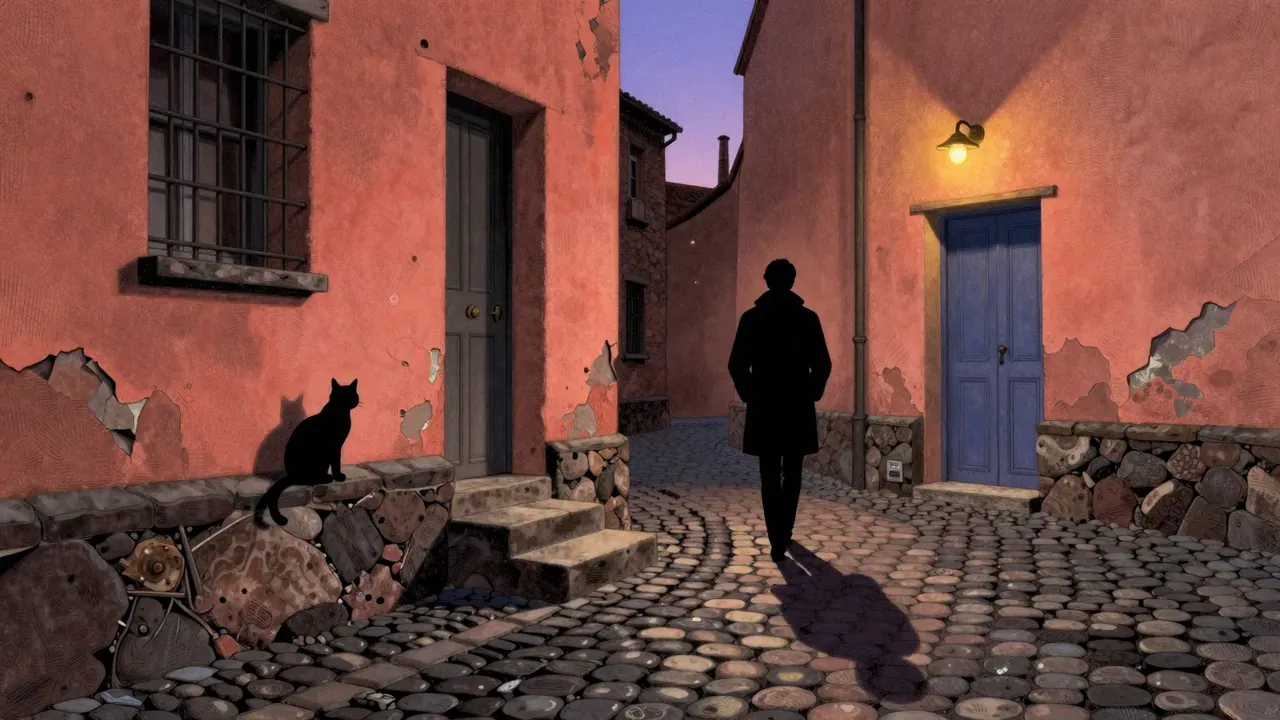
What lands is the cumulative weight of proximity. Burroughs’ physicality—the way he holds a cigarette, adjusts his glasses, stares just past the lens—becomes legible as a language of endurance. The film makes tangible the texture of his daily life: the clutter of his flat, the hum of a typewriter, the quiet friction between him and his son. Moments like Burroughs reading from Naked Lunch while seated beside a window in daylight, or walking alone through a Tangier alley at dusk, register not as illustration but as evidence of sustained observation. The inclusion of contemporaries does not dilute focus; instead Ginsberg, Gysin, Huncke and others act as harmonic frequencies, reinforcing or complicating Burroughs’ self-portrait. Even brief appearances—Lauren Hutton offering a wry aside, Patti Smith reciting a fragment—feel earned, not decorative. The film’s patience pays off in small revelations: Burroughs’ dry amusement at his own notoriety, his precise memory for dates and names, his visible fatigue when discussing William S. Burroughs Jr. These are not insights extracted by the filmmaker but allowed to surface through time spent watching.
The edges of the frame
What does not land is any sustained reckoning with the ethical gravity of Burroughs’ early life—particularly the 1951 shooting of Joan Vollmer, which appears only as a factual footnote, never as psychological or moral terrain. The film skirts the implications of his later associations with figures like James Grauerholz, whose role in managing Burroughs’ archive and image remains unexamined. There is no interrogation of how Burroughs’ privilege—class, education, American citizenship—enabled his transnational mobility and literary reinvention, nor how that privilege operated alongside addiction and marginality. The documentary avoids framing devices that might situate Burroughs within post-war American counterculture as a system rather than a constellation of individuals. Some interviews feel truncated—Brion Gysin’s technical explanations of cut-up method lack context for viewers unfamiliar with his work; Francis Bacon’s remarks on portraiture remain isolated from visual examples. The film assumes a baseline familiarity with Beat history, and offers no scaffolding for those without it.
The rhythm of endurance
The themes that matter are survival as practice, language as instrument and wound, and authorship as accumulation rather than origin. Burroughs’ life is presented not as a series of breakthroughs but as iterative adaptation—moving cities, changing collaborators, adopting new technologies (from typewriter to tape recorder), surviving illness and grief without narrative resolution. His writing is treated less as product than as ongoing procedure: editing, cutting, splicing, repeating. The film quietly insists that influence flows both ways—Ginsberg shaped Burroughs’ public reception, Gysin shaped his methods, Huncke shaped his lexicon—and that none of these relationships were hierarchical. Mortality is present not as climax but as constant companion: in Burroughs’ stoicism, in the photographs of dead friends, in the quiet way he handles his son’s unpublished manuscript. There is no thesis about the Beats as movement, but the film accumulates enough detail to suggest that their coherence came less from shared ideology than from overlapping habits of attention, revision, and refusal.
The reader’s contract
This film is for readers who have spent time with Burroughs’ prose and want to see the man behind the syntax, for students of documentary form interested in long-form portraiture without exposition, and for anyone who values stillness as a mode of inquiry. It is not for viewers seeking narrative propulsion, biographical closure, or contextual framing—there are no maps, no timelines, no definitions of terms like ‘interzone’ or ‘cut-up’. Those expecting analysis of Burroughs’ politics, his late-career conservatism, or his relationship to American empire will find little here. The film presumes familiarity with at least one major text—Naked Lunch, Junkie, or The Nova Trilogy—and rewards close attention to vocal inflection and gesture more than plot summary. A viewer who finds extended silence or unbroken takes uncomfortable will struggle with its pace. Its value lies in what it withholds as much as what it shows: it refuses to explain Burroughs, and in doing so, leaves room for him to remain elusive.
The silence after the sentence
Yes, it is worth your evening—if you are prepared to watch without expectation of revelation, and willing to accept that understanding Burroughs may mean sitting with ambiguity rather than resolving it. The film’s ninety minutes accumulate a density of presence that few documentaries achieve: Burroughs is not interpreted but inhabited, not summarised but observed across seasons and cities. Its restoration in 2012 did not alter its substance but sharpened its textures—grain, hiss, the slight lag between lip and voice—making the materiality of its making part of its meaning. Those who prefer tightly argued essays or fast-cut archival collages will find it slow. But for anyone who has ever paused over a sentence of Burroughs’ and wondered how such syntax could emerge from a human throat, this film offers not answers but adjacency: the sound of his breath, the weight of his gaze, the quiet certainty of his hands turning a page. It earns its duration by refusing to hurry.


