filmbriefs
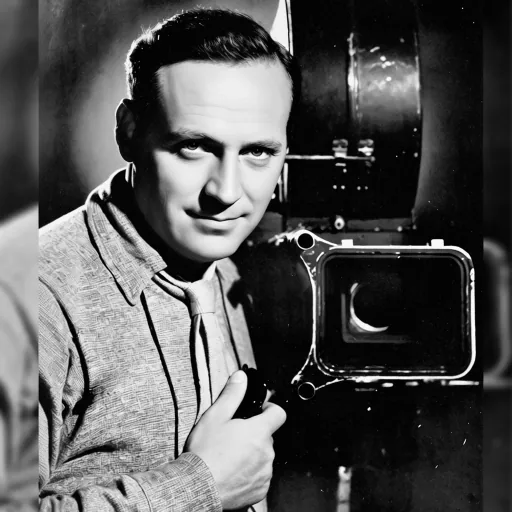
Cinematographer · 1898–1964

Rudolph Maté

8
briefs
13:00
average
104 min
in total
On film.briefs8
13:00

Foreign Correspondent

Alfred Hitchcock · 1940

Alfred Hitchcock’s 1940 thriller follows an American reporter uncovering a fascist conspiracy in pre-war Europe. Made under urgent political conditions and reshaped mid-production to mirror real-world events, it prioritises procedural tension and moral clarity over psychological depth or historical fidelity. Its strengths lie in set-piece choreography, studio-crafted suspense, and a prescient final sequence set in a besieged radio station.
13:00

Gilda

Charles Vidor · 1946

A 1946 Columbia Pictures drama starring Rita Hayworth and Glenn Ford, directed by Charles Vidor. Set in an artificial Buenos Aires, it traces the toxic, circular relationship between a gambler, his boss’s wife, and the boss himself — all rendered in high-contrast black-and-white, with precise performances and deliberate pacing. Though framed as noir, its concerns are psychological and performative, not procedural.

13:00

Love Affair

Leo McCarey · 1939

Leo McCarey’s 1939 Love Affair follows French painter Michel Marnet and American singer Terry McKay, who meet aboard an ocean liner, acknowledge mutual attraction, and part with a promise to reunite in six months — only for accident and silence to intervene. Starring Charles Boyer and Irene Dunne, it is a studio-era drama of quiet precision: restrained performances, unhurried pacing, and a structure that treats time, obligation and visibility as central concerns. Though hampered by Production Code compromises and occasional narrative convenience, its emotional weight resides in what is withheld, not spoken.

13:00

That Hamilton Woman

Alexander Korda · 1941

That Hamilton Woman (1941) is a black-and-white historical drama directed by Alexander Korda, starring Vivien Leigh and Laurence Olivier as Emma Hamilton and Horatio Nelson. Made in Hollywood during British exile, it uses the Napoleonic Wars as allegory for Britain’s resistance to Nazi Germany. The film follows Emma’s rise from courtesan to national symbol and her tragic decline, framed by Nelson’s principled defiance and ultimate sacrifice at Trafalgar. Crafted with restraint and moral clarity, it prioritises thematic weight over psychological nuance or visual spectacle.

13:00

To Be or Not to Be

Ernst Lubitsch · 1942

Ernst Lubitsch’s 1942 To Be or Not to Be follows a Warsaw theatre troupe who use disguise, timing, and theatrical cunning to deceive the Gestapo. Starring Carole Lombard and Jack Benny, it balances farce with peril, treating performance as both profession and resistance. Rudolph Maté’s cinematography and Dorothy Spencer’s editing sustain its breakneck logic, while its themes—identity as costume, authority as mimicry—remain sharply relevant. Though some tonal shifts now feel abrupt, its rigour and restraint make it a landmark of satirical craft.

13:00

The Passion of Joan of Arc

Carl Theodor Dreyer · 1928

Carl Theodor Dreyer’s 1928 silent film distils Joan of Arc’s trial into a single, suffocating day, using radical close-ups, unvarnished performances and a stark concrete set to render her spiritual and physical ordeal with unnerving intimacy. Renée Falconetti’s legendary performance anchors a work of formal and theological rigour — austere, unrelenting, and profoundly human.

13:00

The Lady from Shanghai

Orson Welles · 1947

Orson Welles’s 1947 noir, shot on location in San Francisco and Acapulco, uses a tangled murder plot to interrogate perception, law, and performance. Though heavily cut by Columbia Pictures, its surviving fragments—including the legendary hall-of-mirrors finale—retain a stark, unsettling power rooted in visual and ethical ambiguity.

13:00

Vampyr

Carl Theodor Dreyer · 1932

Carl Theodor Dreyer’s 1932 Vampyr is a Gothic horror film shot on location in France, starring amateur actor Nicolas de Gunzburg as Allan Gray, a student of the occult who enters a cursed village. With minimal dialogue, gauze-diffused cinematography by Rudolph Maté, and a sparse score by Wolfgang Zeller, it builds dread through atmosphere, not exposition. Adapted loosely from Sheridan Le Fanu, it treats vampirism as a perceptual condition — blurring boundaries between dream and wakefulness, self and other, presence and absence.